Results by title
386 books match the query 'Russia' and 9 start with w
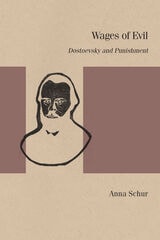
Wages of Evil
Dostoevsky and PunishmentAnna Schur
Northwestern University Press, 2012
As Dostoevsky attempts to balance the various ethical and cultural imperatives, he displays ambivalence both about punishment and about mercy. This ambivalence, Schur argues, is further complicated by what Dostoevsky sees as the unfathomable quality of the self, which hinders every attempt to match crimes with punishments. The one certainty he holds is that a proper response to wrongdoing must include a concern for the wrongdoer’s moral improvement.
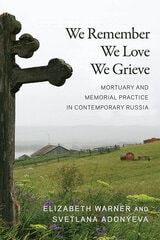
We Remember, We Love, We Grieve
Mortuary and Memorial Practice in Contemporary RussiaElizabeth Warner and Svetlana Adonyeva
University of Wisconsin Press, 2021
“We remember, we love, we grieve” is a common epitaph in this part of the world. As contemporary Russia contends with the Soviet Union’s legacy of dismantling older ways of life, the phrase ripples beyond individual loss—it encapsulates communities’ determination to preserve their customs when faced with oppression. This volume offers insight into a core cultural practice, exploring the dynamism of tradition.
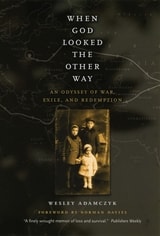
When God Looked the Other Way
An Odyssey of War, Exile, and RedemptionWesley Adamczyk
University of Chicago Press, 2004
Adamczyk was a young Polish boy when he was deported with his mother and siblings from their comfortable home in Luck to Soviet Siberia in May of 1940. His father, a Polish Army officer, was taken prisoner by the Red Army and eventually became one of the victims of the Katyn massacre, in which tens of thousands of Polish officers were slain at the hands of the Soviet secret police. The family's separation and deportation in 1940 marked the beginning of a ten-year odyssey in which the family endured fierce living conditions, meager food rations, chronic displacement, and rampant disease, first in the Soviet Union and then in Iran, where Adamczyk's mother succumbed to exhaustion after mounting a harrowing escape from the Soviets. Wandering from country to country and living in refugee camps and the homes of strangers, Adamczyk struggled to survive and maintain his dignity amid the horrors of war.
When God Looked the Other Way is a memoir of a boyhood lived in unspeakable circumstances, a book that not only illuminates one of the darkest periods of European history but also traces the loss of innocence and the fight against despair that took root in one young boy. It is also a book that offers a stark picture of the unforgiving nature of Communism and its champions. Unflinching and poignant, When God Looked the Other Way will stand as a testament to the trials of a family during wartime and an intimate chronicle of episodes yet to receive their historical due.
“A finely wrought memoir of loss and survival.”—Publishers Weekly
“Adamczyk’s unpretentious prose is well-suited to capture that truly awful reality.” —Andrew Wachtel, Chicago Tribune Books
“Mr. Adamczyk writes heartfelt, straightforward prose. . . . This book sheds light on more than one forgotten episode of history.”—Gordon Haber, New York Sun
“One of the most remarkable World War II sagas I have ever read. It is history with a human face.”—Andrew Beichman, Washington Times
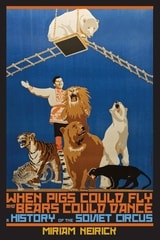
When Pigs Could Fly and Bears Could Dance
A History of the Soviet CircusMiriam Neirick
University of Wisconsin Press, 2012
For more than seven decades the circuses enjoyed tremendous popularity in the Soviet Union. How did the circus—an institution that dethroned figures of authority and refused any orderly narrative structure—become such a cultural mainstay in a state known for blunt and didactic messages? Miriam Neirick argues that the variety, flexibility, and indeterminacy of the modern circus accounted for its appeal not only to diverse viewers but also to the Soviet state. In a society where government-legitimating myths underwent periodic revision, the circus proved a supple medium of communication.
Between 1919 and 1991, it variously displayed the triumph of the Bolshevik revolution, the beauty of the new Soviet man and woman, the vulnerability of the enemy during World War II, the prosperity of the postwar Soviet household, and the Soviet mission of international peace—all while entertaining the public with the acrobats, elephants, and clowns. With its unique ability to meet and reconcile the demands of both state and society, the Soviet circus became the unlikely darling of Soviet culture and an entertainment whose usefulness and popularity stemmed from its ambiguity.
When Russia Learned to Read
Literacy and Popular Literature, 1861-1917Jeffrey Brooks
Northwestern University Press, 2003
With a new introduction that underscores its relevance to a post-Soviet Russia, When Russia Learned to Read addresses the question of Russia's common heritage with the liberal democratic market societies of Western Europe and the United States. This prize-winning book also exposes the unsuspected complexities of a mass culture little known and less understood in the West. Jeffrey Brooks brings out the characteristically Russian aspect of the nation's popular writing as he ranges through chapbooks, detective stories, newspaper serials, and women's fiction, tracing the emergence of secular, rational, and cosmopolitan values along with newly minted notions of individual initiative and talent. He shows how crude popular tales and serials of the era find their echoes in the literary themes of Dostoevsky, Tolstoy, and other great Russian writers, as well as in the current renaissance of Russian detective stories and thrillers.
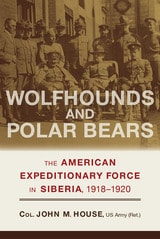
Wolfhounds and Polar Bears
The American Expeditionary Force in Siberia, 1918–1920Col. John M. House, US Army (Ret.)
University of Alabama Press, 2016
In the final months of World War I, President Woodrow Wilson and many US allies decided to intervene in Siberia in order to protect Allied wartime and business interests, among them the Trans-Siberian Railroad, from the turmoil surrounding the Russian Revolution. American troops would remain until April 1920 with some of our allies keeping troops in Siberia even longer.
Few American citizens have any idea that the United States ever deployed soldiers to Siberia and that those soldiers eventually played a role in the Russian revolution while protecting the Trans-Siberian Railroad. Wolfhounds and Polar Bears relies on the detailed reports of the American Expeditionary Force (AEF) as well as on personal stories to bring this rarely discussed expedition to life.
Initial chapters recount the period in World War I when conditions in Russia pointed to the need for intervention as well as the varied reasons for that decision. A description of the military forces and the geographic difficulties faced by those forces operating in Siberia provide the baseline necessary to understand the AEF’s actions in Siberia. A short discussion of the Russian Railway Service Corps explains their essential and sometimes overlooked role in this story, and subsequent chapters provide a description of actual operations by the AEF.
Wolfhounds and Polar Bears: The American Expeditionary Force in Siberia, 1918–1920 may well be the most detailed study of the military aspects of the American intervention in Siberia ever undertaken, offering a multitude of details not available in any other book-length history.
Writing Resistance
Revolutionary Memoirs of Shlissel´burg Prison, 1884-1906Sarah J. Young
University College London, 2021
In 1884, sixty-eight prisoners convicted of terrorism and revolutionary activity were transferred to a new maximum-security prison at Shlissel´burg Fortress near St. Petersburg. Inhuman conditions in the prison caused severe mental and physical deterioration among the prisoners, and over half died. However, the survivors fought back to reform the prison and improve the inmates’ living conditions. Their memoirs enshrined their experience in revolutionary mythology and served as an indictment of the Tsarist autocracy’s loss of moral authority. This book features three of these memoirs—translated into English for the first time—as well as an introductory essay that analyzes the memoirs’ construction of a collective narrative of resilience, resistance, and renewal. The first extended study of these memoirs in English, this book uncovers an important episode in the history of political imprisonment. It will be of interest to scholars and students of the Russian revolution, carceral history, penal practice and behaviors, and prison and life writing.
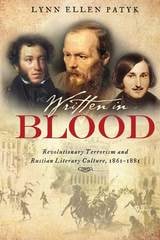
Written in Blood
Revolutionary Terrorism and Russian Literary Culture, 1861–1881Lynn Ellen Patyk
University of Wisconsin Press, 2017
Lynn Ellen Patyk contends that the prototype for the terrorist was the Russian writer, whose seditious word was interpreted as an audacious deed—and a violent assault on autocratic authority. The interplay and interchangeability of word and deed, Patyk argues, laid the semiotic groundwork for the symbolic act of violence at the center of revolutionary terrorism. While demonstrating how literary culture fostered the ethos, pathos, and image of the revolutionary terrorist and terrorism, she spotlights Fyodor Dostoevsky and his "terrorism trilogy"—Crime and Punishment (1866), Demons (1870–73), and The Brothers Karamazov (1878–80)—as novels that uniquely illuminate terrorism's methods and trajectory. Deftly combining riveting historical narrative with penetrating literary analysis of major and minor works, Patyk's groundbreaking book reveals the power of the word to spawn deeds and the power of literature to usher new realities into the world.
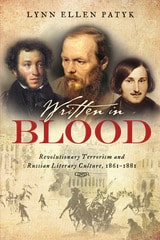
Written in Blood
Revolutionary Terrorism and Russian Literary Culture, 1861–1881Lynn Ellen Patyk
University of Wisconsin Press, 2020