Results by title
74 books match the query 'Russian literature' and 5 start with w
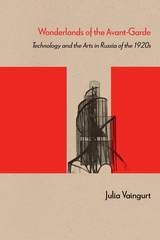
Wonderlands of the Avant-Garde
Technology and the Arts in Russia of the 1920sJulia Vaingurt
Northwestern University Press, 2013
In postrevolutionary Russia, as the Soviet government pursued rapid industrialization, avant-garde artists declared their intent to serve the nascent state and to transform life in accordance with their aesthetic designs. Despite their utilitarian intentions, however, most avant-gardists rarely created works regarded as practical instruments of societal transformation. Exploring this paradox, Vaingurt claims that the artists’ fusion of technology and aesthetics prevented their creations from being fully conscripted into the arsenal of political hegemony. The purposes of avant-garde technologies, she contends, are contemplative rather than constructive. Looking at Meyerhold’s theater, Tatlin’s and Khlebnikov’s architectural designs, Mayakovsky’s writings, and other works from the period, Vaingurt offers an innovative reading of an exceptionally complex moment in the formation of Soviet culture.
Writing a Usable Past
Russian Literary Culture, 1917-1937Angela Brintlinger
Northwestern University Press, 2008
In <i>Writing a Usable Past</i>, Brintlinger considers the interactions of post-Revolutionary Russian and emigre culture with the genre of biography in its various permutations, arguing that in the years after the Revolution, Russian writers looked to the great literary figures of the past to help them construct a post-Revolutionary present. In detailed looks at the biographical writing of Yuri Tynianov, Vladislav Khodasevich, and Mikhail Bulgakov, Brintlinger follows each author's successful biography/ies and their failed attempts at biographies of Alexander Pushkin on the centennial anniversary of his death. Brintlinger compares the Pushkin biographies to the other biographies examined, and in a concluding chapter she considers other, more successful commemorations of the great poet's death. She argues that popular commemorations--exhibits, concerts, special issues of journals--were a more fitting biography than the genre of the "usable past." For post-revolutionary cultural actors, including Tynianov, Khodasevich, and Bulgakov, Pushkin was a symbol rather than a model for constructing that usable past.
Writing as Exorcism
The Personal Codes of Pushkin, Lermontov, and GogolIlya Kutik
Northwestern University Press, 2005
A remarkable literary performance in its own right, this interpretive essay brings a highly original poetic sensibility to bear on the lives and works of three major Russian writers. It is Ilya Kutik's contention that many writers are tormented by secret fears and desires that only writing—in particular, the use of certain words and images—can exorcise. Making this biographical approach peculiarly his own—and susceptible to the nuances of comedy, tragedy, and critical equanimity—Kutik reads works of Alexander Pushkin, Mikhail Lermontov, and Nikolai Gogol, three Russian writers who were demonstrably subject to the whims, superstitions, and talismans that Kutik identifies. Exposing the conjunction of literary effort and private act in writings such as "The Queen of Spades," Dead Souls, and A Hero of Our Time, Kutik's work gives us a new way of understanding these masterpieces of Russian literature and their authors, and a new way of reading the mysteries of life and literature as mutually enriching.
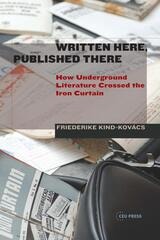
Written Here, Published There
How Underground Literature Crossed the Iron CurtainFriederike Kind-Kovács
Central European University Press, 2015
Written Here, Published There offers a new perspective on the role of underground literature in the Cold War and challenges us to recognize gaps in the Iron Curtain. The book identifies a transnational undertaking that reinforced détente, dialogue, and cultural transfer, and thus counterbalanced the persistent belief in Europe's irreversible division.
It analyzes a cultural practice that attracted extensive attention during the Cold War but has largely been ignored in recent scholarship: tamizdat, or the unauthorized migration of underground literature across the Iron Curtain. Through this cultural practice, I offer a new reading of Cold War Europe's history. Investigating the transfer of underground literature from the 'Other Europe' to Western Europe, the United States, and back illuminates the intertwined fabrics of Cold War literary cultures. Perceiving tamizdat as both a literary and a social phenomenon, the book focuses on how individuals participated in this border-crossing activity and used secretive channels to guarantee the free flow of literature.
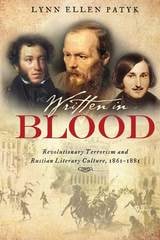
Written in Blood
Revolutionary Terrorism and Russian Literary Culture, 1861–1881Lynn Ellen Patyk
University of Wisconsin Press, 2017
Lynn Ellen Patyk contends that the prototype for the terrorist was the Russian writer, whose seditious word was interpreted as an audacious deed—and a violent assault on autocratic authority. The interplay and interchangeability of word and deed, Patyk argues, laid the semiotic groundwork for the symbolic act of violence at the center of revolutionary terrorism. While demonstrating how literary culture fostered the ethos, pathos, and image of the revolutionary terrorist and terrorism, she spotlights Fyodor Dostoevsky and his "terrorism trilogy"—Crime and Punishment (1866), Demons (1870–73), and The Brothers Karamazov (1878–80)—as novels that uniquely illuminate terrorism's methods and trajectory. Deftly combining riveting historical narrative with penetrating literary analysis of major and minor works, Patyk's groundbreaking book reveals the power of the word to spawn deeds and the power of literature to usher new realities into the world.