Results by title
137 books match the query 'Science & Technology' and 4 start with w
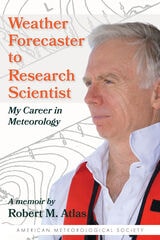
Weather Forecaster to Research Scientist
My Career in MeteorologyRobert M. Atlas
American Meteorological Society, 2022
This memoir follows the sixty-year meteorology career of Robert M. Atlas.
As a young child, Robert M. Atlas would often look up at the sky, observe the clouds, and ask his parents questions about the weather. That early interest sparked a career in meteorology that took place during a period of rapid development in the field. Weather Forecaster to Research Scientist follows his decades-long career and his innovative research, which led to improvements in the understanding and prediction of extreme weather.
Atlas’s journey begins with his start as an apprentice forecaster for the US Weather Bureau during a time when satellite meteorology and operational numerical weather prediction were just in their infancy. Weather Forecaster to Research Scientist also traces his experiences as an operational forecaster in the US Air Force, discusses his pioneering work on ocean surface winds using satellites, and describes his leadership of scientific organizations within NASA and NOAA as well as his experiences teaching at several universities. An engaging account of a distinguished career, this book will appeal to students, educators, weather forecasters, scientists, and weather enthusiasts alike.
[more]
What Process is Due?
Courts and Science-Policy DisputesDavid M. O'Brien
Russell Sage Foundation, 1987
Are judges competent to decide complex scientific disputes over toxic chemicals and hazardous wastes? Have courts gone too far in awarding damages to victims? Does the judiciary unreasonably constrain free market forces and usurp power from democratically elected branches of government? What constitutes judicial "due process" in the regulation of health-safety and environmental risks? David O'Brien addresses these and other key questions in a comprehensive survey of the role of courts in resolving science-policy disputes. He theorizes that such disputes, with their burden of scientific uncertainty and intense value conflict, become judicialized in the United States because they pose an uncomfortable trilemma for policy makers: how to accommodate competing demands for scientific certainty, political compromise, and procedural fairness in the regulation of risks. When policy negotiations break down, courts are called on not to settle scientific controversies per se, but in their traditional role as independent tribunals for settling value conflicts and imposing norms in a pluralistic society. This interpretation is enhanced by a unique set of case studies, including DES and asbestos litigation and the ban on Tris (a carcinogenic flame-retardent). O'Brien's analytical framework and his detailed examples illuminate the extent, the implications, and the underlying causes of the judicialization of risk regulation.
[more]
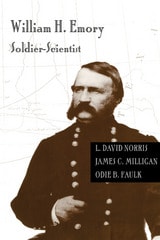
William H. Emory
Soldier-ScientistL. David Norris, James C. Milligan, and Odie B. Faulk
University of Arizona Press, 1998
Soldier and explorer William H. Emory traveled the length and breadth of the United States and participated in some of the most significant events of the nineteenth century. This first complete biography of Emory offers new insights into an often-overlooked military figure and provides an important view of an expanding America.
Born in Maryland in 1811, Emory was a West Point graduate who resigned his commission to become a civil engineer and join the newly formed Corps of Topographical Engineers. After working along the Canadian boundary, he was selected to accompany Stephen Watts Kearny and the Army of the West in their trek to California in 1846, and his map from that expedition helped guide Forty-Niners bound for the goldfields.
Emory worked for nine years on the new border between the United States and Mexico after the Treaty of Guadalupe Hidalgo and the Gadsden Purchase and was responsible for the survey and marking of the boundary. When the Civil War broke out, Emory refused a commission in the Confederate Army, instead commanding a regiment defending Washington, D.C. Later he saw action at Manassas, in the Red River campaign, and in the Shenandoah Valley, where he served under Phil Sheridan.
This biography draws on Emory’s personal papers to reveal other significant episodes of his life. While commanding a cavalry unit in Indian Territory, he was the only officer to bring an entire command out of insurrectionary territory. In hostile action of a different kind, he was a major witness in the impeachment trial of Andrew Johnson and offered testimony that helped save the president.
William H. Emory: Soldier-Scientist is an important resource for scholars of western expansion and the Civil War. More than that, it is a rousing story of an unsung but distinguished hero of his time.
[more]

Wings Over Illinois
Arthur E. Abney
Southern Illinois University Press, 2007
Wings over Illinois recounts World War II veteran Arthur Abney’s illustrious aviation career, effectively documenting a span in our own nation’s history from the vantage of the skies. Abney describes a lifetime of experience, from his time as an eager young pilot with the Flying Egyptians to his tour of service during World War II, his years with the Illinois Department of Aeronautics, American Airlines, and the Southern Illinois University Aviation Management and Flight program.
Abney introduces readers to hangar flying—exciting end-of-day flight tales told in the hangar—with sixty stories provided by military and civilian airmen from across the country. Included are such accounts as a 1943 bombing squadron assignment over Saipan in a typhoon, an engine freeze on takeoff during a solo training flight, a white-knuckle Bermuda Triangle flight, and a power failure on a homebuilt aircraft. Complementing Abney’s own experiences, these stories offer insights into the split-second decision making necessary to resolve problems in the air.
In this fascinating autobiography Abney takes readers on a journey through nearly seven decades of a life in aviation.
[more]