64 books match the query 'Self in literature' and 3 start with w
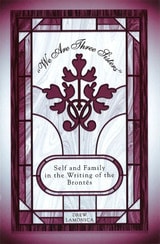
cover of We Are Three Sisters: Self and Family in the Writing of the Brontës

We Are Three Sisters

Self and Family in the Writing of the Brontës

Drew Lamonica

University of Missouri Press, 2003

While biographers have widely acknowledged the importance of family relationships to Charlotte, Emily, and Anne Brontë and to their writing processes, literary critics have yet to give extensive consideration to the family as a subject of the writing itself. In “We Are Three Sisters,” Drew Lamonica focuses on the role of families in the Brontës’ fictions of personal development, exploring the ways in which their writings recognize the family as a defining community for selfhood.
 
 
Drawing on extensive primary sources, including works by Sarah Ellis, Sarah Lewis, Ann Richelieu Lamb, Harriet Martineau, Thomas Carlyle, Charles Dickens, and Elizabeth Gaskell, Lamonica examines the dialogic relationship between the Brontës’ novels and a mid-Victorian domestic ideology that held the family to be the principal nurturer of subjectivity. Using a sociohistorical framework, “We Are Three Sisters” shows that the Brontës’ novels display a heightened awareness of contemporary female experience and the complex problems of securing a valued sense of selfhood not wholly dependent on family ties.
 
 
The opening chapters discuss the mid-Victorian “culture of the family,” in which the Brontës emerged as voices exploring the adequacy of the family as the site for personal, and particularly female, development. These chapters also introduce the Brontës’ early collaborative writings, showing that the sisters’ shared interest in the family’s formative role arose from their own experience as a family of authors. Lamonica also examines the seldom-recognized influences of Patrick and Branwell Brontë on the development of the sisters’ writing.
 
 
        Of the numerous studies on the Brontës, comparatively few consider all seven novels, and no previous study has undertaken to examine the Brontës’ writing in the context of mid-Victorian ideas regarding the family—its relationships, roles, and responsibilities. Lamonica explores in detail the various constructions of family in the sisters’ novels, concluding that the Brontës were attuned to complexities; they were not polemical writers with fixed feminist agendas.
The Brontës disputed the promotion of the family as the exclusive site for female development, morality, and fulfillment, without ever explicitly denying the possibility of domestic contentment. In doing so, the Brontës continue to challenge our readings and our understanding of them as mid-Victorian women. “We Are Three Sisters” is an important addition to the study of these fascinating women and their novels.
 
[more]
cover of Women Reading Women Writing

Women Reading Women Writing

Ann Louise Keating

Temple University Press, 1996
[more]
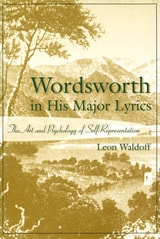
cover of Wordsworth in His Major Lyrics: The Art and Psychology of Self-Representation

Wordsworth in His Major Lyrics

The Art and Psychology of Self-Representation

Leon Waldoff

University of Missouri Press, 2001

Wordsworth in His Major Lyrics explores the identity, role, and subjectivity of the speaker in Wordsworth's finest and best-known longer lyrics—"Tintern Abbey," "Resolution and Independence," "Ode: Intimations of Immortality," and "Elegiac Stanzas." Because Wordsworth is the most autobiographical poet of the Romantic period, and perhaps in the English language, readers naturally take the speaker to be the poet himself or, as Wordsworth says in his prefaces and essays, "the poet in his own person."

Some readers allow for a fictional dimension in the characterization of the speaker and refer to him as a persona; others treat him as a biographical self, defined in literary, political, historical, or cultural terms. Leon Waldoff examines the critical issues posed by these different understandings of the speaker's identity and argues for a conception of Wordsworth's lyrical "I" that deals with the dramatic and psychological complexities of the speaker's act of self-representation.

Taking concepts from Freud and Winnicott, this book presents a psychoanalytic model for defining the speaker and conceptualizing his subjectivity. Waldoff suggests that the lyrical "I" in each poem is a transitional self of the poet. The poem offers, in the suspended moment and cultural space of lyrical form, a self-dramatization in which the speaker attempts to act out, in the sense of both performing and attempting to achieve, a reconstitution and transformation of the self.

In a series of close readings that provide formalistic and psychological analysis, the book shows that the major lyrics contain compelling evidence that Wordsworth devoted much of his poetic art to each speaker's act of self-dramatization. The various strategies that each speaker employs and the self- dramatizing character of his utterance are theorized and assimilated into an understanding of the subjectivity he represents.

Waldoff concludes that Wordsworth's lyrical "I" requires a conception of subjectivity that gives greater recognition to its individual, psychological dimensions and to the art of self-representation in each poem than recent Wordsworth criticism has provided. This important new work will be appreciated by anyone interested in Wordsworth or in Romantic poetry.

[more]