Results by title
66 books match the query 'Sex differences' and 4 start with w
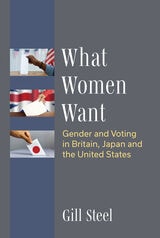
What Women Want
Gender and Voting in Britain, Japan and the United StatesGill Steel
University of Michigan Press, 2022
What Women Want analyzes decades of voting preferences, values, and policy preferences to debunk some of the media and academic myths about gender gaps in voting and policy preferences. Findings show that no single theory explains when differences in women’s and men’s voting preferences emerge, when they do not, or when changes—or the lack thereof—occur over time. Steel extends existing theories to create a broader framework for thinking about gender and voting behavior to provide more analytical purchase in understanding gender and its varying effects on individual voters’ preferences. She incorporates the long-term effects of party identification and class politics on political decision-making, particularly in how they influence preferences on social provision and on expectations of the state. She also points to the importance of symbolic politics

Who Succeeds in Science?
The Gender DilemmaGerald Holton and Gerhard Sonnert
Rutgers University Press, 1995
Why don’t more women become scientists? And why do those who do become scientists often face more difficulties than their male counterparts? Every year, about a quarter of a million young men and women in the United States receive their first academic degree in science, mathematics, or engineering. A small fraction will eventually become research scientists. But many who start out with that goal fail to reach it––for reasons that may have less to do with their scientific ability than with their gender.
Drawing on a wealth of information (699 questionnaires and 200 interviews) from men and women who gave every promise of scientific achievement, Gerhard Sonnert and Gerald Holton illuminate the partly gender-driven dynamics of “the leaky scientific pipeline.” At the heart of this book are gripping personal life stories of ten women and ten men: half became highly successful scientists, the rest left research science. In their own voices, they talk candidly about their career paths, the obstacles and assists they encountered, the difficulties and rewards of attempting to combine a family life with a science career.
This highly readable analysis of the gender dimension in scientific careers––and its clear-headed advice––will be of great interest to everyone considering a career in science as well as to teachers, parents, and active scientists. Academics in sociology of science and gender studies as well as decision-makers in the areas of human resources and science policy will also welcome its discussions of general issues and policy recommendations.
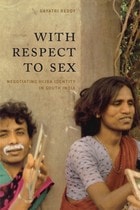
With Respect to Sex
Negotiating Hijra Identity in South IndiaGayatri Reddy
University of Chicago Press, 2005
Hijras are men who sacrifice their genitalia to a goddess in return for the power to confer fertility on newlyweds and newborn children, a ritual role they are respected for, at the same time as they are stigmatized for their ambiguous sexuality. By focusing on the hijra community, Gayatri Reddy sheds new light on Indian society and the intricate negotiations of identity across various domains of everyday life. Further, by reframing hijra identity through the local economy of respect, this ethnography highlights the complex relationships among local and global, sexual and moral, economies.
This book will be regarded as the definitive work on hijras, one that will be of enormous interest to anthropologists, students of South Asian culture, and specialists in the study of gender and sexuality.
Women Writing the Academy
Audience, Authority, and TransformationGesa E. Kirsch. Foreword by John Trimbur
Southern Illinois University Press, 1993
Women Writing the Academy is based on an extensive interview study by Gesa E. Kirsch that investigates how women in different academic disciplines perceive and describe their experiences as writers in the university.
Kirsch’s study focuses on the writing strategies of successful women writers, their ways of establishing authority, and the kinds of audiences they address in different disciplinary settings. Based on multiple interviews with thirty-five women from five different disciplines (anthropology, education, history, nursing, and psychology) and four academic ranks (seniors, graduate students, and faculty before and after tenure), this is the first book to systematically explore the academic context in which women write and publish.
While there are many studies in literary criticism on women as writers of fiction, there has not been parallel scholarship on women as writers of professional discourse, be it inside or outside the academy. Through her research, for example, Kirsch found that women were less likely than their male counterparts to think of their work as sufficiently significant to write up and submit for publication, tended to hold on to their work longer than men before sending it out, and were less likely than men to revise and resubmit manuscripts that had been initially rejected.
This book is significant in that it investigates a new area of research— gender and writing—and in doing so brings together findings on audience, authority, and gender.