Results by title
279 books match the query 'Slavery' and 5 start with w
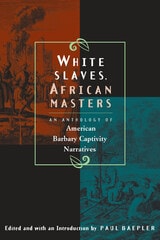
White Slaves, African Masters
An Anthology of American Barbary Captivity NarrativesEdited by Paul Baepler
University of Chicago Press, 1999
A remarkable collection of hard-to-find primary source accounts of nineteenth-century American captivity narratives
Some of the most popular stories in nineteenth-century America were sensational tales of whites captured and enslaved in North Africa. White Slaves, African Masters for the first time gathers together a selection of these Barbary captivity narratives, which significantly influenced early American attitudes toward race, slavery, and nationalism.
Though Barbary privateers began to seize North American colonists as early as 1625, Barbary captivity narratives did not begin to flourish until after the American Revolution. During these years, stories of Barbary captivity forced the U.S. government to pay humiliating tributes to African rulers, stimulated the drive to create the U.S. Navy, and brought on America's first post-revolutionary war. These tales also were used both to justify and to vilify slavery.
The accounts collected here range from the 1798 tale of John Foss, who was ransomed by Thomas Jefferson's administration for tribute totaling a sixth of the annual federal budget, to the story of Ion Perdicaris, whose (probably staged) abduction in Tangier in 1904 prompted Theodore Roosevelt to send warships to Morocco and inspired the 1975 film The Wind and the Lion. Also included is the unusual story of Robert Adams, a light-skinned African American who was abducted by Arabs and used by them to hunt negro slaves; captured by black villagers who presumed he was white; then was sold back to a group of Arabs, from whom he was ransomed by a British diplomat.
Long out of print and never before anthologized, these fascinating tales open an entirely new chapter of early American literary history, and shed new light on the more familiar genres of Indian captivity narrative and American slave narrative.
[more]
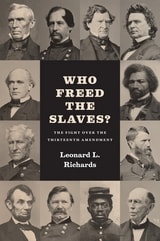
Who Freed the Slaves?
The Fight over the Thirteenth AmendmentLeonard L. Richards
University of Chicago Press, 2015
In the popular imagination, slavery in the United States ended with Abraham Lincoln’s Emancipation Proclamation. The Proclamation may have been limited—freeing only slaves within Confederate states who were able to make their way to Union lines—but it is nonetheless generally seen as the key moment, with Lincoln’s leadership setting into motion a train of inevitable events that culminated in the passage of an outright ban: the Thirteenth Amendment.
The real story, however, is much more complicated—and dramatic—than that. With Who Freed the Slaves?, distinguished historian Leonard L. Richards tells the little-known story of the battle over the Thirteenth Amendment, and of James Ashley, the unsung Ohio congressman who proposed the amendment and steered it to passage. Taking readers to the floor of Congress and the back rooms where deals were made, Richards brings to life the messy process of legislation—a process made all the more complicated by the bloody war and the deep-rooted fear of black emancipation. We watch as Ashley proposes, fine-tunes, and pushes the amendment even as Lincoln drags his feet, only coming aboard and providing crucial support at the last minute. Even as emancipation became the law of the land, Richards shows, its opponents were already regrouping, beginning what would become a decades-long—and largely successful—fight to limit the amendment’s impact.
Who Freed the Slaves? is a masterwork of American history, presenting a surprising, nuanced portrayal of a crucial moment for the nation, one whose effects are still being felt today.
[more]
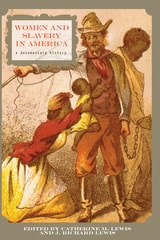
Women and Slavery in America
A Documentary HistoryCatherine M. Lewis
University of Arkansas Press, 2011
Women and Slavery offers readers an opportunity to examine the establishment, growth, and evolution of slavery in the United States as it impacted women-enslaved and free, African American and white, wealthy and poor, northern and southern. The primary documents-including newspaper articles, broadsides, cartoons, pamphlets, speeches, photographs, memoirs, and editorials-are organized thematically and represent cultural, political, religious, economic, and social perspectives on this dark and complex period in American history.
[more]
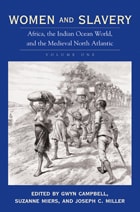
Women and Slavery, Volume One
Africa, the Indian Ocean World, and the Medieval North AtlanticGwyn Campbell
Ohio University Press, 2007
The literature on women enslaved around the world has grown rapidly in the last ten years, evidencing strong interest in the subject across a range of academic disciplines. Until Women and Slavery, no single collection has focused on female slaves who—as these two volumes reveal—probably constituted the considerable majority of those enslaved in Africa, Asia, and Europe over several millennia and who accounted for a greater proportion of the enslaved in the Americas than is customarily acknowledged.
Women enslaved in the Americas came to bear highly gendered reputations among whites—as “scheming Jezebels,” ample and devoted “mammies,” or suffering victims of white male brutality and sexual abuse—that revealed more about the psychology of enslaving than about the courage and creativity of the women enslaved. These strong images of modern New World slavery contrast with the equally expressive virtual invisibility of the women enslaved in the Old—concealed in harems, represented to meddling colonial rulers as “wives” and “nieces,” taken into African families and kin-groups in subtlely nuanced fashion.
Women and Slavery presents papers developed from an international conference organized by Gwyn Campbell.
Volume 1 Contributors: Sharifa Ahjum, Richard B. Allen, Katrin Bromber, Gwyn Campbell, Catherine Coquery-Vidrovitch, Jan-Georg Deutsch, Timothy Fernyhough, Philip J. Havik, Elizabeth Grzymala Jordan, Martin A. Klein, George Michael La Rue, Paul E. Lovejoy, Fred Morton, Richard Roberts, Kirsten A. Seaver
[more]
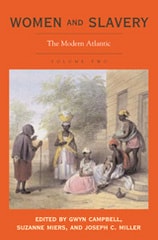
Women and Slavery, Volume Two
The Modern AtlanticGwyn Campbell
Ohio University Press, 2008
The literature on women enslaved around the world has grown rapidly in the last ten years, evidencing strong interest in the subject across a range of academic disciplines. Until Women and Slavery, no single collection has focused on female slaves who—as these two volumes reveal—probably constituted the considerable majority of those enslaved in Africa, Asia, and Europe over several millennia and who accounted for a greater proportion of the enslaved in the Americas than is customarily acknowledged.
Women enslaved in the Americas came to bear highly gendered reputations among whites—as “scheming Jezebels,” ample and devoted “mammies,” or suffering victims of white male brutality and sexual abuse—that revealed more about the psychology of enslaving than about the courage and creativity of the women enslaved. These strong images of modern New World slavery contrast with the equally expressive virtual invisibility of the women enslaved in the Old—concealed in harems, represented to meddling colonial rulers as “wives” and “nieces,” taken into African families and kin-groups in subtlely nuanced fashion.
Volume 2 Contributors: Henrice Altin,k Laurence Brown, Myriam Cottias, Laura F. Edwards, Richard Follett, Tara Inniss, Barbara Krauthamer, Joseph C. Miller, Bernard Moitt, Kenneth Morgan, Claire Robertson, Marsha Robinson, Felipe Smith, and Mariza de Carvalho Soares.
[more]