Results by title
216 books match the query 'Social' and 10 start with w
Water in the Hispanic Southwest
A Social and Legal History, 1550-1850Michael C. Meyer
University of Arizona Press, 1984
Wealth, Commerce, and Philosophy
Foundational Thinkers and Business EthicsEdited by Eugene Heath and Byron Kaldis
University of Chicago Press, 2017
Spanning the history of western philosophy as well as looking toward classical Chinese thought and medieval Islamic philosophy, this volume provides business ethicists a unified source of clear, accurate, and compelling accounts of how the ideas of foundational thinkers—from Aristotle to Friedrich Hayek to Amartya Sen—relate to wealth, commerce, and markets. The essays illuminate perspectives that have often been ignored or forgotten, informing discussion in fresh and often unexpected ways. In doing so, the authors not only throw into relief common misunderstandings and misappropriations often endemic to business ethics but also set forth rich moments of contention as well as novel ways of approaching complex ethical problems. Ultimately, this volume provides a bedrock of moral thought that will move business ethics beyond the ever-changing opinions of headline-driven debate.
What Gender Is, What Gender Does
Judith Roof
University of Minnesota Press, 2016
What Gender Is, What Gender Does provides a forceful new paradigm for considering genders. With depth and insight, Judith Roof argues that genders are much more than binary. And they are constantly morphing: they are conscious and unconscious, simultaneously conventional and idiosyncratic. At any moment, more than one gender dynamic is at work in any individual.
Roof’s interpretation of genders isn’t content with either biological duality or endlessly open performativity, and what results is a nuanced and surprising representation of gender—an account that captures the complexities of lived experience as well as lived ideology. For Roof, genders are interacting sets of operations that link individual desires to multiple, shifting manifestations of sociocultural positioning and self-presentation. Thus, “to gender” is to signal, mask, suggest, mislead, and simplify the uncontainable chaos of desires characteristic of subjects but roundly contained by society.
Drawing illustrative material from contemporary popular culture productions, including My Big Fat Greek Wedding, Spider-Man, Shrek, Shallow Hal, Sex and the City, Bridesmaids, Bond films, and “bromance” movies, What Gender Is, What Gender Does demonstrates how the persistent conflation of gender and sexual difference is, on the one hand, a simple taxonomic urge and, on the other, a cover that offers the security of identity in place of the frustrations and fears of the real asymmetries of personal power dynamics.
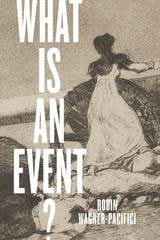
What Is an Event?
Robin Wagner-Pacifici
University of Chicago Press, 2017
What Is an Event? ranges across several disciplines, systematically analyzing the ways that events emerge, take shape, gain momentum, flow, and even get bogged down. As an exploration of how events are constructed out of ruptures, it provides a mechanism for understanding eventful forms and flows, from the micro-level of individual life events to the macro-level of historical revolutions, contemporary terrorist attacks, and financial crises. Wagner-Pacifici takes a close look at a number of cases, both real and imagined, through the reports, personal narratives, paintings, iconic images, political posters, sculptures, and novels they generate and through which they live on. What is ultimately at stake for individuals and societies in events, Wagner-Pacifici argues, are identities, loyalties, social relationships, and our very experiences of time and space. What Is an Event? provides a way for us all—as social and political beings living through events, and as analysts reflecting upon them—to better understand what is at stake in the formations and flows of the events that mark and shape our lives.
What's Left of the Left
Democrats and Social Democrats in Challenging TimesJames Cronin, George Ross, and James Shoch, eds.
Duke University Press, 2011
Contributors. Sheri Berman, James Cronin, Jean-Michel de Waele, Arthur Goldhammer, Christopher Howard, Jane Jenson, Gerassimos Moschonas, Sofia Pérez, Jonas Pontusson, George Ross, James Shoch, Sorina Soare, Ruy Teixeira
When Time Warps
The Lived Experience of Gender, Race, and Sexual ViolenceMegan Burke
University of Minnesota Press, 2019
An inquiry into the phenomenology of “woman” based in the relationship between lived time and sexual violence
Feminist phenomenologists have long understood a woman’s life as inhibited, confined, and constrained by sexual violence. In this important inquiry, author Megan Burke both builds and expands on this legacy by examining the production of normative womanhood through racist tropes and colonial domination. Ultimately, Burke charts a new feminist phenomenology based in the relationship between lived time and sexual violence.
By focusing on time instead of space, When Time Warps places sexualized racism at the center of the way “woman” is lived. Burke transports questions of time and gender outside the realm of the historical, making provocative new insights into how gendered individuals live time, and how their temporal existence is changed through particular experiences.
Providing a potent reexamination of the theory of Simone de Beauvoir—while also bringing to the fore important women of color theorists and engaging in the temporal aspects of #MeToo—When Time Warps makes a necessary, lasting contribution to our understanding of gender, race, and sexual violence.
Wild Thought
A New Translation of “La Pensée sauvage”Claude Lévi-Strauss
University of Chicago Press, 2021
Controversially titled The Savage Mind when it was first published in English in 1966, the original translation nevertheless sparked a fascination with Lévi-Strauss’s work among Anglophone readers. Wild Thought rekindles that spark with a fresh and accessible new translation. Including critical annotations for the contemporary reader, it restores the accuracy and integrity of the book that changed the course of intellectual life in the twentieth century, making it an indispensable addition to any philosophical or anthropological library.

Wisecracks
Humor and Morality in Everyday LifeDavid Shoemaker
University of Chicago Press, 2024
A good sense of humor is key to the good life, but a joke taken too far can get anyone into trouble. Where to draw the line is not as simple as it may seem. After all, even the most innocent quips between friends rely on deception, sarcasm, and stereotypes and often run the risk of disrespect, meanness, and harm. How do we face this dilemma without taking ourselves too seriously?
In Wisecracks, philosopher David Shoemaker examines this interplay between humor and morality and ultimately argues that even morally suspect humor is an essential part of ethical life. Shoemaker shows how improvised “wisecracks” between family and friends—unlike scripted stand-up, sketches, or serials—help us develop a critical human skill: the ability to carry on and find the funny in tragedy. In developing a new ethics of humor in defense of questionable gibes, Wisecracks offers a powerful case for humor as a healing presence in human life.

With Nature
Nature Philosophy as Poetics through Schelling, Heidegger, Benjamin and NancyWarwick Mules
Intellect Books, 2014
Wrong-Doing, Truth-Telling
The Function of Avowal in JusticeMichel Foucault
University of Chicago Press, 2014
Three years before his death, Michel Foucault delivered a series of lectures at the Catholic University of Louvain that until recently remained almost unknown. These lectures—which focus on the role of avowal, or confession, in the determination of truth and justice—provide the missing link between Foucault’s early work on madness, delinquency, and sexuality and his later explorations of subjectivity in Greek and Roman antiquity.