116 books match the query 'Social Services & Welfare' and 7 start with w
cover of Welfare Discipline: Discourse, Governance and Globalization

Welfare Discipline

Discourse, Governance and Globalization

Sanford F. Schram

Temple University Press, 2005

For the past decade, political scientist Sanford Schram has led the academic effort to understand how Americans and their political officials talk about poverty and welfare and what impact that discourse has on policy and on the global society.

In Welfare Discipline, Schram argues that it is time to take stock of the new forms of welfare and to develop even better methods to understand them. He argues for a more contextualized approach to examining welfare policy, from the use of the idea of globalization to justify cutbacks, to the increasing employment of U.S. policy discourse overseas, to the development of asset-based approaches to helping the poor.

Stressing the importance of understanding the ways we talk about welfare, how we study it, and, critically, what we do not discuss and why, Schram offers recommendations for making welfare policy both just and effective.
[more]
cover of Welfare in America: How Social Science Fails the Poor

Welfare in America

How Social Science Fails the Poor

William M. Epstein

University of Wisconsin Press, 1997

William M. Epstein charges that most current social welfare programs are not held to credible standards in their design or their results. Rather than spending less on such research and programs, however, Epstein suggests we should spend much more, and do the job right.
     The American public and policymakers need to rely on social science research for objective, credible information when trying to solve problems of employment, affordable housing, effective health care, and family integrity. But, Epstein contends, politicians treat welfare issues as ideological battlegrounds; they demand immediate results from questionable data and implement policies long before social researchers can complete their analyses. Social scientists often play into the political agenda, supporting poorly conceived programs and doing little to test and revise them. Analyzing Aid to Families with Dependent Children (AFDC) and the recent welfare reform act, Food Stamps, Medicaid, job training, social services, and other programs, Epstein systematically challenges the conservative’s vain hope that neglect is therapeutic for the poor, as well as the liberal’s conceit that a little bit of assistance is sufficient.
[more]
cover of What Government Can Do: Dealing with Poverty and Inequality

What Government Can Do

Dealing with Poverty and Inequality

Benjamin I. Page and James R. Simmons

University of Chicago Press, 2000
It is often said that the federal government cannot or should not attempt to address America's problems of poverty and inequality—because its bureaucracy is wasteful or its programs ineffective. But is this true? In this book, Benjamin I. Page and James R. Simmons examine a number of federal and local programs, detailing what government action already does for its citizens and assessing how efficient it is at solving the problems it seeks to address. Their conclusion, surprisingly, is the polar opposite of the prevailing rhetoric—What Government Can Do is an insightful and compelling argument that it both can and should do more.
[more]
cover of What Role for Government?: Lessons from Policy Research

What Role for Government?

Lessons from Policy Research

Richard J. Zeckhauser and Derek Leebaert, eds.

Duke University Press, 1983
The vital debates on government today are concerned with its social role, its participation in the economy, and its redistributive responsibilities. These functions, not defined in the Constitution, reflect the evolution of society and its values and the powerful but jerky hand of the political process.
[more]
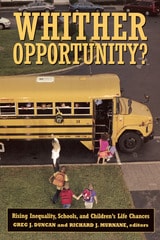
cover of Whither Opportunity?: Rising Inequality, Schools, and Children's Life Chances

Whither Opportunity?

Rising Inequality, Schools, and Children's Life Chances

Greg J. Duncan

Russell Sage Foundation, 2012
As the incomes of affluent and poor families have diverged over the past three decades, so too has the educational performance of their children. But how exactly do the forces of rising inequality affect the educational attainment and life chances of low-income children? In Whither Opportunity? a distinguished team of economists, sociologists, and experts in social and education policy examines the corrosive effects of unequal family resources, disadvantaged neighborhoods, insecure labor markets, and worsening school conditions on K-12 education. This groundbreaking book illuminates the ways rising inequality is undermining one of the most important goals of public education—the ability of schools to provide children with an equal chance at academic and economic success. The most ambitious study of educational inequality to date, Whither Opportunity? analyzes how social and economic conditions surrounding schools affect school performance and children’s educational achievement. The book shows that from earliest childhood, parental investments in children’s learning affect reading, math, and other attainments later in life. Contributor Meredith Phillip finds that between birth and age six, wealthier children will have spent as many as 1,300 more hours than poor children on child enrichment activities such as music lessons, travel, and summer camp. Greg Duncan, George Farkas, and Katherine Magnuson demonstrate that a child from a poor family is two to four times as likely as a child from an affluent family to have classmates with low skills and behavior problems – attributes which have a negative effect on the learning of their fellow students. As a result of such disparities, contributor Sean Reardon finds that the gap between rich and poor children’s math and reading achievement scores is now much larger than it was fifty years ago. And such income-based gaps persist across the school years, as Martha Bailey and Sue Dynarski document in their chapter on the growing income-based gap in college completion. Whither Opportunity? also reveals the profound impact of environmental factors on children’s educational progress and schools’ functioning. Elizabeth Ananat, Anna Gassman-Pines, and Christina Gibson-Davis show that local job losses such as those caused by plant closings can lower the test scores of students with low socioeconomic status, even students whose parents have not lost their jobs. They find that community-wide stress is most likely the culprit. Analyzing the math achievement of elementary school children, Stephen Raudenbush, Marshall Jean, and Emily Art find that students learn less if they attend schools with high student turnover during the school year – a common occurrence in poor schools. And David Kirk and Robert Sampson show that teacher commitment, parental involvement, and student achievement in schools in high-crime neighborhoods all tend to be low. For generations of Americans, public education provided the springboard to upward mobility. This pioneering volume casts a stark light on the ways rising inequality may now be compromising schools’ functioning, and with it the promise of equal opportunity in America.
[more]
cover of Why Americans Hate Welfare: Race, Media, and the Politics of Antipoverty Policy

Why Americans Hate Welfare

Race, Media, and the Politics of Antipoverty Policy

Martin Gilens

University of Chicago Press, 1999

Tackling one of the most volatile issues in contemporary politics, Martin Gilens's work punctures myths and misconceptions about welfare policy, public opinion, and the role of the media in both. Why Americans Hate Welfare shows that the public's views on welfare are a complex mixture of cynicism and compassion; misinformed and racially charged, they nevertheless reflect both a distrust of welfare recipients and a desire to do more to help the "deserving" poor.

"With one out of five children currently living in poverty and more than 100,000 families with children now homeless, Gilens's book is must reading if you want to understand how the mainstream media have helped justify, and even produce, this state of affairs." —Susan Douglas, The Progressive
"Gilens's well-written and logically developed argument deserves to be taken seriously." —Choice

"A provocative analysis of American attitudes towards 'welfare.'. . . [Gilens] shows how racial stereotypes, not white self-interest or anti-statism, lie at the root of opposition to welfare programs." -Library Journal

[more]
cover of World Crisis Effects on Social Security in Latin America and the Caribbean: Lessons and Policies

World Crisis Effects on Social Security in Latin America and the Caribbean

Lessons and Policies

Carmelo Mesa-Lago

University of London Press, 2010

Written by a top scholar on social security in Latin America and the Caribbean, this book assesses the effects of the world economic crisis on social security and welfare in the region. Drawing on the impact of and lessons from previous crises, Carmelo Mesa-Lago identifies the strengths and weakness of Latin American social security before the current global crisis. He evaluates the event's actual and potential effects on pensions, health care, and social assistance programs, based on a taxonomy of three groups of countries. The book ends with a summary of policies adopted by some countries and the author's own recommendations on social policies to lessen the adverse outcomes of the financial crisis. Latin America's pioneering social-welfare reforms make this book important for other regions of the world, both developed and developing.
[more]