158 books match the query 'Social justice' and 6 start with w
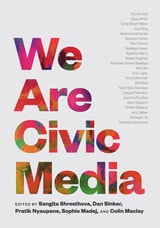
cover of We Are Civic Media

We Are Civic Media

Sangita Shresthova, Dan Sinker, Pratik Nyaupane, Sophie Madej, and Colin Maclay

Northwestern University Press, 2025

A discipline-crossing introduction to civic media via accounts from grassroots practitioners
 
“Civic media” is the use of contemporary technologies to connect communities, inspire action, build civic capacity, and sustain social change efforts. Written by artists, creators, storytellers, organizers, and others working at the intersections of technology, social justice, and culture, this book summons civic media through the lived experiences of its contributors.
 
Latoya Peterson delves into the therapeutic power of gaming; Akilah Hughes discusses identity and community through the lens of her campaign to change her high school's racist mascot; and Tyree Boyd-Pates emphasizes the potential power of museum curation to challenge power dynamics and bridge digital and physical realms. Through the experiences of these grassroots practitioners and many others, We Are Civic Media offers accessible insights for those interested in understanding, respecting, and practicing civic media.
 
[more]
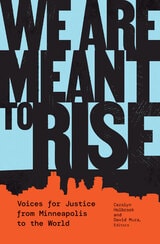
cover of We Are Meant to Rise: Voices for Justice from Minneapolis to the World

We Are Meant to Rise

Voices for Justice from Minneapolis to the World

Carolyn Holbrook

University of Minnesota Press, 2021

A brilliant and rich gathering of voices on the American experience of this past year and beyond, from Indigenous writers and writers of color from Minnesota
 

In this significant collection, Indigenous writers and writers of color bear witness to one of the most unsettling years in the history of the United States. Essays and poems vividly reflect and comment on the traumas we endured in 2020, beginning with the arrival of the COVID-19 pandemic crisis, deepened by the blatant murder of George Floyd by Minneapolis police officers and the uprisings that immersed our city into the epicenter of passionate, worldwide demands for justice. In inspired and incisive writing these contributors speak unvarnished truths not only to the original and pernicious racism threaded through the American experience but also to the deeply personal, in essays about family, loss, food culture, economic security, and mental health. Their call and response is united here to rise and be heard. 

We Are Meant to Rise lifts up the astonishing variety of BIPOC writers in Minnesota. From authors with international reputations to newly emerging voices, it features people from many cultures, including Indigenous Dakota and Anishinaabe, African American, Hmong, Somali, Afghani, Lebanese, Korean, Vietnamese, Japanese, Puerto Rican, Colombian, Mexican, transracial adoptees, mixed race, and LGBTQ+ perspectives. Most of the contributors have participated in More Than a Single Story, a popular and insightful conversation series in Minneapolis that features Indigenous and people of color speaking on what most concerns their communities. 

We Are Meant to Rise meets the events of the day, the year, the centuries before, again and again, with powerful testament to the intrinsic and unique value of the human voice.

Contributors: Suleiman Adan, Mary Moore Easter, Louise Erdrich, Anika Fajardo, Safy-Hallan Farah, Said Farah, Sherrie Fernandez-Williams, Pamela R. Fletcher Bush, Shannon Gibney, Kathryn Haddad, Tish Jones, Ezekiel Joubert III, Douglas Kearney, Ed Bok Lee, Ricardo Levins Morales, Arleta Little, Resmaa Menakem, Tess Montgomery, Ahmad Qais Munhazim, Melissa Olson, Alexs Pate, Bao Phi, Mona Susan Power, Samantha Sencer-Mura, Said Shaiye, Erin Sharkey, Sun Yung Shin, Michael Torres, Diane Wilson, Kao Kalia Yang, and Kevin Yang.
[more]
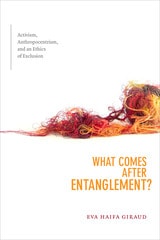
cover of What Comes after Entanglement?: Activism, Anthropocentrism, and an Ethics of Exclusion

What Comes after Entanglement?

Activism, Anthropocentrism, and an Ethics of Exclusion

Eva Haifa Giraud

Duke University Press, 2019

By foregrounding the ways that human existence is bound together with the lives of other entities, contemporary cultural theorists have sought to move beyond an anthropocentric worldview. Yet as Eva Haifa Giraud contends in What Comes after Entanglement?, for all their conceptual power in implicating humans in ecologically damaging practices, these theories can undermine scope for political action. Drawing inspiration from activist projects between the 1980s and the present that range from anticapitalist media experiments and vegan food activism to social media campaigns against animal research, Giraud explores possibilities for action while fleshing out the tensions between theory and practice. Rather than an activist ethics based solely on relationality and entanglement, Giraud calls for what she describes as an ethics of exclusion, which would attend to the entities, practices, and ways of being that are foreclosed when other entangled realities are realized. Such an ethics of exclusion emphasizes foreclosures in the context of human entanglement in order to foster the conditions for people to create meaningful political change.
[more]
cover of What Does the Lord Require?: How American Christians Think about Economic Justice

What Does the Lord Require?

How American Christians Think about Economic Justice

Hart, Stephen

Rutgers University Press, 1996
In this engaging and lively book, Stephen Hart paints a rich portrait of how everyday Christians connect their faith to political issues like economic equality, government intervention, and the rights of private enterprise. Drawing on interviews with forty-seven "ordinary" Christians--Roman Catholics, Evangelical and Pentecostal Protestants, mainline Protestants, and others--Hart argues that Christians do not always learn a conservative political perspective from their religion, as is often the stereotype. Rather, Christian traditions provide a reservoir of resources that supports such varied values as equality, community, individuality, and freedom. Hart profiles these individuals and allows them to explain in their own words how they use these values to formulate views on social justice issues, supporting political positions ranging from left to right. Hart also provides a new way of understanding how religion affects public discourse. This first paperback edition includes a new analysis of recent trends in religious politics, including the religious right and religiously-based movements for peace and justice.
[more]
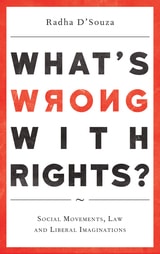
cover of What's Wrong with Rights?: Social Movements, Law and Liberal Imaginations

What's Wrong with Rights?

Social Movements, Law and Liberal Imaginations

Radha D'Souza

Pluto Press, 2018

Rights occupy a strange position in global politics. On the one hand, they’re used by business and governments as a justification for globalization—if the spread of corporate capitalism also helps lead to improvements in human rights, then globalization must be good, right? At the same time, though, even those on the left who are skeptical of that discourse tend to hew to a belief in rights themselves, like the right to food, medicine, housing, free speech, assembly, and religion.
            How can these conflicting attitudes towards rights be reconciled? Radha D’Souza lays out the problem and the solution in this book, applying legal thought to human rights to bridge the gap between rights in the abstract and their institutional context. Through close looks at real struggles, D’Souza shows how the left around the world can develop new strategies and tactics to achieve the goals embodied by rights discourse without giving cover to globalization.
[more]
cover of Writing Assessment, Social Justice, and the Advancement of Opportunity

Writing Assessment, Social Justice, and the Advancement of Opportunity

Mya Poe

University Press of Colorado, 2018

This edited collection provides the first principled examination of social justice and the advancement of opportunity as the aim and consequence of writing assessment. Contributors to the volume offer interventions in historiographic studies, justice-focused applications in admission and placement assessment, innovative frameworks for outcomes design, and new directions for teacher research and professional development. Drawing from contributors' research, the collection constructs a social justice canvas—an innovative technique that suggests ways that principles of social justice can be integrated into teaching and assessing writing. The volume concludes with 18 assertions on writing assessment designed to guide future research in the field. Written with the intention of making a restorative milestone in the history of writing assessment, Writing Assessment, Social Justice, and the Advancement of Opportunity generates new directions for the field of writing studies. This volume will be of interest to all stakeholders interested in the assessment of written communication and the role of literacy in society, including advisory boards, administrators, faculty, professional organizations, students, and the public.
[more]