Results by title
95 books match the query 'Social media' and 3 start with w

Why We Can't Have Nice Things
Social Media’s Influence on Fashion, Ethics, and PropertyMinh-Ha T. Pham
Duke University Press, 2022

Wired TV
Laboring Over an Interactive FutureMann, Denise
Rutgers University Press, 2014
This collection looks at the post–network television industry’s heady experiments with new forms of interactive storytelling—or wired TV—that took place from 2005 to 2010 as the networks responded to the introduction of broadband into the majority of homes and the proliferation of popular, participatory Web 2.0 companies like Facebook, YouTube, and Twitter.
Contributors address a wide range of issues, from the networks’ sporadic efforts to engage fans using transmedia storytelling to the production inefficiencies that continue to dog network television to the impact of multimedia convergence and multinational, corporate conglomeration on entrepreneurial creativity. With essays from such top scholars as Henry Jenkins, John T. Caldwell, and Jonathan Gray and from new and exciting voices emerging in this field, Wired TV elucidates the myriad new digital threats and the equal number of digital opportunities that have become part and parcel of today’s post-network era. Readers will quickly recognize the familiar television franchises on which the contributors focus— including Lost, The Office, Entourage, Battlestar Gallactica, The L Word, and Heroes—in order to reveal their impact on an industry in transition.
While it is not easy for vast bureaucracies to change course, executives from key network divisions engaged in an unprecedented period of innovation and collaboration with four important groups: members of the Hollywood creative community who wanted to expand television’s storytelling worlds and marketing capabilities by incorporating social media; members of the Silicon Valley tech community who were keen to rethink television distribution for the digital era; members of the Madison Avenue advertising community who were eager to rethink ad-supported content; and fans who were enthusiastic and willing to use social media story extensions to proselytize on behalf of a favorite network series.
In the aftermath of the lengthy Writers Guild of America strike of 2007/2008, the networks clamped down on such collaborations and began to reclaim control over their operations, locking themselves back into an aging system of interconnected bureaucracies, entrenched hierarchies, and traditional partners from the past. What’s next for the future of the television industry? Stay tuned—or at least online.
Contributors: Vincent Brook, Will Brooker, John T. Caldwell, M. J. Clarke, Jonathan Gray, Henry Jenkins, Derek Johnson, Robert V. Kozinets, Denise Mann, Katynka Z. Martínez, and Julie Levin Russo
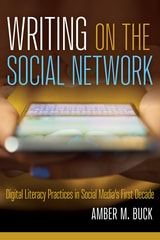
Writing on the Social Network
Digital Literacy Practices in Social Media's First DecadeAmber M. Buck
Utah State University Press, 2023
Through qualitative case study research, Buck explores how literate activities on social network sites coalesced around three areas crucial for writing in digital environments: (1) a heightened awareness of audience and an ability to tailor messages to specific audiences; (2) an understanding of how personal data is collected and circulated in online spaces; and (3) a means through which to use the first two skills for self-promotion and self-presentation in both personal and professional settings. She identifies several distinct literacy practices and strategies used by participants to communicate effectively and addresses how these strategies can help writing researchers and internet scholars understand the impact of social media’s first decade and can inform the ways they will research and understand social media’s second decade.
Social media platforms represent important locations where the different influences on writing become visible. Writing on the Social Network is a close study of the rich literate practices individuals have engaged in on social network sites over the last ten years that allows for a better understanding of the role social media plays in shaping digital literacy.