Results by title
71 books match the query 'Social networks' and 5 start with w
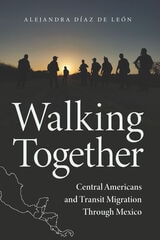
Walking Together
Central Americans and Transit Migration Through MexicoAlejandra Díaz de León
University of Arizona Press, 2023
Migrants in transit form several types of social networks, develop trust, and engage in acts of solidarity. The need to be recognized and grieved, compounded by the practical use of pooling information and resources, leads migrants to form small, strong groups called road families. Through the generalized sharing of information and small items such as food and blankets, migrants also form a transient community that includes everyone on the road at the same time. Sociologist Alejandra Díaz de León shows the trajectories of families that left together, showing, surprisingly, that families might not be the best social arrangement in transit.
Drawing on multisited research, this work contributes to debates on the role of social networks in clandestine migration processes and to discussions on how people create social networks and trust under violent and stressful situations. The detailed ethnographic narratives and accessible writing weave together theory with empirical observations to highlight and humanize the migrant experience.
Sitting at the intersection of border studies, immigration studies, and Latinx studies, this concise volume shows how Central American migrants in transit through Mexico survive the precarious and unpredictable road by forming different types of social ties.

We Gon’ Be Alright
Resistance and Healing in Black Movement Spaces, 2012–2021Stephanie M. Crumpton
University of Arizona Press, 2025
Drawing on oral histories and personal narratives, Crumpton provides an intimate look at the lived experiences of thirty-seven full-time community organizers. These activists and organizers share their strategies for maintaining an ethic of care that sustains them while fighting against both external oppression and internal community struggles. The book highlights how contemporary Black resisters have leveraged a growing understanding of trauma and healing to enhance their activism. This blend of historical knowledge and modern therapeutic practices has equipped them with a broader array of tools to support their communities.
Rooted in womanist practical theology, We Gon’ Be Alright emphasizes the interconnectedness of white supremacy with other forms of oppression such as sexism, homophobia, and classism. Crumpton’s work underscores the necessity of “deep, deep healing” to address these multifaceted threats to Black life. This book is an essential resource for scholars, activists, and anyone interested in understanding the dynamics of Black resistance and healing in contemporary America. Through its detailed examination of the past decade, it offers valuable insights into the ongoing struggle for Black humanity, dignity, and a thriving future.

Who Cares About Parents?
Temporary Alliances, Exclusionary Practices, and the Strategic Possibilities of Parenting GroupsKim Price-Glynn
Rutgers University Press, 2026
Who cares for parental caregivers? The short answer is, parenting groups do. Who Cares for Parents examines how parenting groups collectively build and contribute significant resources to form a broader care infrastructure for adult family caregivers with children. This book looks at the content of care parenting groups provide for parents, through comparative research including mothers, fathers, and nonbinary parents. Cases include some of the most recognizable parenting groups in the United States, some with vast networks of parent members numbering in the thousands or even millions, like the Parent Teacher Association, La Leche League, and MOMS Club International. The book also examines newer and, perhaps, less well known groups like the City Dads Group, the Upper East Side (UES) Mommas, as well as smaller sets of local dads’ groups and a babysitting co-op.
Can parents in the contemporary United States secure some of the necessary resources to provide care, not only for their children but also for themselves, through parenting groups? The evidence from this research suggests they can. Parenting groups have a long history of organizing membership, meetings, education, material resources, and advocacy to provide for parents’ needs. Parenting groups’ ideologies and practices often seek broad goals, and sometimes include far reaching advocacy, innovative solutions, and possibilities for what Price-Glynn calls strategic parenting and social change. Alongside their successes, however, parenting groups also face challenges of producing narrow and temporary alliances, exclusion, and exacerbating inequalities. Despite their many challenges, Price-Glynn remains hopeful about the possibilities for non-familial and collective care infrastructure like that performed by parent groups.

Whom Can We Trust?
How Groups, Networks, and Institutions Make Trust PossibleKaren S. Cook
Russell Sage Foundation, 2009

Women and Networks in Nineteenth-Century Japan
Edited by Bettina GRAMLICH-OKA, Anne WALTHALL, MIYAZAKI Fumiko, and SUGANO Noriko
University of Michigan Press, 2020
Most of the essays in this volume are by Japanese scholars; their inclusion here provides either an introduction to their work or the opportunity to explore their scholarship further. Because women are often invisible in historical documentation, the authors use a range of sources (such as diaries, letters, and legal documents) to reconstruct the familial, neighborhood, religious, political, work, and travel networks that women maintained, constructed, or found themselves in, sometimes against their will. In so doing, most but not all of the authors try to decenter historical narratives built on men’s activities and men’s occupational and status-based networks, and instead recover women’s activities in more localized groupings and personal associations.