Results by title
74 books match the query 'Sociology, Urban' and 4 start with w
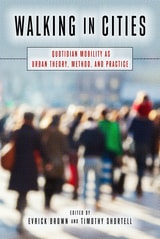
Walking in Cities
Quotidian Mobility as Urban Theory, Method, and PracticeEvrick Brown
Temple University Press, 2015
Walking connects the rhythms of urban life to the configuration of urban spaces. As the contributors and editors show in Walking in Cities, walking also reflects the systematic inequalities that order contemporary urban life. Walking has different meanings because it can be a way of temporarily “taking possession” of urban space, or it can make the relatively powerless more vulnerable to crime. The essays in Walking in Cities explore how walking intersects with sociological dimensions such as gender, race and ethnicity, social class, and power.
Various chapters explorethe flâneuse, or female urban drifter, in Tehran’s shopping malls; Hispanic neighborhoods in New York, San Diego, and El Paso; and the intra-neighborhood and inter-class dynamics of gentrification in Greenpoint, Brooklyn.The essays in Walking in Cities provide important lessons about urban life.

Waste Works
Vital Politics in Urban GhanaBrenda Chalfin
Duke University Press, 2023

Where Texas Meets the Sea
Corpus Christi and Its HistoryBy Alan Lessoff
University of Texas Press, 2019
A favorite destination of visitors to the Texas coast, Corpus Christi is a midsize city that manages to be both cosmopolitan and provincial, networked and local. It is an indispensable provider of urban services to South Texas, as well as a port of international significance. Its industries and military bases and, increasingly, its coastal research institutes give it a range of connections throughout North America. Despite these advantages, however, Corpus Christi has never made it into the first rank of Texas cities, and a keen self-consciousness about the city’s subordinate position has driven debates over Corpus’s identity and prospects for decades.
In this masterful urban history—a study that will reshape the way that Texans look at all their cities—Alan Lessoff analyzes Corpus Christi’s place within Texas, the American Southwest, the western Gulf of Mexico, and the U.S.-Mexican borderlands from the city’s founding in 1839 to the present. He portrays Corpus as a place where westward Anglo expansion overwhelmed the Hispanic settlement process from the south, leaving a legacy of conflicting historical narratives that colors the city’s character even now. Lessoff also explores how competing visions of the city’s identity and possibilities have played out in arenas ranging from artwork in public places to schemes to embellish, redevelop, or preserve the downtown waterfront and North Padre Island. With a deep understanding of the geographic, historical, economic, and political factors that have formed the city, Lessoff demonstrates that Corpus Christi exemplifies the tensions between regional and cosmopolitan influences that have shaped cities across the Southwest.
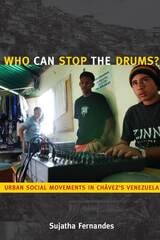
Who Can Stop the Drums?
Urban Social Movements in Chávez's VenezuelaSujatha Fernandes
Duke University Press, 2010
Fernandes portrays everyday life and politics in the shantytowns of Caracas through accounts of community-based radio, barrio assemblies, and popular fiestas, and the many interviews she conducted with activists and government officials. Most of the barrio activists she presents are Chávez supporters. They see the leftist president as someone who understands their precarious lives and has made important changes to the state system to redistribute resources. Yet they must balance receiving state resources, which are necessary to fund their community-based projects, with their desire to retain a sense of agency. Fernandes locates the struggles of the urban poor within Venezuela’s transition from neoliberalism to what she calls “post-neoliberalism.” She contends that in contemporary Venezuela we find a hybrid state; while Chávez is actively challenging neoliberalism, the state remains subject to the constraints and logics of global capital.