Results by title
86 books match the query 'Soul' and 4 start with w
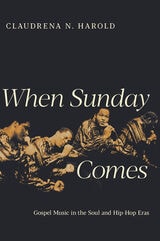
When Sunday Comes
Gospel Music in the Soul and Hip-Hop ErasClaudrena N. Harold
University of Illinois Press, 2020
Weaving insightful analysis into a collective biography of gospel icons, When Sunday Comes explores the music's essential place as an outlet for African Americans to express their spiritual and cultural selves.
Windows into the Soul
Surveillance and Society in an Age of High TechnologyGary T. Marx
University of Chicago Press, 2016
In this landmark book, Marx sums up a lifetime of work on issues of surveillance and social control by disentangling and parsing the empirical richness of watching and being watched. Using fictional narratives as well as the findings of social science, Marx draws on decades of studies of covert policing, computer profiling, location and work monitoring, drug testing, caller identification, and much more, Marx gives us a conceptual language to understand the new realities and his work clearly emphasizes the paradoxes, trade-offs, and confusion enveloping the field. Windows into the Soul shows how surveillance can penetrate our social and personal lives in profound, and sometimes harrowing, ways. Ultimately, Marx argues, recognizing complexity and asking the right questions is essential to bringing light and accountability to the darker, more iniquitous corners of our emerging surveillance society.
For more information, please see www.garymarx.net.
Words Of Gratitude Mind Body & Soul
Robert A. Emmons
Templeton Press, 2001
"The test of all happiness,” said G.K. Chesterton, “is gratitude."
Learning to experience gratitude involves being grateful as an attitude, not as a reaction when good things occur. To be grateful, one does not need to wait until things are perfect. In fact, practicing gratitude makes one receptive to life's blessings, and these blessings continue as we continue to be thankful.
In one study, described by author Robert Emmons, participants who wrote about five things for which they were grateful experienced more positive emotional states and were more likely to help others over a period of ten weeks than were participants who wrote about the hassles and stressors they experienced during the same time.
"Love wholeheartedly,” says Brother David Steindl-Rast, “be surprised, give thanks and praise—then you will discover the fullness of your life."
Gratitude provides gifts to both the giver and the receiver, and this illuminating book will inspire readers to recognize just how truly blessed we are.
Writing the Poetic Soul of Philosophy
Essays in Honor of Michael DavisDenise Schaeffer
St. Augustine's Press, 2017
What is it about the nature of “soul” that makes it so difficult to adequately capture its complexity in a strictly discursive account? Why do some of the most profound human experiences elude our attempts to theorize them? How can a written document do justice to the dynamic activity of thinking, as opposed to merely presenting a collection of thoughts-as-artifacts? Finally, what can we learn about the activity of philosophizing, and about the human soul, by reflecting on the possibilities and limitations of writing?
These concerns, in various forms and in different registers, have preoccupied Michael Davis throughout his distinguished career. This volume is in honor of, and in dialogue with, Davis’s work, which spans ancient philosophy and literature, continental philosophy and political philosophy. It includes original essays by numerous distinguished scholars in the fields of philosophy and political science. The remarkable range and caliber of the contributions attest to the breadth and depth of Davis’s influence.
The essays in Part I of the volume explore the nature of soul through the lens of tragedy. Part II consists of three essays that explore the human longing for perfect knowledge and completion—and the obstacles to the fulfilment of that longing—in relation to the divine. In Part III, the essays address the distinctive challenges of the political sphere and philosophy’s relation to it. And while the relationship between philosophy and poetry is an implicit theme throughout the volume, the essays in Part IV focus directly on philosophy’s aestheticizing tendencies. Many different philosophical and literary works are discussed throughout these chapters, including ancient works such as Plato’s Republic, Euthydemus and Laws, Homer’s Iliad, and Euripides’ Trojan Women, as well as works by modern philosophers such as Rousseau, Kant, Hegel, Kierkegaard and Nietzsche. In addition, three essays analyze some of Shakespeare’s plays in relation to the thought of Plato and Machiavelli. All of the essays are thematically linked by a common thread as they attend to the poetic dimension of philosophical thinking.
Michael Davis is Professor of Philosophy at Sarah Lawrence College, where he has taught since 1977 and has been the Sarah Yates Exley Chair in Teaching Excellence (2003-2005). He has also taught on the graduate faculty at Fordham University and the New School for Social Research. He is the author of numerous articles and books, which include: Ancient Tragedy and the Origins of Modern Science; The Poetry of Philosophy: On Aristotle’s Poetics; The Politics of Philosophy: A Commentary on Aristotle’s Politics; The Autobiography of Philosophy; Rousseau’s The Reveries of the Solitary Walker; Wonderlust: Ruminations on Liberal Education; and The Soul of the Greeks: An Inquiry. He is also co-translator (with Seth Benardete) of Aristotle’s On Poetics.
Contributors include: Abraham Anderson, Jonathan Badger, Robert Berman, Ronna Burger, Kenneth DeLuca, Gwenda-lin Grewal, Scott Hemmenway, Paul Kirkland, Mary Nichols, Denise Schaeffer, Paul Stern, Richard Velkley, Lisa Pace Vetter, Ann Ward, Lee Ward, Catherine Zuckert and Michael Zuckert.
About the Editor: Denise Schaeffer is Professor of Political Science at the College of the Holy Cross. She is the author of Rousseau on Education, Freedom and Judgment and contributing co-editor (with Christopher Dustin) of Socratic Philosophy and Its Others. She is co-editor (with Gregory McBrayer and Mary P. Nichols) of the Focus Philosophical Library edition of Plato’s Euthydemus, for which she authored the Introduction and co-authored the Interpretive Essay.