Results by title
661 books match the query 'South America' and 15 start with w

Wandering Paysanos
State Order and Subaltern Experience in Buenos Aires during the Rosas EraRicardo D. Salvatore
Duke University Press, 2003
Drawing extensively on judicial and military records, Salvatore reveals the state’s files on individual prisoners and recruits to be surprisingly full of personal stories directly solicited from paysanos. While consistently attentive to the fragmented and mediated nature of these archival sources, he chronicles how peons and peasants spoke to power figures—judges, police officers, and military chiefs—about issues central to their lives and to the emerging nation. They described their families and their wanderings across the countryside in search of salaried work, memories and impressions of the civil wars, and involvement with the Federalist armies. Their lamentations about unpaid labor, disrespectful government officials, the meaning of poverty, and the dignity of work provide vital insights into the contested nature of the formation of the Argentine Confederation. Wandering Paysanos discloses a complex world until now obscured—that of rural Argentine subalterns confronting the state.
Wari Imperialism in Middle Horizon Peru
Katharina J. Schreiber with a foreword by Jeffrey R. Parsons
University of Michigan Press, 1992

We Are Important People Now
Kichwa Tourism, Indigeneity, and Masculinity in Ecuador’s AmazonErnesto J. Benitez
University of Alabama Press, 2026
How the “ecoprimitivist” tourism boom of the early 1990s reshaped the lives of young Kichwa men
We Are Important People Now illuminates the trajectories and life experiences of young Napo Kichwa men who have worked as tour guides in the Ecuadorian Upper Amazon, in the wake of the “ecoprimitivist” tourism boom of the early 1990s. Anthropologist Ernesto J. Benitez analyzes the socioeconomic situation of these men and the motivations and desires that drive them to seek service-based employment. Benitez discusses how the tour guides go through complex processes of transition and adjustment navigating tourists’ expectations, familial obligations, and desires for socioeconomic mobility. The opportunities for self-transformation are at once attractive and fraught with contradictions. They now see their indigeneity as an asset, but their urban lifestyles, pursuits of intimate relationships with foreign tourists, and sometimes-dismissive attitudes toward Kichwa people in rural Ecuador distance them socially from the broader Kichwa population.
Importantly, the book interrogates the possibilities and limitations that produce—and are produced by—such emergent forms of identity formation, situating the current period within a broader analysis of the colonial and postcolonial history of the area. It pays special attention to how different processes of interaction with and incorporation into colonial and state productive and biopolitical regimes have impacted the historical production and performance of Kichwa ethnic and gendered identities in the Upper Amazon region. A wide swath of anthropologists, Latin Americanists, and gender and Indigenous studies specialists will be edified by this timely and accessible narrative.
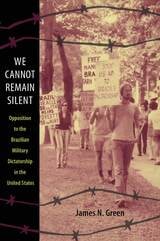
We Cannot Remain Silent
Opposition to the Brazilian Military Dictatorship in the United StatesJames N. Green
Duke University Press, 2010
Green interviewed many of the activists who educated journalists, government officials, and the public about the abuses taking place under the Brazilian dictatorship. Drawing on those interviews and archival research from Brazil and the United States, he describes the creation of a network of activists with international connections, the documentation of systematic torture and repression, and the cultivation of Congressional allies and the press. Those efforts helped to expose the terror of the dictatorship and undermine U.S. support for the regime. Against the background of the political and social changes of the 1960s and 1970s, Green tells the story of a decentralized, international grassroots movement that effectively challenged U.S. foreign policy.
When Rains Became Floods
A Child Soldier's StoryLurgio Gavilán Sánchez
Duke University Press, 2015
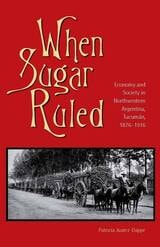
When Sugar Ruled
Economy and Society in Northwestern Argentina, Tucumán, 1876–1916Patricia Juarez-Dappe
Ohio University Press, 2010
Two tropical commodities—coffee and sugar—dominated Latin American export economies in the nineteenth and early twentieth centuries. When Sugar Ruled: Economy and Society in Northwestern Argentina, Tucumán, 1876–1916 presents a distinctive case that does not quite fit into the pattern of many Latin American sugar economies.
During the last quarter of the nineteenth century, the province of Tucumán emerged as Argentina’s main sugar producer, its industry catering almost exclusively to the needs of the national market and financed mostly by domestic capital. The expansion of the sugar industry provoked profound changes in Tucumán’s economy as sugar specialization replaced the province’s diversified productive structure. Since ingenios relied on outside growers for the supply of a large share of the sugarcane, sugar production did not produce massive land dispossession and resulted in the emergence of a heterogeneous planter group. The arrival of thousands of workers from neighboring provinces during the harvest season transformed rural society dramatically. As the most dynamic sector in Tucumán’s economy, revenues from sugar enabled the provincial government to participate in the modernizing movement sweeping turn-of-the-century Argentina.
Patricia Juarez-Dappe uncovers the unique features that characterized sugar production in Tucumán as well as the changes experienced by the province’s economy and society between 1876 and 1916, the period of most dramatic sugar expansion. When Sugar Ruled is an important addition to the literature on sugar economies in Latin America and Argentina.
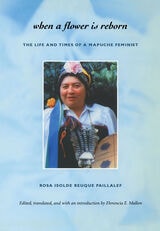
When a Flower Is Reborn
The Life and Times of a Mapuche FeministRosa Isolde Reuque Paillalef, Edited, translated, and with an introduction by Florencia E. Mallon
Duke University Press, 2002
A leading activist during the Pinochet dictatorship, Reuque—a woman, a Catholic, and a Christian Democrat—often felt like an outsider within the male-dominated, leftist Mapuche movement. This sense of herself as both participant and observer allows for Reuque’s trenchant, yet empathetic, critique of the Mapuche ethnic movement and of the policies regarding indigenous people implemented by Chile’s post-authoritarian government. After the 1990 transition to democratic rule, Reuque collaborated with the government in the creation of the Indigenous Development Corporation (CONADI) and the passage of the Indigenous Law of 1993. At the same time, her deepening critiques of sexism in Chilean society in general, and the Mapuche movement in particular, inspired her to found the first Mapuche feminist organization and participate in the 1996 International Women’s Conference in Beijing. Critical of the democratic government’s inability to effectively address indigenous demands, Reuque reflects on the history of Mapuche activism, including its disarray in the early 1990s and resurgence toward the end of the decade, and relates her hopes for the future.
An important reinvention of the testimonial genre for Latin America’s post-authoritarian, post-revolutionary era, When a Flower Is Reborn will appeal to those interested in Latin America, race and ethnicity, indigenous people’s movements, women and gender, and oral history and ethnography.
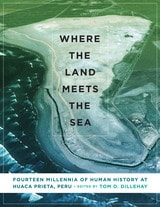
Where the Land Meets the Sea
Fourteen Millennia of Human History at Huaca Prieta, PeruEdited by Tom D. Dillehay
University of Texas Press, 2017
Huaca Prieta—one the world’s best-known, yet least understood, early maritime mound sites—and other Preceramic sites on the north coast of Peru bear witness to the beginnings of civilization in the Americas. Across more than fourteen millennia of human occupation, the coalescence of maritime, agricultural, and pastoral economies in the north coast settlements set in motion long-term biological and cultural transformations that led to increased social complexity and food production, and later the emergence of preindustrial states and urbanism. These developments make Huaca Prieta a site of global importance in world archaeology.
This landmark volume presents the findings of a major archaeological investigation carried out at Huaca Prieta, the nearby mound Paredones, and several Preceramic domestic sites in the lower Chicama Valley between 2006 and 2013 by an interdisciplinary team of more than fifty international specialists. The book’s contributors report on and analyze the extensive material records from the sites, including data on the architecture and spatial patterns; floral, faunal, and lithic remains; textiles; basketry; and more. Using this rich data, they build new models of the social, economic, and ontological practices of these early peoples, who appear to have favored cooperation and living in harmony with the environment over the accumulation of power and the development of ruling elites. This discovery adds a crucial new dimension to our understanding of emergent social complexity, cosmology, and religion in the Neolithic period.

White Waters and Black
Gordon MacCreagh
University of Chicago Press, 2001

Whose National Music?
Identity, Mestizaje, and Migration in EcuadorKetty Wong
Temple University Press, 2012
Musical genres, musical instruments, and even songs can often capture the essence of a country's national character. In Whose National Music?, the first book-length study of Ecuadorian popular music, Ketty Wong explores Ecuadorians' views of their national identity in the twentieth and early twenty-first centuries through an examination of the music labels they use. Wong deftly addresses the notion of música nacional, an umbrella term for Ecuadorian popular songs often defined by the socio-economic, ethnic, racial, and generational background of people discussing the music.
Wong shows how the inclusion or exclusion of elite and working-class musics within the scope of música nacional articulate different social, ethnic, and racial configurations of the nation for white, mestizo, indigenous, and Afro-Ecuadorian populations.
Presenting a macropicture of what música nacional is—or should be—Whose National Music? provides a lively historical trajectory of a country's diverse musical scene.
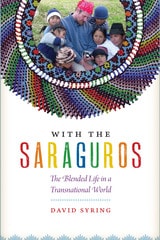
With the Saraguros
The Blended Life in a Transnational WorldBy David Syring
University of Texas Press, 2014
Highlighting globalization’s effects on humanity through the lens of Ecuador’s indigenous Saraguro people, With the Saraguros marks a compelling departure from conventional approaches to ethnography. While documenting and exploring the social patterns among the Saraguro, with an emphasis on the role of women beadworkers, David Syring blends storytelling, dialogue, poetry, and memoir to describe his own realm as a fieldworker in anthropology. As he considers the influence of women’s labor in a community in which the artistry of beadwork is richly symbolic, he also considers how the Saraguro view their observers—the anthropologists.
Probing the role of researchers in a time when basic humanistic questions now often reflect a critical balance between commerce and sustainability, With the Saraguros asks, “What does it mean to live ‘the good life’ in different cultural contexts, and how does our work life relate to this pursuit?” For those who have chosen a work life of anthropology, Syring captures the impact of fieldwork—which uproots the researcher from his or her daily routine—and its potential to deliver new levels of consciousness. The result constitutes more than just the first English-language book dedicated to the dynamic creativity of the Saraguro, contextualized by their social and political history; Syring’s work, which ranges from the ecological imagination to the metaphors of trade, is also a profound meditation on the ways we experience boundaries now that borders no longer create sharply drawn divides between cultural worlds, and “distant” no longer means “separate.”
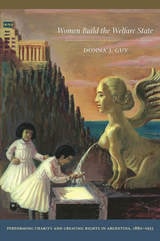
Women Build the Welfare State
Performing Charity and Creating Rights in Argentina, 1880–1955Donna J. Guy
Duke University Press, 2009
Drawing on extensive research in Argentine archives, Guy reveals significant continuities in Argentine history, including the rise of a liberal state that subsidized all kinds of women’s and religious groups. State and private welfare efforts became more organized in the 1930s and reached a pinnacle under Juan Perón, when men took over the welfare state and philanthropic and feminist women’s influence on child-welfare activities and policy declined. Comparing the rise of Argentina’s welfare state with the development of others around the world, Guy considers both why women’s child-welfare initiatives have not received more attention in historical accounts and whether the welfare state emerges from the top down or from the bottom up.
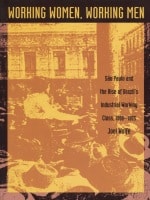
Working Women, Working Men
Sao Paulo & the Rise of Brazil’s Industrial Working Class, 1900–1955Joel Wolfe
Duke University Press, 1993
Drawing on a diverse range of sources—oral histories along with union, industry, and government archival materials—Wolfe's account focuses not only on labor leaders and formal Left groups, but considers the impact of grassroots workers' movements as well. He pays particular attention to the role of gender in the often-contested relations between leadership groups and thee rank and file. Wolfe's analysis illuminates how various class and gender ideologies influenced the development of unions, industrialists' strategies, and rank-and-file organizing and protest activities.
This study reveals how workers in Sào Paulo maintained a local grassroots social movement that, by the mid–1950s, succeeded in seizing control of Brazil's state-run official unions. By examining the actions of these workers in their rise to political prominence in the 1940s and 1950s, this book provides a new understanding of the sources and development of populist politics in Brazil.
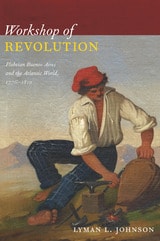
Workshop of Revolution
Plebeian Buenos Aires and the Atlantic World, 1776–1810Lyman L. Johnson
Duke University Press, 2011

World Film Locations
São PauloEdited by Natália Pinazza and Louis Bayman
Intellect Books, 2013