Results by title
73 books match the query 'Style' and 3 start with w
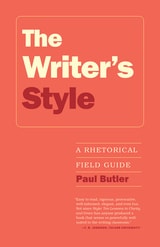
Writer's Style
A Rhetorical Field GuidePaul Butler
Utah State University Press, 2018
Designed to help all writers learn to use style as a rhetorical tool, taking into account audience, purpose, context, and occasion, The Writer’s Style is not only a style guide for a new generation but a new generation of style guide. The book helps writers learn new strategies inductively, by looking at firsthand examples of how they operate rhetorically, as well as deductively, through careful explanations in the text. The work focuses on invention, allowing writers to develop their own style as they analyze writing from varied genres.
In a departure from the deficiency model associated with other commonly used style guides, author Paul Butler encourages writers to see style as a malleable device to use for their own purposes, rather than a domain of rules or privilege. He encourages writing instructors to present style as a practical, accessible, and rhetorical tool, working with models that connect to a broad range of writing situations—including traditional texts like essays, newspaper articles, and creative nonfiction as well as digital texts in the form of tweets, Facebook postings, texts, email, visual rhetoric, YouTube, and others.
Though designed for use in first-year composition courses in which students are learning to write for various audiences, purposes, and contexts, The Writer’s Style is a richly layered work that will serve anyone considering how style applies to their professional, personal, creative, or academic writing.
[more]
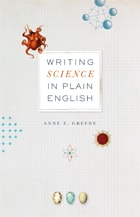
Writing Science in Plain English
Anne E. Greene
University of Chicago Press, 2013
Scientific writing is often dry, wordy, and difficult to understand. But, as Anne E. Greene shows in Writing Science in Plain English,writers from all scientific disciplines can learn to produce clear, concise prose by mastering just a few simple principles.
This short, focused guide presents a dozen such principles based on what readers need in order to understand complex information, including concrete subjects, strong verbs, consistent terms, and organized paragraphs. The author, a biologist and an experienced teacher of scientific writing, illustrates each principle with real-life examples of both good and bad writing and shows how to revise bad writing to make it clearer and more concise. She ends each chapter with practice exercises so that readers can come away with new writing skills after just one sitting.
Writing Science in Plain English can help writers at all levels of their academic and professional careers—undergraduate students working on research reports, established scientists writing articles and grant proposals, or agency employees working to follow the Plain Writing Act. This essential resource is the perfect companion for all who seek to write science effectively.
[more]
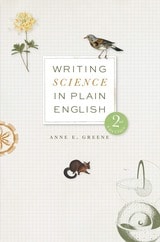
Writing Science in Plain English, Second Edition
Anne E. Greene
University of Chicago Press, 2025
An updated edition of the essential guide for all scientists—from undergraduates to senior scholars—who want to produce prose that anyone can understand.
Scientific writing is often dry, wordy, and difficult to understand. But, as biologist and experienced teacher of scientific writing Anne E. Greene shows in Writing Science in Plain English, writers from all scientific disciplines can learn to produce clear, concise prose by mastering just a few simple principles. This short, focused guide presents roughly a dozen such principles based on what readers need to understand complex information, including concrete subjects, strong verbs, consistent terms, organized paragraphs, and correct sentence structure. Greene illustrates each principle with real-life examples of both good and bad writing and shows how bad writing might be improved. She ends each chapter with revision exercises (and provides suggested answers in a separate key) so that readers can come away with new writing skills after just one sitting. To help readers understand the grammatical terms used in the book, an appendix offers a refresher course on basic grammar.
For this second edition, Greene has incorporated the latest research on what makes writing effective and engaging and has revised or replaced exercises and exercise keys where needed. She has also added new features that make it easier to navigate the book. A new resource for instructors who use Writing Science in Plain English in their classes is a free, online teacher’s guide. Drawn from Greene’s long experience teaching students how to write science clearly, the teacher’s guide provides additional lectures, assignments, and activities that will inform and enliven any class.
[more]