Results by title
62 books match the query 'Teenagers' and 3 start with w

We Boys Together
Teenagers in Love Before Girl-CrazinessJeffery P. Dennis
Vanderbilt University Press, 2007
This book explores romantic relationships between teenage boys as they were portrayed before, during, and immediately after World War II. The author takes the reader through a rich landscape of media -- sci fi pulps, comics, adventure stories, tales of teen sleuths, boys' serial novels, wartime bestsellers, and movies populated by many types of male adolescents: Boys Next Door, Adventure Boys, Jungle Boys, and Lost Boys. In Hollywood movies, Boys Next Door like Jackie Cooper, Ronald Sinclair, and Jimmy Lydon were constantly falling in love, but not with girls. In serial novels, Jungle Boys like Bomba, Sorak, and Og Son of Fire swung through the trees to rescue teenage boys, not teenage girls. In comic strips and on the radio, Adventure Boys like Don Study, Jack Armstrong, and Tim Tyler formed lasting romantic partnerships with other boys or men. Lost Boys like Frankie Darro, Leo Gorcey, and Billy Halop starred in dozens of movies about pairs of poor urban teenagers sticking together, with never a girl in sight.
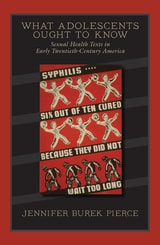
What Adolescents Ought to Know
Sexual Health Texts in Early Twentieth-Century AmericaJennifer Burek Pierce
University of Massachusetts Press, 2011
In 1901, Dr. Alfred Fournier committed an act both simple and revolutionary: he wrote ForOur Sons, When They Turn 18, a sexual and reproductive health treatise based on his clinical work at a leading Paris hospital. If this booklet aided adolescent understanding of health, it also encouraged reformers around the world to publish. By 1913, countless works on venereal disease prevention were available to adolescents.
During this period, authors wrestled with how to make still-developing scientific information available to a reader also in the process of maturing. What would convince a young person to avoid acting on desire? What norms should be employed in these arguments, when social and legal precedents warned against committing ideas about sex to print? How, in other words, could information about sex be made both decent and compelling? Health reformers struggled with these challenges as doctors' ability to diagnose diseases such as syphilis outpaced the production of medicines that could restore health. In this context, information represented the best and truest prophylactic. When publications were successful, from the perspective of information dissemination, they were translated and distributed worldwide.
What Adolescents Ought to Know explores the evolution of these printed materials—from a single tract, written by a medical researcher and given free to anyone, to a thriving commercial enterprise. It tells the story of how sex education moved from private conversation to purchased text in early twentieth-century America.
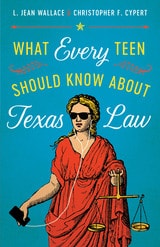
What Every Teen Should Know about Texas Law
By L. Jean Wallace and Christopher F. Cypert
University of Texas Press, 2018
From reviews of earlier editions:
“Young people get into legal trouble for two reasons: they do not know what the law is, and they do not stop to think about the consequences of their actions. This book would make a good text for a preparation for life class. . . . The book is written in plain language, unencumbered by a lot of legal citations, and with no expectation that the reader will have any working knowledge of the law.”
—Texas Bar Journal
“A book any parent should consider giving their child. . . . But before you do, take a look at it yourself. No matter the title, Wallace’s book . . . contains information everyone . . . should know.”
—Austin American-Statesman
What Every Teen Should Know about Texas Law is the only single-source guide for accurate, easy-to-understand information about most areas of civil law in Texas. L. Jean Wallace drew on years of experience as a students’ attorney at Texas Tech University to inform young adults about the areas of law that affect them most: driving and car ownership, pranks and crimes (including alcohol and drug offenses), personal relationships, employment and consumer concerns, and living on their own. She illustrated her points with true, sometimes humorous, stories of young adults’ encounters with the law.
For this new edition, municipal judge Christopher F. Cypert has completely updated the book to reflect the current state of the law. He covers specific topics that are now mandated to be taught in schools, including the proper way to interact with peace officers during traffic stops and other in-person encounters, as well as internet-era misbehaviors such as sexting and cyberbullying. Like Wallace, Cypert has helped many young people navigate the sometimes confusing processes of the legal world, often loaning earlier editions of this book to young offenders in his court. Both authors’ real-world experience and legal expertise ensure that What Every Teen Should Know about Texas Law is indeed a complete and practical guide for assuming the responsibilities of adulthood—as well as a good refresher course for all legal-age Texans.