Results by title
333 books match the query 'Television' and 19 start with w
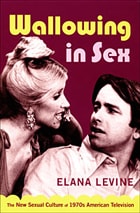
Wallowing in Sex
The New Sexual Culture of 1970s American TelevisionElana Levine
Duke University Press, 2007
Wallowing in Sex is a lively analysis of the key role of commercial television in the new sexual culture of the 1970s. Elana Levine explores sex-themed made-for-TV movies; female sex symbols such as the stars of Charlie’s Angels and Wonder Woman; the innuendo-driven humor of variety shows (The Sonny and Cher Comedy Hour, Laugh-In), sitcoms (M*A*S*H, Three’s Company), and game shows (Match Game); and the proliferation of rape plots in daytime soap operas. She also uncovers those sexual topics that were barred from the airwaves. Along with program content, Levine examines the economic motivations of the television industry, the television production process, regulation by the government and the tv industry, and audience responses. She demonstrates that the new sexual culture of 1970s television was a product of negotiation between producers, executives, advertisers, censors, audiences, performers, activists, and many others. Ultimately, 1970s television legitimized some of the sexual revolution’s most significant gains while minimizing its more radical impulses.
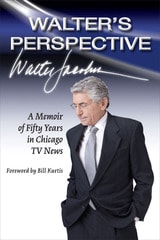
Walter's Perspective
A Memoir of Fifty Years in Chicago TV NewsWalter Jacobson, Foreword by Bill Kurtis
Southern Illinois University Press, 2012
This highly readable book provides a unique glimpse into the rough-and-tumble Chicago news business as seen through the eyes of one of its legendary players. From his first news job working as a legman for Daily News columnist Jack Mabley in the 1950s to his later role as a news anchor and political commentator at CBS-owned WBBM, Walter Jacobson battled along the front lines of an industry undergoing dramatic changes. While it is ultimately Jacobson’s story, a memoir of a long and distinguished (and sometimes highly controversial) career, it is also an insider’s account of the inner workings of Chicago television news, including the ratings games, the process of defining news and choosing stories, the media’s power and its failures, and the meddling by corporate and network executives.
As a reporter, Jacobson was regularly contentious and confrontational. He was fired on a number of occasions and was convicted of libeling tobacco company Brown and Williamson, resulting in a multimillion-dollar federal court judgment against him and CBS. Yet it was this gutsy attitude that put him at the top of the news game. With an engaging writing style, Jacobson recollects his interactions with Chicago mayors Richard J. and Richard M. Daley, Jane Byrne, Harold Washington, and Rahm Emanuel; recounts his coverage of such fascinating news stories as the violent 1968 Democratic National Convention and the execution of convicted mass murderer John Wayne Gacy; and recalls his reporting on and interviews with Louis Farrakhan, governors George Ryan and Rod Blagojevich, and Barack Obama. More than a memoir, Walter’s Perspective is the extraordinary journey of one reporter whose distinctive career followed the changing face of Chicago’s local news.
Watching Jim Crow
The Struggles over Mississippi TV, 1955–1969Steven D. Classen
Duke University Press, 2004
During the 1990s, Classen conducted extensive interviews with more than two dozen African Americans living in Jackson, several of whom, decades earlier, had fought to integrate television programming. He draws on these interviews not only to illuminate their perceptions—of the civil rights movement, what they accomplished, and the present as compared with the past—but also to reveal the inadequate representation of their viewpoints in the legal proceedings surrounding WLBT’s licensing. The story told in Watching Jim Crow has significant implications today, not least because the Telecommunications Act of 1996 effectively undid many of the hard-won reforms achieved by activists—including those whose stories Classen relates here.
Watching Our Weights
The Contradictions of Televising Fatness in the “Obesity Epidemic”Zimdars, Melissa
Rutgers University Press, 2019
Watching Our Weights explores the competing and contradictory fat representations on television that are related to weight-loss and health, medicalization and disease, and body positivity and fat acceptance. While television—especially reality television—is typically understood to promote individual self-discipline and expert interventions as necessary for transforming fat bodies into thin bodies, fat representations and narratives on television also create space for alternative as well as resistant discourses of the body. Melissa Zimdars thus examines the resistance inherent within TV representations and narratives of fatness as a global health issue, the inherent and overt resistance found across stories of medicalized fatness, and programs that actively avoid dieting narratives in favor of less oppressive ways of thinking about the fat body. Watching Our Weights weaves together analyses of media industry lore and decisions, communication and health policies, medical research, activist projects, popular culture, and media texts to establish both how television shapes our knowledge of fatness and how fatness helps us better understand contemporary television.
Watching Race
Television and the Struggle for BlacknessHerman Gray
University of Minnesota Press, 1997
Watching Television Come of Age
The New York Times Reviews by Jack GouldEdited by Lewis L. Gould
University of Texas Press, 2002
Providing video companionship for isolated housewives, afternoon babysitting for children, and nonstop evening entertainment for the whole family, television revolutionized American society in the post-World War II years. Helping the first TV generation make sense of the new medium was the mission of Jack Gould, television critic of The New York Times from 1947 to 1972. In columns noteworthy for crisp writing, pointed insights, and fair judgment, he highlighted both the untapped possibilities and the imminent perils of television, becoming "the conscience of the industry" for many people.
In this book, historian Lewis L. Gould, Jack Gould's son, collects over seventy of his father's best columns. Grouped topically, they cover a wide range of issues, including the Golden Age of television drama, McCarthy-era blacklisting, the rise and fall of Edward R. Murrow, quiz show scandals, children's programming, and the impact of television on American life and of television criticism on the medium itself. Lewis Gould also supplies a brief biography of his father that assesses his influence on the evolution of television, as well as prefaces to each section.
Watching While Black Rebooted!
The Television and Digitality of Black AudiencesBeretta E. Smith-Shomade
Rutgers University Press, 2024
Chapters rethink such historically significant programs as Roots and Underground, such seemingly innocuous programs as Soul Food, and such contemporary and culturally complicated programs as Being Mary Jane and Atlanta. The book makes a case for the centrality of these programs while always recognizing the racial dynamics that continue to shape Black representation on the small screen. Painting a decidedly introspective portrait across forty years of Black television, Watching While Black Rebooted sheds much-needed light on under examined demographics, broadens common audience considerations, and gives deference to the preferences of audiences and producers of Black-targeted programming.
Watching While Black
Centering the Television of Black AudiencesSmith-Shomade, Beretta E
Rutgers University Press, 2013
2013 Choice Outstanding Academic Title
Television scholarship has substantially ignored programming aimed at Black audiences despite a few sweeping histories and critiques. In this volume, the first of its kind, contributors examine the televisual diversity, complexity, and cultural imperatives manifest in programming directed at a Black and marginalized audience.
Watching While Black considers its subject from an entirely new angle in an attempt to understand the lives, motivations, distinctions, kindred lines, and individuality of various Black groups and suggest what television might be like if such diversity permeated beyond specialized enclaves. It looks at the macro structures of ownership, producing, casting, and advertising that all inform production, and then delves into television programming crafted to appeal to black audiences—historic and contemporary, domestic and worldwide.
Chapters rethink such historically significant programs as Roots and Black Journal, such seemingly innocuous programs as Fat Albert and bro’Town, and such contemporary and culturally complicated programs as Noah’s Arc, Treme, and The Boondocks. The book makes a case for the centrality of these programs while always recognizing the racial dynamics that continue to shape Black representation on the small screen. Painting a decidedly introspective portrait across forty years of Black television, Watching While Black sheds much-needed light on under-examined demographics, broadens common audience considerations, and gives deference to the the preferences of audiences and producers of Black-targeted programming.
Watching Wildlife
Cynthia Chris
University of Minnesota Press, 2006
Watching Women's Liberation, 1970
Feminism's Pivotal Year on the Network NewsBonnie J. Dow
University of Illinois Press, 2014
In Watching Women's Liberation, 1970: Feminism's Pivotal Year on the Network News, Bonnie J. Dow uses case studies of key media events to delve into the ways national TV news mediated the emergence of feminism's second wave. First legitimized as a big story by print media, the feminist movement gained broadcast attention as the networks’ eagerness to get in on the action was accompanied by feminists’ efforts to use national media for their own purposes. Dow chronicles the conditions that precipitated feminism's new visibility and analyzes the verbal and visual strategies of broadcast news discourses that tried to make sense of the movement.
Groundbreaking and packed with detail, Watching Women's Liberation, 1970 shows how feminism went mainstream--and what it gained and lost on the way.
Wayang and Its Doubles
Javanese Puppet Theatre, Television and the InternetJan Mrázek
National University of Singapore Press, 2019
This book explores the ways two complex forms of media coexist and meet as well as haunt and invade each other. It looks at performance aesthetics and the technicalities of television production, as well as issues of time, space, light, place, and movement. It compares audience experiences of live and televised performances, and highlights the collaboration and struggle between performers and television producers. Interviews with performers from both sides are brought into a larger conversation on media and technology, one that includes ideas from Karl Marx, Martin Heidegger, Maurice Merleau-Ponty, Jacques Derrida, Paul Virilio, and James Siegel. The book also looks ahead to new formats that have the potential to disrupt in ways never imagined: the worlds of streaming and social media.
Welcome to the Dreamhouse
Popular Media and Postwar SuburbsLynn Spigel
Duke University Press, 2001
The volume considers not only how the media portrayed suburban family life, but also how both middle-class ideals and a perceived division between private and public worlds helped to shape the visual forms, storytelling practices, and reception of postwar media and consumer culture. Spigel also explores those aspects of suburban culture that media typically render invisible. She looks at the often unspoken assumptions about class, nation, ethnicity, race, and sexual orientation that underscored both media images (like those of 1960s space missions) and social policies of the mass-produced suburb. Issues of memory and nostalgia are central in the final section as Spigel considers how contemporary girls use television reruns as a source for women’s history and then analyzes the current nostalgia for baby boom era family ideals that runs through contemporary images of new household media technologies.
Containing some of Spigel’s well-known essays on television’s cultural history as well as new essays on a range of topics dealing with popular visual culture, Welcome to the Dreamhouse is important reading for students and scholars of media and communications studies, popular culture, American studies, women’s studies, and sociology.
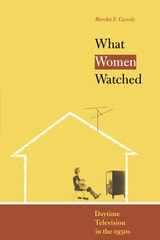
What Women Watched
Daytime Television in the 1950sBy Marsha F. Cassidy
University of Texas Press, 2005
In this pathfinding book, based on original archival research, Marsha F. Cassidy offers the first thorough analysis of daytime television's earliest and most significant women's genres, appraising from a feminist perspective what women watched before soap opera rose to prominence.
After providing a comprehensive history of the early days of women's programming across the nation, Cassidy offers a critical discussion of the formats, programs, and celebrities that launched daytime TV in America—Kate Smith's variety show and the famed singer's unsuccessful transition from patriotic radio star to 1950s TV idol; the "charm boys" Garry Moore, Arthur Godfrey, and Art Linkletter, whose programs honored women's participation but in the process established the dominance of male hosts on TV; and the "misery shows" Strike It Rich and Glamour Girl and the controversy, both critical and legal, they stirred up.
Cassidy then turns to NBC's Home show, starring the urbane Arlene Francis, who infused the homemaking format with Manhattan sophistication, and the ambitious daily anthology drama Matinee Theater, which strove to differentiate itself from soap opera and become a national theater of the air. She concludes with an analysis of four popular audience participation shows of the era—the runaway hit Queen for a Day; Ralph Edwards's daytime show of surprises, It Could Be You; Who Do You Trust?, starring a youthful Johnny Carson; and The Big Payoff, featuring Bess Myerson, the country's first Jewish Miss America. Cassidy's close feminist reading of these shows clearly demonstrates how daytime TV mirrored the cultural pressures, inconsistencies, and ambiguities of the postwar era.
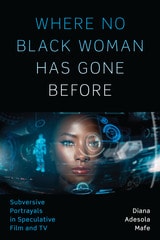
Where No Black Woman Has Gone Before
Subversive Portrayals in Speculative Film and TVBy Diana Adesola Mafe
University of Texas Press, 2018
When Lieutenant Uhura took her place on the bridge of the Starship Enterprise on Star Trek, the actress Nichelle Nichols went where no African American woman had ever gone before. Yet several decades passed before many other black women began playing significant roles in speculative (i.e., science fiction, fantasy, and horror) film and television—a troubling omission, given that these genres offer significant opportunities for reinventing social constructs such as race, gender, and class. Challenging cinema’s history of stereotyping or erasing black women on-screen, Where No Black Woman Has Gone Before showcases twenty-first-century examples that portray them as central figures of action and agency.
Writing for fans as well as scholars, Diana Adesola Mafe looks at representations of black womanhood and girlhood in American and British speculative film and television, including 28 Days Later, AVP: Alien vs. Predator, Children of Men, Beasts of the Southern Wild, Firefly, and Doctor Who: Series 3. Each of these has a subversive black female character in its main cast, and Mafe draws on critical race, postcolonial, and gender theories to explore each film and show, placing the black female characters at the center of the analysis and demonstrating their agency. The first full study of black female characters in speculative film and television, Where No Black Woman Has Gone Before shows why heroines such as Lex in AVP and Zoë in Firefly are inspiring a generation of fans, just as Uhura did.
Who Got the Camera?
A History of Rap and RealityEric Harvey
University of Texas Press, 2021
Reality first appeared in the late 1980s—in the sense not of real life but rather of the TV entertainment genre inaugurated by shows such as Cops and America’s Most Wanted; the daytime gabfests of Geraldo, Oprah, and Donahue; and the tabloid news of A Current Affair. In a bracing work of cultural criticism, Eric Harvey argues that reality TV emerged in dialog with another kind of entertainment that served as its foil while borrowing its techniques: gangsta rap. Or, as legendary performers Ice Cube and Ice-T called it, “reality rap.”
Reality rap and reality TV were components of a cultural revolution that redefined popular entertainment as a truth-telling medium. Reality entertainment borrowed journalistic tropes but was undiluted by the caveats and context that journalism demanded. While N.W.A.’s “Fuck tha Police” countered Cops’ vision of Black lives in America, the reality rappers who emerged in that group’s wake, such as Snoop Doggy Dogg and Tupac Shakur, embraced reality’s visceral tabloid sensationalism, using the media's obsession with Black criminality to collapse the distinction between image and truth. Reality TV and reality rap nurtured the world we live in now, where politics and basic facts don’t feel real until they have been translated into mass-mediated entertainment.
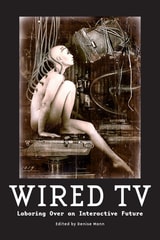
Wired TV
Laboring Over an Interactive FutureMann, Denise
Rutgers University Press, 2014
This collection looks at the post–network television industry’s heady experiments with new forms of interactive storytelling—or wired TV—that took place from 2005 to 2010 as the networks responded to the introduction of broadband into the majority of homes and the proliferation of popular, participatory Web 2.0 companies like Facebook, YouTube, and Twitter.
Contributors address a wide range of issues, from the networks’ sporadic efforts to engage fans using transmedia storytelling to the production inefficiencies that continue to dog network television to the impact of multimedia convergence and multinational, corporate conglomeration on entrepreneurial creativity. With essays from such top scholars as Henry Jenkins, John T. Caldwell, and Jonathan Gray and from new and exciting voices emerging in this field, Wired TV elucidates the myriad new digital threats and the equal number of digital opportunities that have become part and parcel of today’s post-network era. Readers will quickly recognize the familiar television franchises on which the contributors focus— including Lost, The Office, Entourage, Battlestar Gallactica, The L Word, and Heroes—in order to reveal their impact on an industry in transition.
While it is not easy for vast bureaucracies to change course, executives from key network divisions engaged in an unprecedented period of innovation and collaboration with four important groups: members of the Hollywood creative community who wanted to expand television’s storytelling worlds and marketing capabilities by incorporating social media; members of the Silicon Valley tech community who were keen to rethink television distribution for the digital era; members of the Madison Avenue advertising community who were eager to rethink ad-supported content; and fans who were enthusiastic and willing to use social media story extensions to proselytize on behalf of a favorite network series.
In the aftermath of the lengthy Writers Guild of America strike of 2007/2008, the networks clamped down on such collaborations and began to reclaim control over their operations, locking themselves back into an aging system of interconnected bureaucracies, entrenched hierarchies, and traditional partners from the past. What’s next for the future of the television industry? Stay tuned—or at least online.
Contributors: Vincent Brook, Will Brooker, John T. Caldwell, M. J. Clarke, Jonathan Gray, Henry Jenkins, Derek Johnson, Robert V. Kozinets, Denise Mann, Katynka Z. Martínez, and Julie Levin Russo
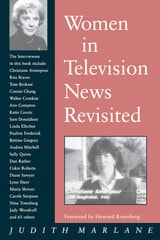
Women in Television News Revisited
Into the Twenty-first CenturyBy Judith Marlane
University of Texas Press, 1999
Women in television news have made great strides in the past twenty-five years. No longer limited to being the token pretty face on the nightly newscast, women have taken their places as working journalists in newsrooms, on the campaign trail, in war zones, and in the highest echelons of network news management. Barbara Walters and Connie Chung have even occupied the coveted network anchor's chair, if only briefly.
In this book, 70 of the foremost women in television news reflect on their professional successes, the personal and professional sacrifices that often bought those successes, and the barriers that still confront women in the news business. Weaving their interviews into a compelling text, Judith Marlane covers a wide range of issues, including looks versus ability and experience, sexual harassment, the resistance to women news anchors, the difficulties of balancing work and family life, women's and men's salaries, and the willingness of women to help other women in the business.
This book builds from Marlane's 1976 work, Women in Television News. Interviews with many of the same women highlight the gains that women have made in broadcast journalism. Simultaneously, Marlane has expanded her range of informants to include fifteen of America's most famous male anchors and correspondents to gather their assessments of the role of women in broadcasting today.
Writings on Media
History of the PresentStuart Hall
Duke University Press, 2021

Wuthering Heights on Film and Television
A Journey Across Time and CulturesValérie V. Hazette
Intellect Books, 2015