Results by title
85 books match the query 'Television broadcasting' and 6 start with w
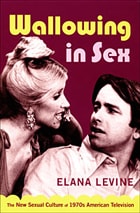
Wallowing in Sex
The New Sexual Culture of 1970s American TelevisionElana Levine
Duke University Press, 2007
Wallowing in Sex is a lively analysis of the key role of commercial television in the new sexual culture of the 1970s. Elana Levine explores sex-themed made-for-TV movies; female sex symbols such as the stars of Charlie’s Angels and Wonder Woman; the innuendo-driven humor of variety shows (The Sonny and Cher Comedy Hour, Laugh-In), sitcoms (M*A*S*H, Three’s Company), and game shows (Match Game); and the proliferation of rape plots in daytime soap operas. She also uncovers those sexual topics that were barred from the airwaves. Along with program content, Levine examines the economic motivations of the television industry, the television production process, regulation by the government and the tv industry, and audience responses. She demonstrates that the new sexual culture of 1970s television was a product of negotiation between producers, executives, advertisers, censors, audiences, performers, activists, and many others. Ultimately, 1970s television legitimized some of the sexual revolution’s most significant gains while minimizing its more radical impulses.
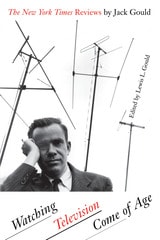
Watching Television Come of Age
The New York Times Reviews by Jack GouldEdited by Lewis L. Gould
University of Texas Press, 2002
Providing video companionship for isolated housewives, afternoon babysitting for children, and nonstop evening entertainment for the whole family, television revolutionized American society in the post-World War II years. Helping the first TV generation make sense of the new medium was the mission of Jack Gould, television critic of The New York Times from 1947 to 1972. In columns noteworthy for crisp writing, pointed insights, and fair judgment, he highlighted both the untapped possibilities and the imminent perils of television, becoming "the conscience of the industry" for many people.
In this book, historian Lewis L. Gould, Jack Gould's son, collects over seventy of his father's best columns. Grouped topically, they cover a wide range of issues, including the Golden Age of television drama, McCarthy-era blacklisting, the rise and fall of Edward R. Murrow, quiz show scandals, children's programming, and the impact of television on American life and of television criticism on the medium itself. Lewis Gould also supplies a brief biography of his father that assesses his influence on the evolution of television, as well as prefaces to each section.
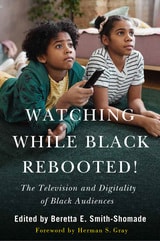
Watching While Black Rebooted!
The Television and Digitality of Black AudiencesBeretta E. Smith-Shomade
Rutgers University Press, 2024
Chapters rethink such historically significant programs as Roots and Underground, such seemingly innocuous programs as Soul Food, and such contemporary and culturally complicated programs as Being Mary Jane and Atlanta. The book makes a case for the centrality of these programs while always recognizing the racial dynamics that continue to shape Black representation on the small screen. Painting a decidedly introspective portrait across forty years of Black television, Watching While Black Rebooted sheds much-needed light on under examined demographics, broadens common audience considerations, and gives deference to the preferences of audiences and producers of Black-targeted programming.
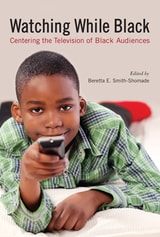
Watching While Black
Centering the Television of Black AudiencesSmith-Shomade, Beretta E
Rutgers University Press, 2013
2013 Choice Outstanding Academic Title
Television scholarship has substantially ignored programming aimed at Black audiences despite a few sweeping histories and critiques. In this volume, the first of its kind, contributors examine the televisual diversity, complexity, and cultural imperatives manifest in programming directed at a Black and marginalized audience.
Watching While Black considers its subject from an entirely new angle in an attempt to understand the lives, motivations, distinctions, kindred lines, and individuality of various Black groups and suggest what television might be like if such diversity permeated beyond specialized enclaves. It looks at the macro structures of ownership, producing, casting, and advertising that all inform production, and then delves into television programming crafted to appeal to black audiences—historic and contemporary, domestic and worldwide.
Chapters rethink such historically significant programs as Roots and Black Journal, such seemingly innocuous programs as Fat Albert and bro’Town, and such contemporary and culturally complicated programs as Noah’s Arc, Treme, and The Boondocks. The book makes a case for the centrality of these programs while always recognizing the racial dynamics that continue to shape Black representation on the small screen. Painting a decidedly introspective portrait across forty years of Black television, Watching While Black sheds much-needed light on under-examined demographics, broadens common audience considerations, and gives deference to the the preferences of audiences and producers of Black-targeted programming.
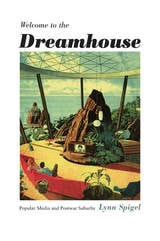
Welcome to the Dreamhouse
Popular Media and Postwar SuburbsLynn Spigel
Duke University Press, 2001
The volume considers not only how the media portrayed suburban family life, but also how both middle-class ideals and a perceived division between private and public worlds helped to shape the visual forms, storytelling practices, and reception of postwar media and consumer culture. Spigel also explores those aspects of suburban culture that media typically render invisible. She looks at the often unspoken assumptions about class, nation, ethnicity, race, and sexual orientation that underscored both media images (like those of 1960s space missions) and social policies of the mass-produced suburb. Issues of memory and nostalgia are central in the final section as Spigel considers how contemporary girls use television reruns as a source for women’s history and then analyzes the current nostalgia for baby boom era family ideals that runs through contemporary images of new household media technologies.
Containing some of Spigel’s well-known essays on television’s cultural history as well as new essays on a range of topics dealing with popular visual culture, Welcome to the Dreamhouse is important reading for students and scholars of media and communications studies, popular culture, American studies, women’s studies, and sociology.
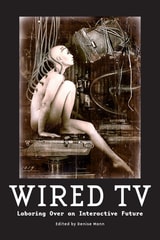
Wired TV
Laboring Over an Interactive FutureMann, Denise
Rutgers University Press, 2014
This collection looks at the post–network television industry’s heady experiments with new forms of interactive storytelling—or wired TV—that took place from 2005 to 2010 as the networks responded to the introduction of broadband into the majority of homes and the proliferation of popular, participatory Web 2.0 companies like Facebook, YouTube, and Twitter.
Contributors address a wide range of issues, from the networks’ sporadic efforts to engage fans using transmedia storytelling to the production inefficiencies that continue to dog network television to the impact of multimedia convergence and multinational, corporate conglomeration on entrepreneurial creativity. With essays from such top scholars as Henry Jenkins, John T. Caldwell, and Jonathan Gray and from new and exciting voices emerging in this field, Wired TV elucidates the myriad new digital threats and the equal number of digital opportunities that have become part and parcel of today’s post-network era. Readers will quickly recognize the familiar television franchises on which the contributors focus— including Lost, The Office, Entourage, Battlestar Gallactica, The L Word, and Heroes—in order to reveal their impact on an industry in transition.
While it is not easy for vast bureaucracies to change course, executives from key network divisions engaged in an unprecedented period of innovation and collaboration with four important groups: members of the Hollywood creative community who wanted to expand television’s storytelling worlds and marketing capabilities by incorporating social media; members of the Silicon Valley tech community who were keen to rethink television distribution for the digital era; members of the Madison Avenue advertising community who were eager to rethink ad-supported content; and fans who were enthusiastic and willing to use social media story extensions to proselytize on behalf of a favorite network series.
In the aftermath of the lengthy Writers Guild of America strike of 2007/2008, the networks clamped down on such collaborations and began to reclaim control over their operations, locking themselves back into an aging system of interconnected bureaucracies, entrenched hierarchies, and traditional partners from the past. What’s next for the future of the television industry? Stay tuned—or at least online.
Contributors: Vincent Brook, Will Brooker, John T. Caldwell, M. J. Clarke, Jonathan Gray, Henry Jenkins, Derek Johnson, Robert V. Kozinets, Denise Mann, Katynka Z. Martínez, and Julie Levin Russo