Results by title
80 books match the query 'Tennessee' and 4 start with w
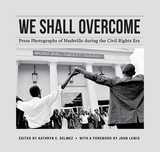
We Shall Overcome
Press Photographs of Nashville during the Civil Rights EraKathryn E. Delmez
Vanderbilt University Press, 2023
Fifty years after Martin Luther King Jr.'s death—and at a time when race relations and social justice are again at the forefront of our country's consciousness—this book expands on a Frist Art Museum exhibition to present a selection of approximately one hundred photographs that document an important period in Nashville's struggle for racial equality. The images were taken between 1957, the year that desegregation in public schools began, and 1968, when the National Guard was called in to surround the state capitol in the wake of the civil rights leader's assassination in Memphis.
Of central significance are photographs of lunch counter sit-ins in early 1960, led by a group of students, including John Lewis (who contributed the book's foreword) and Diane Nash, from local historically black colleges and universities. The demonstrations were so successful that King stated just a few weeks later at Fisk University: "I did not come to Nashville to bring inspiration but to gain inspiration from the great movement that has taken place in this community." The role that Nashville played in the national civil rights movement as a hub for training students in nonviolent protest and as the first Southern city to integrate places of business is a story that warrants reexamination.
The book also provides an opportunity to consider the role of images and the media in shaping public opinion, a relevant subject in today's news-saturated climate. Photographs from the archives of both daily newspapers are included: the Tennessean, which was the more liberal publication, and the Nashville Banner, a conservative paper whose leadership seemed less interested in covering events related to racial issues. Some of the photographs in the exhibition had been selected to be published in the papers, but many were not, and their disclosure reveals insight into the editorial process. In several images, other photojournalists and news crews are visible, serving as a reminder of the almost constant presence of the camera during these historic times.
Essays by Linda Wynn of Fisk University and the Tennessee Historical Commission and Susan H. Edwards, executive director of the Frist Art Museum, offer historical context on Nashville during the civil rights era and on photojournalism, respectively. Congressman John Lewis's foreword recounts memories of his time in Nashville and reminds us that there is still work to be done to build King's Beloved Community.
We Should Soon Become Respectable
Nashville's Own Timothy DemonbreunElizabeth Elkins
Vanderbilt University Press, 2022
Lightly called a "fur trader," he came to the city to make his fortune and fame, much like songwriters today. Looking back, it would be easy to call Demonbreun, the son of French Canadian near-royalty and brother to two nuns, a spoiled child who did what he wanted, a classic-case misogynist and polygamist, a conceited adventurer. He was a man who conned the Spanish governor out of a war, carried on graceful correspondence with Thomas Jefferson and Alexander Hamilton, owned several slaves, may have served as a spy, and was a decorated veteran. He fought in the Revolutionary War, extraordinarily so it seems, given the number of land grants he received across Kentucky and Tennessee.
He's also known around Nashville as the guy who lived in a cave.
Author Elizabeth Elkins sorts through the legends and nails down the facts in order to present the true story of "Nashville's First Citizen."
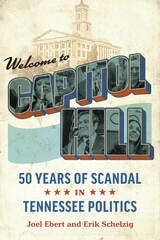
Welcome to Capitol Hill
Fifty Years of Scandal in Tennessee PoliticsJoel Ebert and Erik Schelzig
Vanderbilt University Press, 2023
Veteran political reporters Joel Ebert and Erik Schelzig draw from interviews, archival documents, and never-before-seen federal investigative files to provide readers with a handy resource about the wrongdoings of our elected officials.
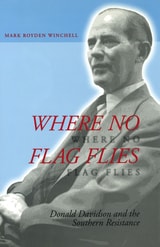
Where No Flag Flies
Donald Davidson and the Southern ResistanceMark Royden Winchell
University of Missouri Press, 2000
Donald Davidson (1893-1968) may well be the most unjustifiably neglected figure in twentieth-century southern literature. One of the most important poets of the Fugitive movement, he also produced a substantial body of literary criticism, the libretto for an American folk opera, a widely used composition textbook, and the recently discovered novel The Big Ballad Jamboree. As a social and political activist, Davidson had significant impact on conservative thought in this century, imfluencing important scholars from Cleanth Brooks to M. E. Bradford.
Despite these accomplishments, Donald Davidson has received little critical attention from either the literary or the southern scholarly community. Where No Flag Flies is Mark Royden Winchell's redress of this critical disservice. A comprehensive intellectual biography of Davidson, this seminal work offers a complete narrative of Davidson's life with all of its triumphs and losses, frustrations and fulfillments.
Winchell provides the reader with more than a simple study of a man and his achievements; he paints a complete portrait of the times in which Davidson published, from the 1930s to the early 1960s. Davidson was more directly involved in political and social activities than most writers of his generation, and Winchell provides the context, both literary and historical, in which Davidson's opinions and works developed. At the same time, Winchell offers detailed evaluations of Davidson's poetry, fiction, historical writings, and essays.
Drawing upon a wealth of previously unpublished archival material, including Davidson's letters and diary, Where No Flag Flies provides unique access to one of the most original minds of the twentieth-century South. Donald Davidson may not have achieved the recognition he deserved, but this remarkable biography finally makes it possible for a considerable literary audience to discover his true achievement.