Results by title
967 books match the query 'Theater' and 20 start with w
Walking on Fire
The Shaping Force of Emotion in Writing DramaJim Linnell
Southern Illinois University Press, 2011
Walking on Fire opens up new conversations about content and emotion for writers and offers exciting answers to the questions of why we make drama and why we connect to it. Linnell’s userfriendly theory and passionate approach create a framework for understanding the links between the writer’s work in creating the text, the text itself, and the audience’s engagement.

Walking, Writing and Performance
Autobiographical Texts by Deirdre Heddon, Carl Lavery and Phil SmithEdited by Roberta Mock
Intellect Books, 2009
This collection charts three projects by performers who generate autobiographical writing by walking through inspirational landscapes. Included in the book are the full texts of The Crab Walks and Crab Steps Aside by Phil Smith, Mourning Walk by Carl Lavery, and Tree by Deirdre Heddon, each accompanied by photographs and contextual essays. Taken together or separately, the work of all three artist-scholars raises important issues about memory, the ethics of autobiographical performance, ritual, life writing, and site-specific performance.
Wandering Stars
Russian Emigré Theatre, 1905-1940Laurence Senelick
University of Iowa Press, 1992
Weavers of Dreams, Unite!
Actors' Unionism in Early Twentieth-Century AmericaSean P. Holmes
University of Illinois Press, 2013
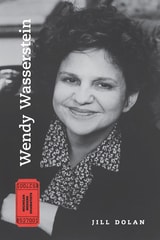
Wendy Wasserstein
Jill Dolan
University of Michigan Press, 2017
Wendy Wasserstein provides a critical introduction and a feminist reappraisal of the significant plays of one of the most famous contemporary American women playwrights. Following a biographical introduction, chapters address each of her important plays, situating Wasserstein’s work in the history of the US feminist movement and in a historical moment in which women artists continue to struggle for recognition.

When the Ocean Holds the Stage
Moby-Dick and Archipelagic WorldsMaurya Wickstrom
University of Michigan Press, 2027
When the Ocean Holds the Stage is a work in which Moby-Dick and Melville’s ocean dramaturgy is the deep thru-current and archipelagic structure, forming his brilliant watery excavation of the forces of containment and continentalization, capitalization, racialization, enslavement, species destruction, and white Christian supremacism. As such, it is an original and challenging political and aesthetic engagement with Melville and Moby-Dick. Melville’s Benito Cereno, Homer’s The Odyssey, and Dereck Walcott’s Omeros are also central studies. Wickstrom argues that the ocean and the ship emerge in these texts as new kinds of performance stages on which there is a unique freedom to bring critical thought to bear on many harmful systems, and to offer visions of ways to live differently. Introducing new practices in academic writing, Wickstrom works against the constraints of linear argumentation and toward archipelagic and poetic openness. Gatherings replace chapters and, in addition to the main texts, bring many artists, historical situations, contemporary crises, and political proposals into loose, archipelagic correspondences. Finally, the book is an important contribution from Theatre and Performance Studies to the vital and broad coalition of scholars, artists, and activists whose focus is on water.
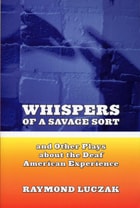
Whispers of a Savage Sort
And Other Plays about the Deaf American ExperienceRaymond Luczak
Gallaudet University Press, 2009
“Oh, why can’t the deaf community be more like a family?” is the plaint of a character in Raymond Luczak’s title play Whispers of a Savage Sort. It also goes far in characterizing the main thread that runs through his remarkable collection of work offered in this new volume. Whispers of a Savage Sort and Other Plays about the Deaf American Experience presents a progression of plays that depict Deaf people in situations well-known by the community’s members. Written to be signing-driven, these plays feature Deaf characters from the various strata of Deaf society. Each play centers on different yet equally familiar issues.
Snooty brings to life the difficulties of surviving the social pecking order in a deaf residential school. The main character’s only escape is a rich fantasy life in which he is in control. Doogle confronts its characters with the intrusion of technological communication devices parallel to the virtually forced intimacy of such a small, close community. Brought into stark focus by the specter of AIDS, Love in My Veins explores how trust, betrayal, and ultimately forgiveness can transform a Deaf couple’s love for each other in a Deaf community. The collection’s eponymous Whispers of a Savage Sort reveals the relentless damage that rumor and innuendo can do to a diverse group of Deaf individuals. The emotions, identities, and consequences created by Luczak in these dramas illuminate the Deaf American community in fascinating detail rarely seen in any medium today.
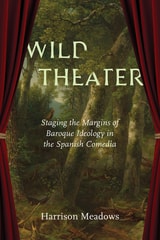
Wild Theater
Staging the Margins of Baroque Ideology in the Spanish ComediaHarrison Meadows
Vanderbilt University Press, 2025
In five compelling chapters, Meadows argues that a major shift occurred during the Baroque period, whereby the largely positive quality of previous iterations in the genealogy of wildness take on a negative character in the cultural ethos—and that this fundamental shift was representative of the influence of Spanish colonialism on racial thinking and a larger set of changes in how early modern people viewed gender and class. In this way, the book identifies the wild figure’s dramatic roots in the carnivalesque as an indispensable point of departure to plot the trajectory of wild representation in the theater of the Hispanic Baroque. From this guiding premise, Meadows traces the carryovers, transformations, and negations of the carnivalesque into early modern dramaturgy, specifically the Spanish comedia, which are emblematic of the poetic and ideological features of the emerging commercial theater in Iberia.
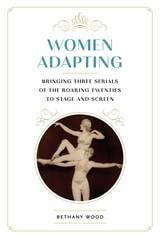
Women Adapting
Bringing Three Serials of the Roaring Twenties to Stage and ScreenBethany Wood
University of Iowa Press, 2019
Bethany Wood examines three well-known stories that debuted as women’s magazine serials—Gentlemen Prefer Blondes, Edith Wharton’s The Age of Innocence, and Edna Ferber’s Show Boat—and traces how each of these beloved narratives traveled across publishing, theatre, and film through adaptation. She documents the formation of adaptation systems and how they involved women’s voices and labor in modern entertainment in ways that have been previously underappreciated. What emerges is a picture of a unique window of time in the early decades of the twentieth century, when women in entertainment held influential positions in production and management. These days, when filmic adaptations seem endless and perhaps even unoriginal, Women Adapting challenges us to rethink the popular platitude, “The book is always better than the movie.”
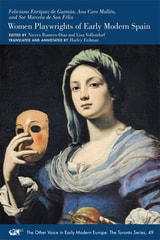
Women Playwrights of Early Modern Spain
Feliciana Enríquez de Guzmán, Ana Caro Mallén, and Sor Marcela de San Félix
Iter Press, 2016
This volume presents ten plays by three leading women playwrights of Spain’s Golden Age. Included are four bawdy and outrageous comic interludes; a full-length comedy involving sorcery, chivalry, and dramatic stage effects; and five short religious plays satirizing daily life in the convent. A critical introduction to the volume positions these women and their works in the world of seventeenth-century Spain.
Women Warriors in Romantic Drama
Wendy C. Nielsen
University of Delaware Press, 2013
Women Warriors in Romantic Drama examines a recurring figure that appears in French, British, and German drama between 1789 and 1830: the woman warrior. The term itself, “woman warrior,” refers to quasi-historical female soldiers or assassins. Women have long contributed to military campaigns as canteen women. Camp followers ranged from local citizenry to spouses and prostitutes, and on occasion, women assisted men in combat. However, the woman warrior is a romantic figure, meaning a fanciful ideal, despite the reality of women’s participation in select scenes of the French Revolution and the Napoleonic Wars. The central claim of this book is the woman warrior is a way for some women writers (Olympe de Gouges, Christine Westphalen, Karoline von Günderrode, and Mary Robinson) to explore the case for extending citizenship to women. This project focuses primarily on theater for the reason that the stage simulates the public world that female dramatists and their warriors seek to inhabit. Novels and poetry clearly belong to the realm of fiction, but when audiences see women fighting onstage, they confront concrete visions of impossible women. I examine dramas in the context of their performance and production histories in order to answer why so many serious dramas featuring women warriors fail to find applause, or fail to be staged at all. Dramas about women warriors seem to sometimes contribute to the argument for female citizenship when they take the form of tragedy, because the deaths of female protagonists in such plays often provoke consideration about women’s place in society.
Consequently, where we find women playing soldiers in various entertainment venues, farce and satire often seem to dominate, although this book points to some exceptions. Censorship and audience demand for comedies made producing tragedies difficult for female playwrights, who battled additional obstacles to fashioning their careers. I compare male (Edmund Eyre, Heinrich von Kleist) and female writers’ dramatizations of the woman warrior. This analysis shows that the difficult project of getting audiences to take women warriors seriously resembles women writers’ struggles to enter the ostensibly male domains of tragedy and the public sphere.
Published by University of Delaware Press. Distributed worldwide by Rutgers University Press.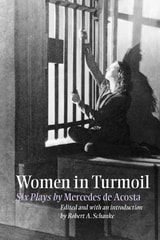
Women in Turmoil
Six Plays by Mercedes de AcostaEdited and with an introduction by Robert A. Schanke
Southern Illinois University Press, 2003
In this first publication of six plays by the flamboyantly uninhibited author, poet, and playwright Mercedes de Acosta (1893–1968), theater historian Robert A. Schanke rescues these lost theatrical writings from the dusty margins of obscurity. Often autobiographical, always rife with gender struggle, and still decidedly stageworthy, Women in Turmoil: Six Plays by Mercedes de Acosta constitutes a significant find for the canon of gay and lesbian drama.
In her 1960 autobiography Here Lies the Heart, de Acosta notes that as she was contemplating marriage to a man in 1920, she was "in a strange turmoil about world affairs, my own writing, suffrage, sex, and my inner spiritual development." The voice in these plays is that of a lesbian in turmoil, marginalized and ignored. Her same-sex desires and struggles for acceptance fueled her writings, and nowhere is that more evident than in the plays contained herein. The women characters struggle with unfulfilling marriages, divorce, unrequited sexual desire, suppressed identity, and a longing for recognition.
Of the six plays, only the first two were ever produced. Jehanne d’Arc (1922) premiered in Paris with de Acosta’s lover at the time, Eva Le Gallienne, starring and Norman Bel Geddes designing the set and lights. In 1934, de Acosta adapted it into a screenplay for Greta Garbo, then her lover, but it was never filmed. Portraying rampant anti-Semitism in a small New England town, Jacob Slovak (1923) was performed both on Broadway and in London, with the London production starring John Gielgud and Ralph Richardson.
The Mother of Christ (1924) is a long one-act play written for the internationally known actress Eleonora Duse. After Duse’s death, several other actresses including Eva Bartok, Jeanne Eagels, and Lillian Gish explored productions of the play. Igor Stravinsky wrote a score, Norman Bel Geddes designed a set, and Gladys Calthrop designed costumes. However, the play was never produced.
Her most autobiographical play, World Without End (1925), and her most sensational play, The Dark Light (1926), both unfold through plots of sibling rivalry, incest, and suicide. With overtones of Ibsen, Illusion (1928) continues the themes of de Acosta’s previous plays with her rough and seedy cast of characters, but here the playwright’s drama grows to incorporate a yearning for belonging as well as strong elements of class conflict.
What notoriety remains associated with de Acosta has less to do with her writing than with her infamous romances with the likes of Greta Garbo, Marlene Dietrich, Isadora Duncan, Alla Nazimova, Eva Le Gallienne, Tamara Karsavina, Pola Negri, and Ona Munson. Through this collection of six powerfully poignant dramas, editor Robert A. Schanke strives to correct myths about Mercedes de Acosta and to restore both her name and her literary achievements to their proper place in history.
Robert A. Schanke has authored the original biography, “That Furious Lesbian:” The Story of Mercedes de Acosta, also available from Southern Illinois University Press.
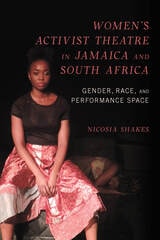
Women's Activist Theatre in Jamaica and South Africa
Gender, Race, and Performance SpaceNicosia M. Shakes
University of Illinois Press, 2023
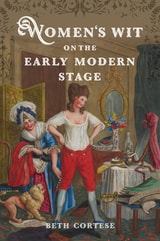
Women's Wit on the Early Modern Stage
Beth Cortese
University of Delaware Press, 2027
Women's Wit on the Early Modern Stage explores the overlooked, gendered challenge posed by heroines and villainesses in comedies, tragedies, and tragicomedies through who displayed their wit through repartee, plotting, and disguise, combining verbal skill with physical action to produce a feminized perspective. The chapters showcase the portrayal of women’s wit in the works of Frances Boothby, Aphra Behn, Elizabeth Polwhele, Mary Pix, Catharine Trotter, Delarivier Manley, and Susanna Centlivre, in which female characters criticize authority and address female spectators in the theater, including them as part of an emerging critical discourse on the public stage. As the first-ever scholarly monograph about women’s wit in drama before the twentieth century, this book draws attention to the cultural and social role that wit played in the public sphere as a mode of critique, empowerment, and play for women both on and offstage.
Words at Play
Creative Writing and DramaturgyFelicia Hardison Londre. Forewords by Dakin Williams and Barry Kyle
Southern Illinois University Press, 2005
In this encompassing and accessible introduction to dramaturgy, Felicia Hardison Londré promotes the dramaturgical essay as both an art form and as a method for improving creative writing skills. Words at Play: Creative Writing and Dramaturgy includes Londré’s essays on plays produced at several regional professional theatre companies interspersed with instructive examples for writing more clearly, economically, and compellingly.
Beginning with an introduction that outlines the purpose of the dramaturgical essay as well as its usefulness as a tool for teaching how to write for the theatre, Londré provides numerous examples of this specialized literary genre culled from program essays she has written for Missouri Repertory Theatre, Nebraska Shakespeare Festival, Heart of America Shakespeare Festival, American Heartland Theatre, and Cincinnati Playhouse in the Park. Words at Play: Creative Writing and Dramaturgy contains more than sixty complete essays and pertinent selections from twenty others.
Drawing on personal and professional experiences as a teacher and dramaturg, Londré considers plays from timeless classics, including those of Shakespeare and Chekhov, to contemporary favorites and a few unusual and largely unknown pieces. Words at Play: Creative Writing and Dramaturgy furthermore incorporates introductory paragraphs that are informal and personal yet cogent and critical, providing readers with object lessons in both writing style and analysis. Taking the reader into her confidence, Londré also shows how a dramaturg develops a print relationship with other theatre artists and the community. A foreword by Royal Shakespeare Company associate artist Barry Kyle addresses the evolving role of the dramaturg in Britain and America. Dakin Williams, brother of playwright Tennessee Williams, provides a letter.
Working Backstage
A Cultural History and Ethnography of Technical Theater LaborChristin Essin
University of Michigan Press, 2021
Working Backstage illuminates the work of New York City’s theater technicians, shining a light on the essential contributions of unionized stagehands, carpenters, electricians, sound engineers, properties artisans, wardrobe crews, makeup artists, and child guardians. Too-often dismissed or misunderstood as mere functionaries, these technicians are deeply engaged in creative problem-solving and perform collaborative, intricate choreographed work that parallels the performances of actors, singers, and dancers onstage. Although their contributions have fueled the Broadway machine, their contributions have been left out of most theater histories.
Theater historian Christin Essin offers clear and evocative descriptions of this invaluable labor, based on her archival research and interviews with more than 100 backstage technicians, members of the New York local of the International Alliance of Theatrical Stage Employees. A former theater technician herself, Essin provides readers with an insider’s view of the Broadway stage, from the suspended lighting bridge of electricians operating followspots for A Chorus Line; the automation deck where carpenters move the massive scenic towers for Newsies; the makeup process in the dressing room for The Lion King; the offstage wings of Matilda the Musical, where guardians guide child actors to entrances and exits. Working Backstage makes an significant contribution to theater studies and also to labor studies, exploring the politics of the unions that serve backstage professionals, protecting their rights and insuring safe working conditions. Illuminating the history of this typically hidden workforce, the book provides uncommon insights into the business of Broadway and its backstage working relationships among cast and crew members.
Working in the Wings
New Perspectives on Theatre History and LaborEdited by Elizabeth A. Osborne and Christine Woodworth
Southern Illinois University Press, 2015
Theatre has long been an art form of subterfuge and concealment. Working in the Wings: New Perspectives on Theatre History and Labor, edited by Elizabeth A. Osborne and Christine Woodworth, brings attention to what goes on behind the scenes, challenging, and revising our understanding of work, theatre, and history.
Essays consider a range of historic moments and geographic locations—from African Americans’ performance of the cakewalk in Florida’s resort hotels during the Gilded Age to the UAW Union Theatre and striking automobile workers in post–World War II Detroit, to the struggle in the latter part of the twentieth century to finish an adaptation of Moby Dick for the stage before the memory of creator Rinde Eckert failed. Contributors incorporate methodologies and theories from fields as diverse as theatre history, work studies, legal studies, economics, and literature and draw on traditional archival materials, including performance texts and architectural structures, as well as less tangible material traces of stagecraft.
Working in the Wings looks at the ways in which workers' identities are shaped, influenced, and dictated by what they do; the traces left behind by workers whose contributions have been overwritten; the intersections between the sometimes repetitive and sometimes destructive process of creation and the end result—the play or performance; and the ways in which theatre affects the popular imagination. This collected volume draws attention to the significance of work in the theatre, encouraging a fresh examination of this important subject in the history of the theatre and beyond.
Worldmaking
Race, Performance, and the Work of CreativityDorinne Kondo
Duke University Press, 2018
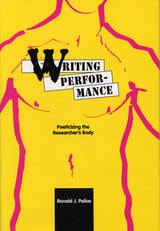
Writing Performance
Poeticizing the Researcher's BodyRonald J. Pelias
Southern Illinois University Press, 1999
Ronald J. Pelias is concerned with writing about performance, from the everyday performative routines to the texts on stage. He seeks to write performatively, to offer poetic or aesthetic renderings of performance events in order to capture some sense of their nature. In his quest for the spirit of theatrical performances, Pelias asks more of the written word than the word can deliver. Yet the attempt is both desirable—and necessary. To discuss performance without some accounting for its essence as art, he asserts, is at best misleading, at worst, fraud.
Pelias divides his efforts to present performance events into three general categories: "Performing Every Day," "On Writing and Performing," and "Being a Witness." "Performing Every Day" focuses on performances ranging from the daily business of enacting roles to the telling of tales that make life meaningful. It incorporates essays about the ongoing process of presenting oneself in everyday life; the gender script that insists that men enact manly performances; the classroom performances of teachers and students; stories of gender, class, and race that mark identity; and a performance installation entitled "A Day’s Talk."
"On Writing and Performing" examines the written script and performance practices. It includes a description of a struggle between a writer and a performer as they protect their own interests; an intimate look at an apprehensive performer; a short play entitled "The Audition"; and a chronicle of performance process from the perspective of an actor.
"Being a Witness" examines performance from the perspective of the audience and the director: being an audience member; viewing theatre in the context of New York City; directing and being directed by actors’ bodies; and watching The DEF Comedy Jam.
Writing and Rewriting National Theatre Histories
S.E. Wilmer
University of Iowa Press, 2004