Results by title
91 books match the query 'Theater and society' and 2 start with w
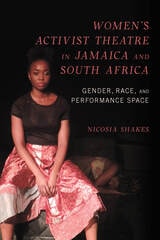
Women's Activist Theatre in Jamaica and South Africa
Gender, Race, and Performance SpaceNicosia M. Shakes
University of Illinois Press, 2023
Theater is an essential theoretical and practical site for forging Black radical thought, Africana feminisms, and womanism. Nicosia M. Shakes draws on ethnographic research in Jamaica and South Africa to analyze the vital relationship between activism and theater production. Concentrating on four performance events, Shakes situates the work of theater groups and projects within a trajectory of women-led social justice movements established in Jamaica, South Africa, and globally from the early 2000s to the present. Her analysis reveals movements driven by Black women’s artistic, intellectual, and organizational labor and focused on issues that range from sexual violence to reproductive justice to the spatial manifestations of racial, gender, and economic oppression. Shakes shows how theater’s political and pedagogical roles become entangled with histories and geographies of oppression and resistance; the identities and connections created by movements of people in the context of colonial and settler colonial histories; and ideas of womanism and feminism.
[more]
Worldmaking
Race, Performance, and the Work of CreativityDorinne Kondo
Duke University Press, 2018
In this bold, innovative work, Dorinne Kondo theorizes the racialized structures of inequality that pervade theater and the arts. Grounded in twenty years of fieldwork as dramaturg and playwright, Kondo mobilizes critical race studies, affect theory, psychoanalysis, and dramatic writing to trenchantly analyze theater's work of creativity as theory: acting, writing, dramaturgy. Race-making occurs backstage in the creative process and through economic forces, institutional hierarchies, hiring practices, ideologies of artistic transcendence, and aesthetic form. For audiences, the arts produce racial affect--structurally over-determined ways affect can enhance or diminish life. Upending genre through scholarly interpretation, vivid vignettes, and Kondo's original play, Worldmaking journeys from an initial romance with theater that is shattered by encounters with racism, toward what Kondo calls reparative creativity in the work of minoritarian artists Anna Deavere Smith, David Henry Hwang, and the author herself. Worldmaking performs the potential for the arts to remake worlds, from theater worlds to psychic worlds to worldmaking visions for social transformation.
[more]