Results by title
86 books match the query 'Translating & Interpreting' and 4 start with w
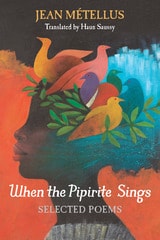
When the Pipirite Sings
Selected PoemsJean Métellus, Translated by Haun Saussy
Northwestern University Press, 2019
Translated by formidable comparative literature scholar Haun Saussy, When the Pipirite Sings expresses an acute historical consciousness and engages recurrent Haitian themes—the wrenching impact of colonialism and underdevelopment, the purposes of education, and the merging of spiritual and temporal power. And, as always with Métellus’s poetry, the range of voices and points of view evokes other genres, including fiction and cinema. This eminently readable book has formal and thematic ties to Aimé Césaire’s Notebook of a Return to the Native Land, central to the canon of French-language postcolonial writings.
In addition to many books of poetry, Métellus published novels, chiefly about the remembered Haiti of his youth, and plays about the conquest of the Caribbean. His nonfiction included reflections on Haitian history and politics, on the iconography of slave emancipation, and studies of aphasia and dyslexia.
Women as Translators in Early Modern England
Deborah Uman
University of Delaware Press, 2012
Women as Translators in Early Modern England offers a feminist theory of translation that considers both the practice and representation of translation in works penned by early modern women. It argues for the importance of such a theory in changing how we value women’s work. Because of England’s formal split from the Catholic Church and the concomitant elevation of the written vernacular, the early modern period presents a rich case study for such a theory. This era witnessed not only a keen interest in reviving the literary glories of the past, but also a growing commitment to humanist education, increasing literacy rates among women and laypeople, and emerging articulations of national sentiment. Moreover, the period saw a shift in views of authorship, in what it might mean for individuals to seek fame or profit through writing. Until relatively recently in early modern scholarship, women were understood as excluded from achieving authorial status for a number of reasons—their limited education, the belief that public writing was particularly scandalous for women, and the implicit rule that they should adhere to the holy trinity of “chastity, silence, and obedience.”
While this view has changed significantly, women writers are still understood, however grudgingly, as marginal to the literary culture of the time. Fewer women than men wrote, they wrote less, and their “choice” of genres seems somewhat impoverished; add to this the debate over translation as a potential vehicle of literary expression and we can see why early modern women’s writings are still undervalued. This book looks at how female translators represent themselves and their work, revealing a general pattern in which translation reflects the limitations women faced as writers while simultaneously giving them the opportunity to transcend these limitations. Indeed, translation gave women the chance to assume an authorial role, a role that by legal and cultural standards should have been denied to them, a role that gave them ownership of their words and the chance to achieve profit, fame, status and influence.
Published by University of Delaware Press. Distributed worldwide by Rutgers University Press.
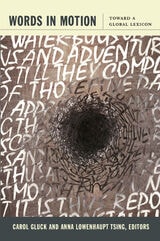
Words in Motion
Toward a Global LexiconCarol Gluck and Anna Lowenhaupt Tsing, eds.
Duke University Press, 2009
Such words as security in Brazil, responsibility in Japan, community in Thailand, and hijāb in France changed the societies in which they moved even as the words were changed by them. Some words threatened to launch wars, as injury did in imperial Britain’s relations with China in the nineteenth century. Others, such as secularism, worked in silence to agitate for political change in twentieth-century Morocco. Words imposed or imported from abroad could be transformed by those who wielded them to oppose the very powers that first introduced them, as happened in Turkey, Indonesia, and the Philippines. Taken together, this selection of fourteen essays reveals commonality as well as distinctiveness across modern societies, making the world look different from the interdisciplinary and transnational perspective of “words in motion.”
Contributors. Mona Abaza, Itty Abraham, Partha Chatterjee, Carol Gluck, Huri Islamoglu, Claudia Koonz, Lydia H. Liu, Driss Maghraoui, Vicente L. Rafael, Craig J. Reynolds, Seteney Shami, Alan Tansman, Kasian Tejapira, Anna Lowenhaupt Tsing
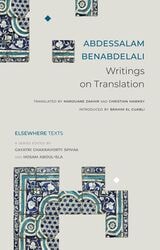
Writings on Translation
Abdessalam Benabdelali
Seagull Books, 2025
Abdessalam Benabdelali is a revered Moroccan philosopher and translator whose work maps an invaluable history of the status of translation in contemporary Arabic thought and language. Bringing together essays from two linked Arabic works by Benabdelali—On Translation and Hosting the Stranger—this volume represents one of the first extended philosophical explorations of translation by a contemporary Arab philosopher. These works reframe Arabic and European cultural histories around translation to counter hegemonic discourses and celebrate translation as a form of philosophical thought and practice, one that both preserves and proliferates difference.
Whether discussing eighteenth-century European perceptions of Arabic culture, classical Arabic literature and its express intent to resist all translation, or contemporary Arabic authors who write in anticipation of translation, Writings on Translation nimbly outlines the key philosophical questions at stake in translation. It concludes with an impassioned argument for translations that “host the stranger” and allow texts to “lift off and migrate.”