Results by title
63 books match the query 'Turkey & Ottoman Empire' and 3 start with w
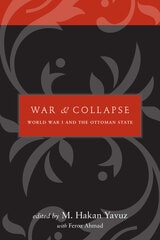
War and Collapse
World War I and the Ottoman StateEdited by M. Hakan Yavuz with Feroz Ahmad
University of Utah Press, 2015
War and Collapse is the third and final volume in a series that covers the last years of the Ottoman Empire. This book stems from a three-day international conference held in May 2012 at which scholars examined the causes and consequences of World War I, with a distinctive focus on how these events pertained to the Ottoman state and society. Fifty-three scholars—both new and established—contributed to this collection, with the goal of explaining what happened within the Ottoman Empire before and during WWI and how ethnic and national groups constructed these events to enhance their identities, promote their interests, and situate their collective selves in the international system. The chapters provide insight into the mindset and experiences of Ottoman peoples from the end of the Balkan Wars through the end of World War I, showing how earlier events set in motion the Ottoman response to the war and how continued engagement in conflict had devastating, irreversible effects on Ottoman society. The articles in this volume include a wide variety of ideas and points of view, thus presenting a comprehensive picture of the events.
[more]
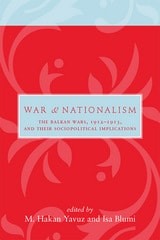
War and Nationalism
The Balkan Wars, 1912–1913, and Their Sociopolitical ImplicationsM Hakan Yavuz
University of Utah Press, 2013
War and Nationalism presents thorough up-to-date scholarship on the often misunderstood and neglected Balkan Wars of 1912 to 1913, which contributed to the outbreak of World War I. The essays contain critical inquiries into the diverse and interconnected processes of social, economic, and political exchange that escalated into conflict. The wars represented a pivotal moment that had a long-lasting impact on the regional state system and fundamentally transformed the beleaguered Ottoman Empire in the process.
This interdisciplinary volume stands as a critique of the standard discourse regarding the Balkan Wars and effectively questions many of the assumptions of prevailing modern nation-state histories, which have long privileged the ethno-religious dimensions present in the Balkans. The authors go to great lengths in demonstrating the fluidity of social, geographical, and cultural boundaries before 1912 and call into question the “nationalist watershed” notion that was artificially imposed by manipulative historiography and political machinations following the end of fighting in 1913.
War and Nationalism will be of interest to scholars looking to enrich their own understanding of an overshadowed historical event and will serve as a valuable contribution to courses on Ottoman and European history.
[more]
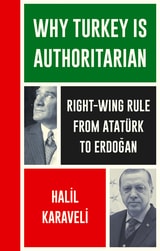
Why Turkey is Authoritarian
Right-Wing Rule from Atatürk to ErdoganHalil Karaveli
Pluto Press, 2018
For the last century, the Western world has regarded Turkey as a pivotal case of the 'clash of civilisations' between Islam and the West. Why Turkey is Authoritarian offers a radical challenge to this conventional narrative. Halil Karaveli highlights the danger in viewing events in Turkey as a war between a 'westernising' state and the popular masses defending their culture and religion, arguing instead for a class analysis that is largely ignored in the Turkish context.
This book goes beyond cultural categories that overshadow more complex realities when thinking about the 'Muslim world', while highlighting the ways in which these cultural prejudices have informed ideological positions. Karaveli argues that Turkey's culture and identity have disabled the Left, which has largely been unable to transcend these divisions.
This book asks the crucial question: why does democracy continue to elude Turkey? Ultimately, Karaveli argues that Turkish history is instructive for a left that faces the global challenge of a rising populist right, which succeeds in mobilising culture and identity to its own purposes.
Published in partnership with the Left Book Club.
[more]