Results by title
161 books match the query 'Universities and colleges' and 9 start with w
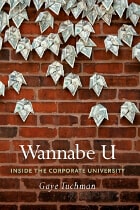
Wannabe U
Inside the Corporate UniversityGaye Tuchman
University of Chicago Press, 2009
Based on years of observation at a large state university, Wannabe U tracks the dispiriting consequences of trading in traditional educational values for loyalty to the market. Aping their boardroom idols, the new corporate administrators at such universities wander from job to job and reductively view the students there as future workers in need of training. Obsessed with measurable successes, they stress auditing and accountability, which leads to policies of surveillance and control dubiously cloaked in the guise of scientific administration. In this eye-opening exposé of the modern university, Tuchman paints a candid portrait of the corporatization of higher education and its impact on students and faculty.
Like the best campus novelists, Tuchman entertains with her acidly witty observations of backstage power dynamics and faculty politics, but ultimately Wannabe U is a hard-hitting account of how higher education’s misguided pursuit of success fails us all.
What Every Science Student Should Know
Justin L. Bauer, Yoo Jung Kim, Andrew H. Zureick, and Daniel K. Lee
University of Chicago Press, 2016
In 2012, the White House put out a call to increase the number of STEM graduates by one million. Since then, hundreds of thousands of science students have started down the path toward a STEM career. Yet, of these budding scientists, more than half of all college students planning to study science or medicine leave the field during their academic careers.
What Every Science Student Should Know is the perfect personal mentor for any aspiring scientist. Like an experienced lab partner or frank advisor, the book points out the pitfalls while providing encouragement. Chapters cover the entire college experience, including choosing a major, mastering study skills, doing scientific research, finding a job, and, most important, how to foster and keep a love of science.
This guide is a distillation of the authors’ own experiences as recent science graduates, bolstered by years of research and interviews with successful scientists and other science students. The authorial team includes former editors-in-chief of the prestigious Dartmouth Undergraduate Journal of Science. All have weathered the ups and downs of undergrad life—and all are still pursuing STEM careers. Forthright and empowering, What Every Science Student Should Know is brimming with insider advice on how to excel as both a student and a scientist.

What's the Use?
On the Uses of UseSara Ahmed
Duke University Press, 2019
Who Should Pay?
Higher Education, Responsibility, and the PublicNatasha Quadlin
Russell Sage Foundation, 2022
Who Should Pay? draws on a decade’s worth of public opinion surveys analyzing public attitudes about whether parents, students, or the government should be primarily responsible for funding higher education. Quadlin and Powell find that between 2010 and 2019, public opinion has shifted dramatically in favor of more government funding. In 2010, Americans overwhelming believed that parents and students were responsible for the costs of higher education. Less than a decade later, the percentage of Americans who believed that federal or state/local government should be the primary financial contributor has more than doubled. The authors contend that the rapidity of this change may be due to the effects of the 2008 financial crisis and the growing awareness of the social and economic costs of high levels of student debt. Quadlin and Powell also find increased public endorsement of shared responsibility between individuals and the government in paying for higher education. The authors additionally examine attitudes on the accessibility of college for all, whether higher education at public universities should be free, and whether college is worth the costs.
Quadlin and Powell also explore why Americans hold these beliefs. They identify individualistic and collectivist world views that shape public perspectives on the questions of funding, accessibility, and worthiness of college. Those with more individualistic orientations believed parents and students should pay for college, and that if students want to attend college, then they should work hard and find ways to achieve their goals. Those with collectivist orientations believed in a model of shared responsibility – one in which the government takes a greater level of responsibility for funding education while acknowledging the social and economic barriers to obtaining a college degree for many students. The authors find that these belief systems differ among socio-demographic groups and that bias – sometimes unconscious and sometimes deliberate – regarding race and class affects responses from both individualistic and collectivist-oriented participants.
Public opinion is typically very slow to change. Yet Who Should Pay? provides an illuminating account of just how quickly public opinion has shifted regarding the responsibility of paying for a college education and its implications for future generations of students.
Why Public Higher Education Should Be Free
How to Decrease Cost and Increase Quality at American UniversitiesSamuels, Robert
Rutgers University Press, 2013
In Why Public Higher Education Should Be Free, Robert Samuels argues that many institutions of higher education squander funds and mislead the public about such things as average class size, faculty-to-student ratios, number of faculty with PhDs, and other indicators of educational quality. Parents and students seem to have little knowledge of how colleges and universities have been restructured over the past thirty years.
Samuels shows how research universities have begun to function as giant investment banks or hedge funds that spend money on athletics and administration while increasing tuition costs and actually lowering the quality of undergraduate education. In order to fight higher costs and lower quality, Samuels suggests, universities must reallocate these misused funds and concentrate on their core mission of instruction and related research.
Throughout the book, Samuels argues that the future of our economy and democracy rests on our ability to train students to be thoughtful participants in the production and analysis of knowledge. If leading universities serve only to grant credentials and prestige, our society will suffer irrevocable harm. Presenting the problem of how universities make and spend money, Samuels provides solutions to make these important institutions less expensive and more vital. By using current resources in a more effective manner, we could even, he contends, make all public higher education free.
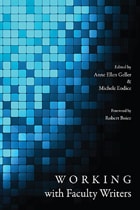
Working with Faculty Writers
Anne Ellen Geller and Michele Eodice
Utah State University Press, 2013
Contributors from a variety of institution types and perspectives consider who faculty writers are and who they may be in the future, reveal the range of locations and models of support for faculty writers, explore the ways these might be delivered and assessed, and consider the theoretical, philosophical, political, and pedagogical approaches to faculty writing support, as well as its relationship to student writing support.
With the pressure on faculty to be productive researchers and writers greater than ever, this is a must-read volume for administrators, faculty, and others involved in developing and assessing models of faculty writing support.
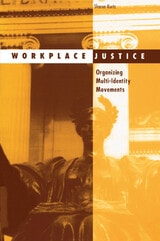
Workplace Justice
Organizing Multi-Identity MovementsSharon Kurtz
University of Minnesota Press, 2002
An unheralded union battle offers new insight into identity politics.
In 1991, Columbia University’s one thousand clerical workers launched a successful campaign for justice in their workplace. This diverse union-two-thirds black and Latina, three-fourths women-was committed to creating an inclusive movement organization and to fighting for all kinds of justice. How could they address the many race and gender injustices members faced, avoid schism, and maintain the unity needed to win? Sharon Kurtz, an experienced union activist and former clerical worker herself, was welcomed into the union and pursued these questions. Using this case study and secondary studies of sister clerical unions at Yale and Harvard, she examines the challenges and potential of identity politics in labor movements.
With the Columbia strike as a point of departure, Kurtz argues that identity politics are valuable for mobilizing groups, but often exclude members and their experiences of oppression. However, Kurtz believes that identity politics should not be abandoned as a component in building movements, but should be reframed-as multi-identity politics. In the end she shows an approach to organizing with great potential impact not only for labor unions but for any social movement.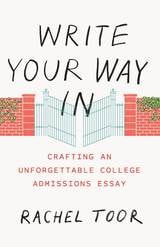
Write Your Way In
Crafting an Unforgettable College Admissions EssayRachel Toor
University of Chicago Press, 2017
The good news? You already have the “secret sauce” for crafting a compelling personal essay: your own experiences and your unique voice.
More than twenty million students apply to college every year; many of them look similar in terms of test scores, grades, courses taken, extracurricular activities. Admissions officers wade through piles of files. As an applicant, you need to think about what will interest an exhausted reader. What can you write that will make her argue to admit you instead of the thousands of other applicants?
A good essay will be conversational and rich in vivid details, and it could only be written by one person—you. This book will help you figure out how to find and present the best in yourself. You’ll acquire some useful tools for writing well—and may even have fun—in the process.
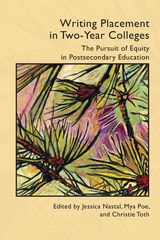
Writing Placement in Two-Year Colleges
The Pursuit of Equity in Postsecondary EducationJessica Nastal
University Press of Colorado, 2023