97 books match the query 'Urbanization' and 4 start with w
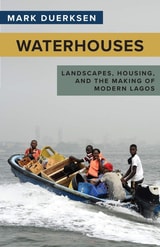
cover of Waterhouses: Landscapes, Housing, and the Making of Modern Lagos

Waterhouses

Landscapes, Housing, and the Making of Modern Lagos

Mark Duerksen

Ohio University Press, 2024
Waterhouses is about the places the people of Lagos have inhabited, imagined, and made home for the past two centuries. It asks what a house in Lagos is and explores how the answer to that question has been historically constructed and reconstructed in turn with the city’s changing landscapes. Written for historians of African and Atlantic history, scholars and practitioners of urbanism, and anyone looking to make sense of Africa’s most populous metropolis today, the book is an approachable history of how houses and water have formed modern Lagos. The book argues that in the coastlands from which Lagos rose, housing architectures were the single most important social, material, and political instruments for people hoping to contour the city’s landscapes—both its ecology and its image—and its historical course. The forms and meanings of houses in Lagos have shifted dramatically over time and in ways that reveal how power, house making, visual perception, and the environment are entangled in modern cities. The book’s chapters encompass six eras and six waterscapes: sandbars, canals, swamps, lagoons, oceans, and floods. These spaces guide the book’s exploration of how people saw and attempted to remake Lagos’s environs in a process that invariably involved housing architectures. At its core, Lagos is a city built through the materials, relations, and powers contained in the dry, solid, and hospitable spaces of homes, which have long been scarce and culturally celebrated resources in the city’s water-constricted setting. While shelter is integral to any city’s development, houses have been particularly important and sought after in Lagos because of the city’s land shortages and because of the societal influence and physical footprint of traditional Yoruba ilé (family compounds), in which activities were historically organized and centered. Through dozens of maps, photographs, and housing plans found in British and Nigerian archives, this book traces the relationship between Lagos’s residential spaces and its urban landscapes across the rise, fall, and aftermath of British colonization. By showing how Yoruba visions of home—though often forgotten or misunderstood today—coexisted with European notions, Waterhouses offers urban planners, policy makers, and architects ideas for how the definingly human act of inhabiting a place might be grounded in practices of continuous custodianship rather than extractive possession.
[more]
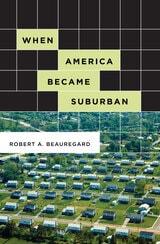
cover of When America Became Suburban

When America Became Suburban

Robert A. Beauregard

University of Minnesota Press, 2006
In the decades after World War II, the United States became the most prosperous nation in the world and a superpower whose dominance was symbolized by the American suburbs. Spurred by the decline of its industrial cities and by mass suburbanization, people imagined a new national identity—one that emphasized consumerism, social mobility, and a suburban lifestyle. The urbanity of the city was lost. In When America Became Suburban, Robert A. Beauregard examines this historic intersection of urban decline, mass suburbanization, domestic prosperity, and U.S. global aspirations as it unfolded from 1945 to the mid-1970s. Suburban expansion and the subsequent emergence of sprawling Sunbelt cities transformed every aspect of American society. Assessing the global implications of America’s suburban way of life as evidence of the superiority of capitalist democracy, Beauregard traces how the suburban ideology enabled America to distinguish itself from both the Communist bloc and Western Europe, thereby deepening its claim of exceptionalism on the world-historical stage.Placing the decline of America’s industrial cities and the rise of vast suburban housing and retail spaces into a cultural, political, and global context, Beauregard illuminates how these phenomena contributed to a changing notion of America’s identity at home and abroad. When America Became Suburban brings to light the profound implications of de-urbanization: from the siphoning of investments from the cities and the effect on the quality of life for those left behind to a profound shift in national identity.Robert A. Beauregard is a professor in the Graduate School of Architecture, Planning, and Preservation at Columbia University. He is the author of Voices of Decline: The Postwar Fate of U.S. Cities and editor of Economic Restructuring and Political Response and Atop the Urban Hierarchy.
[more]
cover of Workers from the North: Plantations, Bolivian Labor, and the City in Northwest Argentina

Workers from the North

Plantations, Bolivian Labor, and the City in Northwest Argentina

By Scott Whiteford

University of Texas Press, 1981

International migration between countries in Latin America became increasingly important during the twentieth century, but for a long time it was the subject of only limited research. Scott Whiteford sets the Argentina-Bolivia experience in historical perspective by examining the macrolevel factors that influenced social change in both countries and brought streams of migration into Argentina. Seasonal labor, the expansion of capitalist agriculture, international migration, and urbanization are central topics in this in-depth study of Bolivian migrants in Northwest Argentina.

Whiteford’s vivid portrayal of the lives and working conditions of the migrants is based on two years of research during which he lived with the workers on a sugar plantation and, after the harvest, accompanied them to other farms and to the city of Salta in their search for more work. He traces the development of plantation agriculture in Northwest Argentina and the processes by which the plantation gained access to cheap labor and maintained control over it.

As Bolivians migrated to Argentina in ever greater numbers, many recruited for the harvest remained. Whiteford’s analysis of the diverse strategies employed by workers and their families to support themselves during the post-harvest season is a major contribution to migration literature. The four distinct but related patterns of migration that he describes created a labor reserve that transcends rural/urban designations, one that is utilized by employers in both the countryside and the city.

[more]
cover of World Patterns in Modern Urban Change: Essays in Honor of Chauncey D. Harris

World Patterns in Modern Urban Change

Essays in Honor of Chauncey D. Harris

Edited by Michael P. Conzen

University of Chicago Press, 1986

[more]