Results by title
57 books match the query 'Victorian Era (1837-1901)' and 4 start with w

Waterscapes
Reservoirs, Environment and Identity in Modern England and WalesAndrew McTominey
University of London Press, 2025
How did reservoirs alter the countryside and city life? The answer is a riveting story of water and identity in modern Britain.
Carving vast lakes into the countryside, reservoirs have long reshaped the landscapes and communities of England and Wales. Waterscapes evaluates how these feats of engineering transformed rural and urban environments between the late nineteenth and early twentieth centuries, altering local ecologies and economies. Through studies of Leeds’s Washburn Valley, Liverpool’s Vyrnwy Reservoir, and Birmingham’s Elan Reservoir, Andrew McTominey addresses the environmental consequences of dam construction and the surprising ways in which reservoirs became sites of leisure and tourism.
McTominey explains that water management has never been a simple question of supply and demand, but a story of contested landscapes and the complex interplay between nature and human ambition. Drawing on environmental history and urban studies, Waterscapes demystifies the reservoirs that continue to shape Britain’s countryside and city life.
[more]
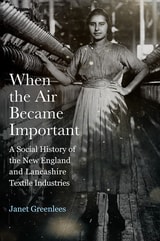
When the Air Became Important
A Social History of the New England and Lancashire Textile IndustriesJanet Greenlees
Rutgers University Press, 2019
In When the Air Became Important, medical historian Janet Greenlees examines the working environments of the heartlands of the British and American cotton textile industries from the nineteenth to the late twentieth centuries. Greenlees contends that the air quality within these pioneering workplaces was a key contributor to the health of the wider communities of which they were a part. Such enclosed environments, where large numbers of people labored in close quarters, were ideal settings for the rapid spread of diseases including tuberculosis, bronchitis and pneumonia. When workers left the factories for home, these diseases were transmitted throughout the local population, yet operatives also brought diseases into the factory. Other aerial hazards common to both the community and workplace included poor ventilation and noise. Emphasizing the importance of the peculiarities of place as well as employers’ balance of workers’ health against manufacturing needs, Greenlees’s pioneering book sheds light on the roots of contemporary environmentalism and occupational health reform. Her work highlights the complicated relationships among local business, local and national politics of health, and community priorities.
[more]
Worthy of Freedom
Indenture and Free Labor in the Era of EmancipationJonathan Connolly
University of Chicago Press, 2024
A study of Indian indentured labor in Mauritius, British Guiana, and Trinidad that explores the history of indenture’s normalization.
In this book, historian Jonathan Connolly traces the normalization of indenture from its controversial beginnings to its widespread adoption across the British Empire during the nineteenth century. Initially viewed as a covert revival of slavery, indenture caused a scandal in Britain and India. But over time, economic conflict in the colonies altered public perceptions of indenture, now increasingly viewed as a legitimate form of free labor and a means of preserving the promise of abolition. Connolly explains how the large-scale, state-sponsored migration of Indian subjects to work on sugar plantations across Mauritius, British Guiana, and Trinidad transformed both the notion of post-slavery free labor and the political economy of emancipation.
Excavating legal and public debates and tracing practical applications of the law, Connolly carefully reconstructs how the categories of free and unfree labor were made and remade to suit the interests of capital and empire, showing that emancipation was not simply a triumphal event but, rather, a deeply contested process. In so doing, he advances an original interpretation of how indenture changed the meaning of “freedom” in a post-abolition world.
[more]
Worthy of Freedom
Indenture and Free Labor in the Era of EmancipationJonathan Connolly
University of Chicago Press, 2024
This is an auto-narrated audiobook version of this book.
A study of Indian indentured labor in Mauritius, British Guiana, and Trinidad that explores the history of indenture’s normalization.
In this book, historian Jonathan Connolly traces the normalization of indenture from its controversial beginnings to its widespread adoption across the British Empire during the nineteenth century. Initially viewed as a covert revival of slavery, indenture caused a scandal in Britain and India. But over time, economic conflict in the colonies altered public perceptions of indenture, now increasingly viewed as a legitimate form of free labor and a means of preserving the promise of abolition. Connolly explains how the large-scale, state-sponsored migration of Indian subjects to work on sugar plantations across Mauritius, British Guiana, and Trinidad transformed both the notion of post-slavery free labor and the political economy of emancipation.
Excavating legal and public debates and tracing practical applications of the law, Connolly carefully reconstructs how the categories of free and unfree labor were made and remade to suit the interests of capital and empire, showing that emancipation was not simply a triumphal event but, rather, a deeply contested process. In so doing, he advances an original interpretation of how indenture changed the meaning of “freedom” in a post-abolition world.
[more]