Results by title
52 books match the query 'Women political activists' and 6 start with w

Warriors for Social Justice and Equality
Maria Jimenez of Houston and Mexican American ActivismLinda J. Quintanilla
University of North Texas Press, 2025

When I Look into the Mirror and See You
Women, Terror, and ResistanceMargaret Randall
Rutgers University Press, 2002
In the early 1980s, in the midst of Central America’s decades of dirty wars, Nora Miselem of Honduras and Maria Suárez Toro of Costa Rica were kidnapped and subjected to rape and other tortures. Of the nearly two hundred disappeared persons in Honduras in those years, they are, remarkably, two of only five survivors. Fourteen years after their ordeal, Suárez and Miselem’s chance meeting at a conference on human rights was witnessed by and is now retold in Margaret Randall’s When I Look into the Mirror andSee You.
Through direct testimony, vivid prose, and evocative photographs, Randall recounts the terror, resistance, and survival of Suárez and Miselem. The book details the abuses suffered by them, the ruses they used to foil their captors, the support that they gave each other while imprisoned, the means they used to escape, and their attempts to reconstruct their lives. For the first time, Suárez and Miselem explore the pain and trauma of their past and Randall has done the service of adding these remarkable voices to the global campaign to bring the world’s attention to women’s human rights.
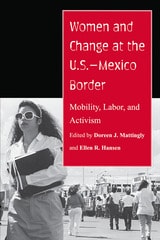
Women and Change at the U.S.–Mexico Border
Mobility, Labor, and ActivismEdited by Doreen J. Mattingly and Ellen R. Hansen
University of Arizona Press, 2006

Women and the Animal Rights Movement
Emily Gaarder
Rutgers University Press, 2011
Animal rights is one of the fastest growing social movements today. Women greatly outnumber men as activists, yet surprisingly, little has been written about the importance and impact of gender on the movement. Women and the Animal Rights Movement combats stereotypes of women activists as mere sentimentalists by exploring the political and moral character of their advocacy on behalf of animals.
Emily Gaarder analyzes the politics of gender in the movement, incorporating in-depth interviews with women and participant observation of animal rights organizations, conferences, and protests to describe struggles over divisions of labor and leadership. Controversies over PETA advertising campaigns that rely on women's sexuality to "sell" animal rights illustrate how female crusaders are asked to prioritize the cause of animals above all else. Gaarder underscores the importance of a paradigm shift in the animal liberation movement, one that seeks a more integrated vision of animal rights that connects universally to other issues--gender, race, economics, and the environment--highlighting that many women activists recognize and are motivated by the connection between the oppression of animals and other social injustices.
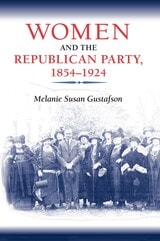
Women and the Republican Party, 1854-1924
Melanie Susan Gustafson
University of Illinois Press, 2001
Acclaimed as groundbreaking since its publication, Women and the Republican Party, 1854-1924 explores the forces that propelled women to partisan activism in an era of widespread disfranchisement and provides a new perspective on how women fashioned their political strategies and identities before and after 1920.
Melanie Susan Gustafson examines women's partisan history against the backdrop of women's political culture. Contesting the accepted notion that women were uninvolved in political parties before gaining the vote, Gustafson reveals the length and depth of women's partisan activism between the founding of the Republican Party, whose abolitionist agenda captured the loyalty of many women, and the passage of the Nineteenth Amendment. Her account also looks at the complex interplay of partisan and nonpartisan activity; the fierce debates among women about how to best use their influence; the ebb and flow of enthusiasm for women's participation; and the third parties that fused the civic world of reform organizations with the electoral world of voting and legislation.
Women's Activism and Feminist Agency in Mozambique and Nicaragua
Jennifer Leigh Disney
Temple University Press, 2009
In Women's Activism and Feminist Agency in Mozambique and Nicaragua, Jennifer Leigh Disney investigates the contours of women’s emancipation outside the framework of liberal democracy and a market economy. She interviews 146 women and men in the two countries to explore the comparative contribution of women’s participation in subsistence and informal economies, political parties and civil society organizations. She also discusses military struggles against colonialism and imperialism in fostering feminist agency to provide a fascinating look at how each movement evolved and how it changed in a post-revolutionary climate.