Results by title
77 books match the query 'Words' and 23 start with w
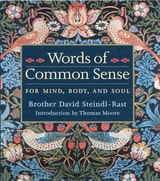
Words Of Common Sense
Brother David Steindl-Rast
Templeton Press, 2002
Brother David Steindl-Rast takes us on a journey to discover the wisdom preserved in common sense sayings that have been passed down through generations. These timeless words reflect the shared values cherished by people all over the world.
"When you drink from a stream,” says one Chinese proverb, “remember the spring." From these simple words we are reminded to be grateful for even the smallest graces that we receive. Another homespun phrase tells us that "a contented heart is a continual feast," reminding us to look within, rather than without, for the source of our happiness.
Words of Common Sense reveals the thread of human experience expressed in the world’s proverbs and sayings. It helps us connect with cultures other than our own and recognize our shared humanity. These words resonate around the world because they are timeless reflections on how to cultivate a life of love, gratitude, and meaning.
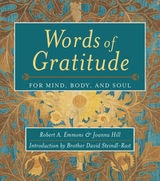
Words Of Gratitude Mind Body & Soul
Robert A. Emmons
Templeton Press, 2001
"The test of all happiness,” said G.K. Chesterton, “is gratitude."
Learning to experience gratitude involves being grateful as an attitude, not as a reaction when good things occur. To be grateful, one does not need to wait until things are perfect. In fact, practicing gratitude makes one receptive to life's blessings, and these blessings continue as we continue to be thankful.
In one study, described by author Robert Emmons, participants who wrote about five things for which they were grateful experienced more positive emotional states and were more likely to help others over a period of ten weeks than were participants who wrote about the hassles and stressors they experienced during the same time.
"Love wholeheartedly,” says Brother David Steindl-Rast, “be surprised, give thanks and praise—then you will discover the fullness of your life."
Gratitude provides gifts to both the giver and the receiver, and this illuminating book will inspire readers to recognize just how truly blessed we are.
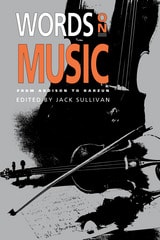
Words On Music
From Addison To BarzunJack Sullivan
Ohio University Press, 1990
Words on Music is thus the first book of its kind. Covering instrumental and vocal music from the eighteenth through the twentieth centuries, it features essays distinguished by their literary quality, their readability, and their appeal to a wide audience. Included is writing by novelists, essayists, composers, performers, cultural historians, and others who have written about music with precision and passion.
Here is George Bernard Shaw on Handel, Albert Schweitzer on Bach, Glenn Gould on Scarlatti, E. T. A. Hoffman on Beethoven, Heinrich Heine on Rossini, Aaron Copland on Mozart, George Eliot on Wagner, G. K. Chesterton on Gilbert and Sullivan, Leonard Bernstein on Mahler, Guy Davenport on Ives, Pierre Boulez on Stravinsky, Ned Rorem on Ravel, and more than fifty others. Here also are essays on broader topics—Joseph Addison on opera, Anthony Burgess on music and literature, Jacques Barzun on music criticism, H. L. Mencken on “Music an Sin”—as well as musical memoirs by such masters of the genre as Hector Berlioz, Leigh Hunt, and Ethel Smyth.
Words on Music is a uniquely literary and readable book on music. With its wide range of tones and voices, it is ideal for the general reader, the humanities educator, and the musical specialist. Each article is introduced by an informative headnote on the writer and subject. In addition, the volume offers a bibliography with valuable clues for further reading and a substantial essay introducing the elusive art of writing about music.
Words and Contents
Richard Vallée
CSLI, 2018
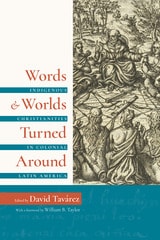
Words and Worlds Turned Around
Indigenous Christianities in Colonial Latin AmericaDavid Tavárez
University Press of Colorado, 2017
A sophisticated, state-of-the-art study of the remaking of Christianity by indigenous societies, Words and Worlds Turned Around reveals the manifold transformations of Christian discourses in the colonial Americas. The book surveys how Christian messages were rendered in indigenous languages; explores what was added, transformed, or glossed over; and ends with an epilogue about contemporary Nahuatl Christianities.
In eleven case studies drawn from eight Amerindian languages—Nahuatl, Northern and Valley Zapotec, Quechua, Yucatec Maya, K'iche' Maya, Q'eqchi' Maya, and Tupi—the authors address Christian texts and traditions that were repeatedly changed through translation—a process of “turning around” as conveyed in Classical Nahuatl. Through an examination of how Christian terms and practices were made, remade, and negotiated by both missionaries and native authors and audiences, the volume shows the conversion of indigenous peoples as an ongoing process influenced by what native societies sought, understood, or accepted.
The volume features a rapprochement of methodologies and assumptions employed in history, anthropology, and religion and combines the acuity of of methodologies drawn from philology and historical linguistics with the contextualizing force of the ethnohistory and social history of Spanish and Portuguese America.
Contributors: Claudia Brosseder, Louise M. Burkhart, Mark Christensen, John F. Chuchiak IV, Abelardo de la Cruz, Gregory Haimovich, Kittiya Lee, Ben Leeming, Julia Madajczak, Justyna Olko, Frauke Sachse, Garry Sparks
Words and Worlds
A Lexicon for Dark TimesVeena Das and Didier Fassin, editors
Duke University Press, 2021
Contributors. Banu Bargu, Veena Das, Alex de Waal, Didier Fassin, Peter Geschiere, Behrooz Ghamari-Tabrizi, Caroline Humphrey, Ravi Kanbur, Julieta Lemaitre, Uday S. Mehta, Jan-Werner Müller, Jonathan Pugh, Elizabeth F. Sanders, Todd Sanders
Words and the Grammar of Context
Paul Kay
CSLI, 1997
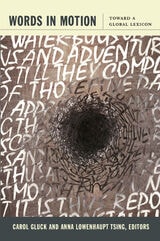
Words in Motion
Toward a Global LexiconCarol Gluck and Anna Lowenhaupt Tsing, eds.
Duke University Press, 2009
Such words as security in Brazil, responsibility in Japan, community in Thailand, and hijāb in France changed the societies in which they moved even as the words were changed by them. Some words threatened to launch wars, as injury did in imperial Britain’s relations with China in the nineteenth century. Others, such as secularism, worked in silence to agitate for political change in twentieth-century Morocco. Words imposed or imported from abroad could be transformed by those who wielded them to oppose the very powers that first introduced them, as happened in Turkey, Indonesia, and the Philippines. Taken together, this selection of fourteen essays reveals commonality as well as distinctiveness across modern societies, making the world look different from the interdisciplinary and transnational perspective of “words in motion.”
Contributors. Mona Abaza, Itty Abraham, Partha Chatterjee, Carol Gluck, Huri Islamoglu, Claudia Koonz, Lydia H. Liu, Driss Maghraoui, Vicente L. Rafael, Craig J. Reynolds, Seteney Shami, Alan Tansman, Kasian Tejapira, Anna Lowenhaupt Tsing
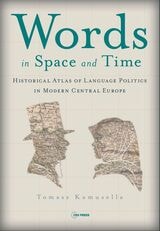
Words in Space and Time
A Historical Atlas of Language Politics in Modern Central EuropeTomasz Kamusella
Central European University Press, 2022
With forty-two extensively annotated maps, this atlas offers novel insights into the history and mechanics of how Central Europe’s languages have been made, unmade, and deployed for political action. The innovative combination of linguistics, history, and cartography makes a wealth of hard-to-reach knowledge readily available to both specialist and general readers. It combines information on languages, dialects, alphabets, religions, mass violence, or migrations over an extended period of time.
The story first focuses on Central Europe’s dialect continua, the emergence of states, and the spread of writing technology from the tenth century onward. Most maps concentrate on the last two centuries. The main storyline opens with the emergence of the Western European concept of the nation, in accord with which the ethnolinguistic nation-states of Italy and Germany were founded. In the Central European view, a “proper” nation is none other than the speech community of a single language. The Atlas aspires to help users make the intellectual leap of perceiving languages as products of human history and part of culture. Like states, nations, universities, towns, associations, art, beauty, religions, injustice, or atheism—languages are artefacts invented and shaped by individuals and their groups.

Words in Transit
Stories of ImmigrantsIlan Stavans
University of Massachusetts Press, 2016
Gathered together in a beautifully designed book that showcases Beth Reynolds's photographic portraits of each immigrant, these oral histories illuminate the many paths leading to the Pioneer Valley and demonstrate the shared experience among those seeking a new life in a foreign land. Storytellers include a massage therapist from Ireland, a Fulbright scholar from Palestine, a health educator from Taiwan, a literature professor from Spain, and a yoga teacher from Romania. Other participants hail from far-flung places including Haiti, Jamaica, El Salvador, Côte d'Ivoire, the Dominican Republic, Bhutan, Laos, Syria, Cambodia, Sri Lanka, Nepal, Congo, Slovenia, Iraq, and Ukraine. Introduced by the renowned scholar of translation and global literature Ilan Stavans, these stories testify to the resilience, bravery, and hopefulness of western New England émigrés. Proceeds from this book go to scholarships for immigrants at Holyoke Community College.
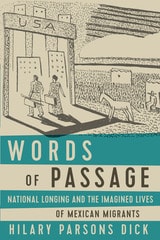
Words of Passage
National Longing and the Imagined Lives of Mexican MigrantsBy Hilary Parsons Dick
University of Texas Press, 2018
Migration fundamentally shapes the processes of national belonging and socioeconomic mobility in Mexico—even for people who never migrate or who return home permanently. Discourse about migrants, both at the governmental level and among ordinary Mexicans as they envision their own or others’ lives in “El Norte,” generates generic images of migrants that range from hardworking family people to dangerous lawbreakers. These imagined lives have real consequences, however, because they help to determine who can claim the resources that facilitate economic mobility, which range from state-sponsored development programs to income earned in the North.
Words of Passage is the first full-length ethnography that examines the impact of migration from the perspective of people whose lives are affected by migration, but who do not themselves migrate. Hilary Parsons Dick situates her study in the small industrial city of Uriangato, in the state of Guanajuato. She analyzes the discourse that circulates in the community, from state-level pronouncements about what makes a “proper” Mexican to working-class people’s talk about migration. Dick shows how this migration discourse reflects upon and orders social worlds long before—and even without—actual movements beyond Mexico. As she listens to men and women trying to position themselves within the migration discourse and claim their rights as “proper” Mexicans, she demonstrates that migration is not the result of the failure of the Mexican state but rather an essential part of nation-state building.
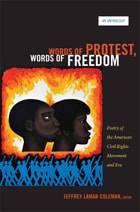
Words of Protest, Words of Freedom
Poetry of the American Civil Rights Movement and EraJeffrey Lamar Coleman, ed.
Duke University Press, 2012
Some of the poems address crucial movement-related events—such as the integration of the Little Rock schools, the murders of Emmett Till and Medgar Evers, the emergence of the Black Panther party, and the race riots of the late 1960s—and key figures, including Martin Luther King Jr., Malcolm X, and John and Robert Kennedy. Other poems speak more broadly to the social and political climate of the times. Along with Jeffrey Lamar Coleman's headnotes, the poems recall the heartbreaking and jubilant moments of a tumultuous era. Altogether, more than 150 poems by approximately 100 poets showcase the breadth of the genre of civil rights poetry.
Selected contributors. Maya Angelou, W. H. Auden, Amiri Baraka, Gwendolyn Brooks, Lucille Clifton Lawrence Ferlinghetti, Allen Ginsberg, Langston Hughes, June Jordan, Philip Levine, Audre Lorde, Robert Lowell, Pauli Murray, Huey P. Newton, Adrienne Rich, Sonia Sanchez, Léopold Sédar Senghor, Derek Walcott, Alice Walker, Yevgeny Yevtushenko
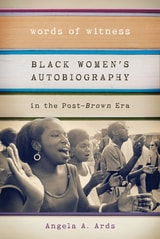
Words of Witness
Black Women's Autobiography in the Post-<i>Brown</i> EraAngela A. Ards
University of Wisconsin Press, 2015
Exploring works by the critically acclaimed June Jordan and Edwidge Danticat, as well as by popular and emerging authors such as Melba Beals, Rosemary Bray, and Eisa Davis, Ards demonstrates how each text asserts countermemories to official—and often nostalgic—understandings of the civil rights and Black Power movements. She situates each writer as activist-citizen, adopting and remaking particular roles—warrior, “the least of these,” immigrant, hip-hop head—to crystallize a range of black feminist responses to urgent but unresolved political issues.

Words of the Inuit
A Semantic Stroll through a Northern CultureLouis-Jacques Dorais
University of Manitoba Press, 2020
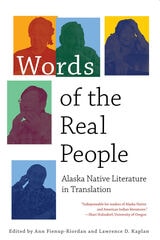
Words of the Real People
Alaska Native Literature in TranslationEdited by Ann Fienup-Riordan and Lawrence D. Kaplan
University of Alaska Press, 2007
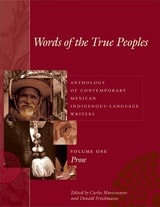
Words of the True Peoples/Palabras de los Seres Verdaderos
Anthology of Contemporary Mexican Indigenous-Language Writers/Antología de Escritores Actuales en Lenguas Indígenas de México: Volume One/Tomo Uno: Prose/ProsaEdited by Carlos Montemayor and Donald Frischmann
University of Texas Press, 2005
As part of the larger, ongoing movement throughout Latin America to reclaim non-Hispanic cultural heritages and identities, indigenous writers in Mexico are reappropriating the written word in their ancestral tongues and in Spanish. As a result, the long-marginalized, innermost feelings, needs, and worldviews of Mexico's ten to twenty million indigenous peoples are now being widely revealed to the Western societies with which these peoples coexist. To contribute to this process and serve as a bridge of intercultural communication and understanding, this groundbreaking, three-volume anthology gathers works by the leading generation of writers in thirteen Mexican indigenous languages: Nahuatl, Maya, Tzotzil, Tzeltal, Tojolabal, Tabasco Chontal, Purepecha, Sierra Zapoteco, Isthmus Zapoteco, Mazateco, Ñahñu, Totonaco, and Huichol.
Volume 1 contains narratives and essays by Mexican indigenous writers. Their texts appear first in their native language, followed by English and Spanish translations. Frischmann and Montemayor have abundantly annotated the English, Spanish, and indigenous-language texts and added glossaries and essays that trace the development of indigenous texts, literacy, and writing. These supporting materials make the anthology especially accessible and interesting for nonspecialist readers seeking a greater understanding of Mexico's indigenous peoples.
The other volumes of this work will be Volume 2: Poetry/Poesía and Volume 3: Theater/Teatro.
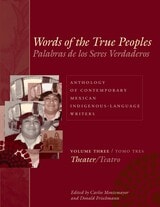
Words of the True Peoples/Palabras de los Seres Verdaderos
Anthology of Contemporary Mexican Indigenous-Language Writers/Antología de Escritores Actuales en Lenguas Indígenas de México: Volume Three/Tomo Tres: Theater/TeatroEdited by Carlos Montemayor and Donald Frischmann
University of Texas Press, 2007
As part of the larger, ongoing movement throughout Latin America to reclaim non-Hispanic cultural heritages and identities, indigenous writers in Mexico are reappropriating the written word in their ancestral tongues and in Spanish. As a result, the long-marginalized, innermost feelings, needs, and worldviews of Mexico's ten to twenty million indigenous peoples are now being widely revealed to the Western societies with which these peoples coexist. To contribute to this process and serve as a bridge of intercultural communication and understanding, this groundbreaking, three-volume anthology gathers works by the leading generation of writers in thirteen Mexican indigenous languages: Nahuatl, Maya, Tzotzil, Tzeltal, Tojolabal, Tabasco Chontal, Purepecha, Sierra Zapoteco, Isthmus Zapoteco, Mazateco, Ñahñu, Totonaco, and Huichol.
Volume Three contains plays by six Mexican indigenous writers. Their plays appear first in their native language, followed by English and Spanish translations. Montemayor and Frischmann have abundantly annotated the Spanish, English, and indigenous-language texts and added glossaries and essays that introduce the work of each playwright and discuss the role of theater within indigenous communities. These supporting materials make the anthology especially accessible and interesting for nonspecialist readers seeking a greater understanding of Mexico's indigenous peoples.
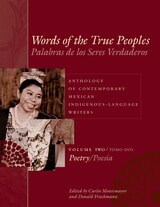
Words of the True Peoples/Palabras de los Seres Verdaderos
Anthology of Contemporary Mexican Indigenous-Language Writers/Antología de Escritores Actuales en Lenguas Indígenas de México: Volume Two/Tomo Dos: Poetry/PoesíaEdited by Carlos Montemayor and Donald Frischmann
University of Texas Press, 2005
As part of the larger, ongoing movement throughout Latin America to reclaim non-Hispanic cultural heritages and identities, indigenous writers in Mexico are reappropriating the written word in their ancestral tongues and in Spanish. As a result, the long-marginalized, innermost feelings, needs, and worldviews of Mexico's ten to twenty million indigenous peoples are now being widely revealed to the Western societies with which these peoples coexist. To contribute to this process and serve as a bridge of intercultural communication and understanding, this groundbreaking, three-volume anthology gathers works by the leading generation of writers in thirteen Mexican indigenous languages: Nahuatl, Maya, Tzotzil, Tzeltal, Tojolabal, Tabasco Chontal, Purepecha, Sierra Zapoteco, Isthmus Zapoteco, Mazateco, Ñahñu, Totonaco, and Huichol.
Volume Two contains poetry by Mexican indigenous writers. Their poems appear first in their native language, followed by English and Spanish translations. Montemayor and Frischmann have abundantly annotated the Spanish, English, and indigenous-language texts and added glossaries and essays that discuss the formal and linguistic qualities of the poems, as well as their place within contemporary poetry. These supporting materials make the anthology especially accessible and interesting for nonspecialist readers seeking a greater understanding of Mexico's indigenous peoples.

Words on Words
Quotations about Language and LanguagesEdited by David Crystal and Hilary Crystal
University of Chicago Press, 2000
The quotations are grouped thematically under 65 different headings, from "The Nature of Language" through the "Language of Politics" to "Quoting and Misquoting." This arrangement enables the reader to explore a topic through a variety of lenses, ancient and modern, domestic and foreign, scientific and casual, ironic and playful. Three thorough indexes—to authors, sources, and key words—provide different entry points into the collection. A valuable resource for professional writers and scholars, Words on Words is for anyone who loves language and all things linguistic.
Words on the Air
Essays on Language, Manners, Morals, and LawsJohn Sparrow
University of Chicago Press, 1981
Words to Create a World
Daniel Hoffman
University of Michigan Press, 1993
Between these are discussions of books by and about founding modernists (Pound, Moore, Sitwell, Frost, Graves, Auden) who do not “succumb to the imitative fallacy and gibber at the window because the house is on fire.” Hoffman’s historical imagination elucidates the work of many other contemporary American and British poets, including his own. Words to Create a World will appeal to the reader who enjoys poetry and who hopes for guidance over the sprawling terrain of verse in the twentieth century.
Words to Our Now
Imagination and DissentThomas Glave
University of Minnesota Press, 2007
In these lyrical and powerful essays, Thomas Glave draws on his experiences as a politically committed, gay Jamaican American to deliver a condemnation of the prejudices, hatreds, and inhumanities that persist in the United States and elsewhere. Exposing the hypocrisies of liberal multiculturalism, Glave offers instead a politics of heterogeneity in which difference informs the theory and practice of democracy. At the same time, he experiments with language to provide a model of creative writing as a tool for social change. From the death of black gay poet Essex Hemphill to the revelations of abuse at Abu Ghraib, Glave puts forth an ethical understanding of human rights to make vital connections across nations, races, genders, and sexualities.
Thomas Glave is assistant professor of English at SUNY Binghamton. He is author of Whose Song? and Other Stories.
Words, Works, and Ways of Knowing
The Breakdown of Moral Philosophy in New England before the Civil WarSara Paretsky
University of Chicago Press, 2016
What’s less well-known is that before Paretsky began her writing career, she earned a PhD in history from the University of Chicago with a dissertation on moral philosophy and religion in New England in the early and mid-nineteenth century. Now, for the first time, fans of Paretsky can read that earliest work, Words, Works, and Ways of Knowing.
Paretsky here analyzes attempts by theologians at Andover Seminary, near Boston, to square and secure Calvinist religious beliefs with emerging knowledge from history and the sciences. She carefully shows how the open-minded scholasticism of these theologians paradoxically led to the weakening of their intellectual credibility as conventional religious belief structures became discredited, and how this failure then incited reactionary forces within Calvinism. That conflict between science and religion in the American past is of interest on its face, but it also sheds light on contemporary intellectual battles.
Rounding out the book, leading religious scholar Amanda Porterfield provides an afterword discussing where Paretsky’s work fits into the contemporary study of religion. And in a sobering—sometimes shocking—preface, Paretsky paints a picture of what it was like to be a female graduate student at the University of Chicago in the 1970s. A treat for Paretsky’s many fans, this book offers a glimpse of the development of the mind behind the mysteries.