Results by title
80 books match the query 'foundations' and 5 start with w
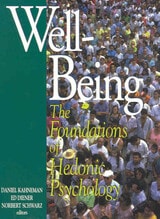
Well-Being
Foundations of Hedonic PsychologyDaniel Kahneman
Russell Sage Foundation, 1999
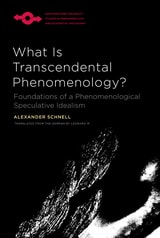
What Is Transcendental Phenomenology?
Foundations of a Phenomenological Speculative IdealismAlexander Schnell; Leonard Ip
Northwestern University Press, 2027
Offering a systematic introduction to a vital discipline
Phenomenology is a now century-old school of philosophy, to which Alexander Schnell offers here a threefold introduction that explores its diversity of approaches. In What Is Transcendental Phenomenology?, Schnell provides an in-depth overview of the Husserlian phenomenological method and its fundamental concepts (epoché and reduction, eidetic variation, phenomenological description, and phenomenological construction). He then examines that method’s limits, stressing the necessity of overcoming them in order to achieve a constructive approach while staying true to its fundamental disciplinary frameworks. Finally, he outlines a theory of understanding that expands the phenomenological method and highlights its speculative grounding before turning to speculative realists’ criticisms of the field. Schnell’s work shows that phenomenology can face the challenge of speculative thinking from an idealist standpoint, making a vital contribution to current debates about new, or speculative, realism. This important volume not only answers its titular question but, in its mode of discussing its subject, is itself phenomenology.

Who is my neighbor?
personalism and the foundations of human rightsThomas D. Williams
Catholic University of America Press, 2005
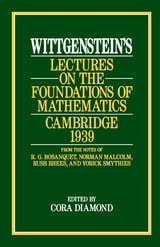
Wittgenstein's Lectures on the Foundations of Mathematics, Cambridge, 1939
Ludwig Wittgenstein
University of Chicago Press, 1989
He sat on a chair in the middle of the room, with some of the class sitting in chairs, some on the floor. He never used notes. He paused frequently, sometimes for several minutes, while he puzzled out a problem. He often asked his listeners questions and reacted to their replies. Many meetings were largely conversation.
These lectures were attended by, among others, D. A. T. Gasking, J. N. Findlay, Stephen Toulmin, Alan Turing, G. H. von Wright, R. G. Bosanquet, Norman Malcolm, Rush Rhees, and Yorick Smythies. Notes taken by these last four are the basis for the thirty-one lectures in this book.
The lectures covered such topics as the nature of mathematics, the distinctions between mathematical and everyday languages, the truth of mathematical propositions, consistency and contradiction in formal systems, the logicism of Frege and Russell, Platonism, identity, negation, and necessary truth. The mathematical examples used are nearly always elementary.

Women's Studies for the Future
Foundations, Interrogations, PoliticsEdited by Elizabeth Lapovsky Kennedy and Agatha Beins
Rutgers University Press, 2005
Established as an academic field in the 1970s, women’s studies is a relatively young but rapidly growing area of study. Not only has the number of scholars working in this subject expanded exponentially, but women’s studies has become institutionalized, offering graduate degrees and taking on departmental status in many colleges and universities. At the same time, this field—formed in the wake of the feminist movement—is finding itself in a precarious position in what is now often called a “post-feminist” society. This raises challenging issues for faculty, students, and administrators. How must the field adjust its goals and methods to continue to affect change in the future?
Bringing together essays by newcomers as well as veterans to the field, this essential volume addresses timely questions including:
- Without a unitary understanding of the subject, woman, what is the focus of women’s studies?
- How can women’s studies fulfill the promise of interdisciplinarity?
- What is the continuing place of activism in women’s studies?
- What are the best ways to think about, teach, and act upon the intersections of race, class, gender, disability, nation, and sexuality?
Offering innovative models for research and teaching and compelling new directions for action, Women’s Studies for the Future ensures the continued relevance and influence of this developing field.