Results by title
28167 books match the query 'History' and 1118 start with w
Women, Power, and Dissent in the Hills of Carolina
Mary K. Anglin
University of Illinois Press, 2002
Women, Power, and Dissent in the Hills of Carolina is a unique and impassioned exploration of gender, labor, and resistance in western North Carolina. Based on eight months of field research in a mica manufacturing plant and the surrounding rural community, as well as oral histories of women who worked in mica houses in the early twentieth century, this landmark study canvasses the history of the mica industry and the ways it came to be organized around women's labor.
Mary K. Anglin's investigation of working women's lives in the plant she calls "Moth Hill Mica Company" reveals the ways women have contributed to household and regional economies for more than a century. Without union support or recognition as skilled laborers, these women developed alternate strategies for challenging the poor working conditions, paltry wages, and corporate rhetoric of Moth Hill. Utilizing the power of memory and strong family and community ties, as well as their own interpretations of gender and culture, the women have found ways to "boss themselves."
Women, Production, and Patriarchy in Late Medieval Cities
Martha C. Howell
University of Chicago Press, 1986
Women, Violence and Trauma in Wartime and Postwar Northeastern Adriatic
Marta Verginella
Central European University Press, 2026
Drawing on a rich range of sources—psychiatric records, diaries, autobiographies, oral histories, literature, film, and archival documents—the contributors foreground voices long marginalized in official histories. Together, the chapters reveal both vulnerability and resilience, tracing how trauma was lived, narrated, silenced, and politically instrumentalized across different post-war contexts, from the early Cold War to post-socialist societies. This collection reshapes debates in gender history, memory studies, and trauma research, offering new insights into how women endured, interpreted, and transformed the violent legacies of the twentieth century.

Women, Violence and War
Wartime Victimization of Refugees in the BalkansVesna Nikolic-Ristanovic
Central European University Press, 2000
Based on interviews with seventy women refugees, Women, Violence and War is a book about war as it is seen, lived and interpreted by women who were citizens of the former Yugoslavia.
Many of the accounts portray the horrific experiences the victims had to face and the book addresses issues of sexual, physical and psychological violence, as well as problems of confinement, upheaval and family separation. In a completely new insight the book dispels the myth that many of the women were peasants, and shows that in fact they were educated, middle-class women with independent careers. The study also depicts how some of the victims attempt to come to terms with the aftermath of wartime abuse.
This probing, accurate and unique investigation of victimization is an unparalleled volume that presents a completely new perspective maintaining that violence against women in war is not independent of peace-time victimization and the imbalance of power between sexes.
Women, War, and the Making of Bangladesh
Remembering 1971Yasmin Saikia
Duke University Press, 2011
Women, Work, and Activism
Chapters of an Inclusive History of Labor in the Long Twentieth CenturyEloisa Betti
Central European University Press, 2022
The thirteen critical and well-documented chapters of Women, Work and Activism examine women’s labor struggle from late nineteenth-century Portuguese mutual societies to Yugoslav peasant women’s work in the 1930s, and from the Catalan labor movement under the Franco dictatorship to workplace democracy in the United States. The authors portray women's labor activism in a wide variety of contexts. This includes spontaneous resistance to masculinist trade unionism, the feminist engagement of women workers, the activism of communist wives of workers, and female long-distance migration, among others. The chapters address the gendered involvement of working people in multiple and often precarious and unstable labor relations and in unpaid labor, as well as the role of the state and other institutions in shaping the history of women’s labor.
The book is an innovative contribution to both the new labor history and feminist history. It fully integrates the conceptual advances made by gender historians in the study of labor activism, driving home critiques of Eurocentric historiographies of labor to Europe while simultaneously contributing to an inclusive history of women’s labor-related activism wherever to be found. Examining women’s activism in male-dominated movements and institutions, and in women’s networks and organizations, the authors make a case for a new direction in gender history.

Women, Work, and Representation
Needlewomen in Victorian Art and LiteratureLynn M. Alexander
Ohio University Press, 2003
In Victorian England, virtually all women were taught to sew; needlework was allied with images of domestic economy and with traditional female roles of wife and mother- with home rather than factory. The professional seamstress, however, labored long hours for very small wages creating gowns for the upper and middle classes. In her isolation and helplessness, she provided social reformers with a powerful image of working-class suffering that appealed to the sensibilities of the upper classes and helped galvanize public opinion around the need for reform.
Women, Work, and Representation addresses the use of that image in the reform movement, underscoring the shock to the Victorian public when reports revealed that the profession of needlework was extremely hazardous, even deadly.
Author Lynn M. Alexander traces the development of the symbol of the seamstress through a variety of presentations, drawing from the writings of Charles Dickens, Elizabeth Gaskell, Charlotte Elizabeth Tonna, and George W. M. Reynolds, and on visual representations by Richard Redgrave, Thomas Benjamin Kennington, John Everett Millais, John Leech, John Tenniel, and Hubert von Herkomer.
Written to appeal to Victorian scholars, women's studies scholars, and those interested in semiotics and aestheticism, Women, Work, and Representation includes twenty illustrations, most from periodicals of the day, providing new insights into the lives of working women throughout the Victorian era.
Women, Work, and Worship in Lincoln's Country
The Dumville Family LettersEdited by Anne M. Heinz and John P. Heinz
University of Illinois Press, 2016
Women, the Family, and Peasant Revolution in China
Kay Ann Johnson
University of Chicago Press, 1983
Johnson's primary focus is on reforms of marriage and family because traditional marriage, family, and kinship practices have had the greatest influence in defining and shaping women's place in Chinese society. Conversant with current theory in political science, anthropology, and Marxist and feminist analysis, Johnson writes with clarity and discernment free of dogma. Her discussions of family reform ultimately provide insights into the Chinese government's concern with decreasing the national birth rate, which has become a top priority. Johnson's predictions of a coming crisis in population control are borne out by the recent increase in female infanticide and the government abortion campaign.
Women, the New York School, and Other True Abstractions
Maggie Nelson
University of Iowa Press, 2007
Women, the State, and Welfare
Edited by Linda Gordon
University of Wisconsin Press, 1990
Womenfolks
Growing Up Down SouthShirley Abbott
University of Arkansas Press, 2017
Women’s Bookscapes in Early Modern Britain
Reading, Ownership, CirculationLeah Knight, Micheline White, and Elizabeth Sauer, Editors
University of Michigan Press, 2018
Women in 16th- and 17th-century Britain read, annotated, circulated, inventoried, cherished, criticized, prescribed, and proscribed books in various historically distinctive ways. Yet, unlike that of their male counterparts, the study of women’s reading practices and book ownership has been an elusive and largely overlooked field.
In thirteen probing essays, Women’s Bookscapesin Early Modern Britain brings together the work of internationally renowned scholars investigating key questions about early modern British women’s figurative, material, and cultural relationships with books. What constitutes evidence of women’s readerly engagement? How did women use books to achieve personal, political, religious, literary, economic, social, familial, or communal goals? How does new evidence of women’s libraries and book usage challenge received ideas about gender in relation to knowledge, education, confessional affiliations, family ties, and sociability? How do digital tools offer new possibilities for the recovery of information on early modern women readers?
The volume’s three-part structure highlights case studies of individual readers and their libraries; analyses of readers and readership in the context of their interpretive communities; and new types of scholarly evidence—lists of confiscated books and convent rules, for example—as well as new methodologies and technologies for ongoing research. These essays dismantle binaries of private and public; reading and writing; female and male literary engagement and production; and ownership and authorship.
Interdisciplinary, timely, cohesive, and concise, this collection’s fresh, revisionary approaches represent substantial contributions to scholarship in early modern material culture; book history and print culture; women’s literary and cultural history; library studies; and reading and collecting practices more generally.
Women’s Labour Activism in Eastern Europe and Beyond
A New Transnational historySelin Çagatay, et al.
University College London, 2025
So often, theories of activism and social change neglect acts of resistance in informal, community, and domestic contexts. This collaborative investigation from a transnational team of scholars addresses two related shortcomings: the lack of class analysis in gender history and the neglect of gender dynamics in labor history. Women’s Labour Activism in Eastern Europe and Beyond highlights understudied topics in both of these fields, such as radical, grassroots, and interclass women’s labor activism on behalf of lower-income and working-class women and communities; women’s participation in trade unions on both sides of the Iron Curtain; and the heretofore neglected presence of Eastern European women in international organizations, including the cooperative movement.
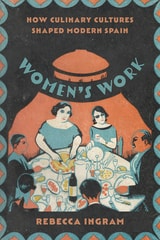
Women’s Work
How Culinary Cultures Shaped Modern SpainRebecca Ingram
Vanderbilt University Press, 2022
We are living in a moment in which famous chefs, Michelin stars, culinary techniques, and gastronomical accolades attract moneyed tourists to Spain from all over the world. This has prompted the Spanish government to declare its cuisine as part of Spanish patrimony. Even with this widespread global attention, we know little about how Spanish cooking became a litmus test for demonstrating Spain's modernity and, relatedly, the roles ascribed to the modern Spanish women responsible for daily cooking.
Efforts to articulate a new, modern Spain infiltrated writing in multiple genres and media. Women's Work offers a sharp reading of diverse sources, placed in their historical context, that yields a better understanding of the roles of food within an inherently uneven modernization process. Further, author Rebecca Ingram's perceptive critique reveals the paradoxical messages women have navigated, even in texts about a daily practice that shaped their domestic and work lives. Women's Work posits that this is significant because of the degree to which domestic activities, including cooking, occupied women's daily lives, even while issues like their fitness as citizens and participation in the public sphere were hotly debated. At the same time, progressive intellectuals from diverse backgrounds began to invoke Spanish cooking and eating as one measure of Spanish modernity.
Women's Work shows how culinary writing engaged these debates and reached women at the site of much of their daily labor—the kitchen—and, in this way, shaped their thinking about their roles in modernizing Spain.
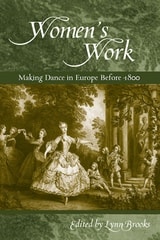
Women’s Work
Making Dance in Europe before 1800Edited by Lynn Matluck Brooks
University of Wisconsin Press, 2007
Through dance, women asserted power in spheres largely dominated by men: the court, the theater, and the church. As women’s dance worlds intersected with men’s, their lives and visions were supported or opposed, creating a complex politics of creative, spiritual, and political expression. From a women’s religious order in the thirteenth-century Low Countries that used dance as a spiritual rite of passage to the salon culture of eighteenth-century France where dance became an integral part of women’s cultural influence, the writers in this volume explore the meaning of these women’s stories, performances, and dancing bodies, demonstrating that dance is truly a field across which women have moved with finesse and power for many centuries past.

Wonder Shows
Performing Science, Magic, and Religion in AmericaNadis, Fred
Rutgers University Press, 2005
Imagine a stage full of black cats emitting electrical sparks, a man catching bullets with his teeth, or an evangelist jumping on a transformer to shoot bolts of lightning through his fingertips. These and other wild schemes were part of the repertoire of showmen who traveled from city to city, making presentations that blended science with myth and magic.
In Wonder Shows, Fred Nadis offers a colorful history of these traveling magicians, inventors, popular science lecturers, and other presenters of “miracle science” who revealed science and technology to the public in awe-inspiring fashion. The book provides an innovative synthesis of the history of performance with a wider study of culture, science, and religion from the antebellum period to the present.
It features a lively cast of characters, including electrical “wizards” Nikola Tesla and Thomas Alva Edison, vaudeville performers such as Harry Houdini, mind readers, UFO cultists, and practitioners of New Age science. All of these performers developed strategies for invoking cultural authority to back their visions of science and progress. The pseudo-science in their wonder shows helped promote a romantic worldview that called into question the absolute authority of scientific materialism while reaffirming the importance of human spirituality. Nadis argues that the sensation that these entertainers provided became an antidote to the alienation and dehumanization that accompanied the rise of modern America.
Although most recent defenders of science are prone to reject wonder, considering it an ally of ignorance and superstition, Wonder Shows demonstrates that the public’s passion for magic and meaning is still very much alive. Today, sales continue to be made and allegiances won based on illusions that products are unique, singular, and at best, miraculous. Nadis establishes that contemporary showmen, corporate publicists, advertisers, and popular science lecturers are not that unlike the magicians and mesmerists of years ago.
Wonderful Things from 400 Years of Collecting
The Bodleian Library 1602-2002Edited by the Bodleian Library
Bodleian Library Publishing, 2002
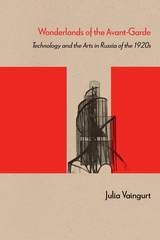
Wonderlands of the Avant-Garde
Technology and the Arts in Russia of the 1920sJulia Vaingurt
Northwestern University Press, 2013
In postrevolutionary Russia, as the Soviet government pursued rapid industrialization, avant-garde artists declared their intent to serve the nascent state and to transform life in accordance with their aesthetic designs. Despite their utilitarian intentions, however, most avant-gardists rarely created works regarded as practical instruments of societal transformation. Exploring this paradox, Vaingurt claims that the artists’ fusion of technology and aesthetics prevented their creations from being fully conscripted into the arsenal of political hegemony. The purposes of avant-garde technologies, she contends, are contemplative rather than constructive. Looking at Meyerhold’s theater, Tatlin’s and Khlebnikov’s architectural designs, Mayakovsky’s writings, and other works from the period, Vaingurt offers an innovative reading of an exceptionally complex moment in the formation of Soviet culture.
Wonders of Sand and Stone
A History of Utah's National Parks and MonumentsFrederick H. Swanson
University of Utah Press, 2020
Drawing on extensive historical research, Swanson presents little-known accounts of people who saw in these sculptured landscapes something worth protecting. Readers are introduced to the region’s early explorers, scientists, artists, and travelers as well as the local residents and tourism promoters who worked with the National Park Service to build the system of parks and monuments we know today, when Utah’s national parks and monuments face multiple challenges from increased human use and from development outside their borders. As scientists continue to uncover the astonishing diversity of life in these desert and mountain landscapes, and archaeologists and Native Americans document their rich cultural resources, the management of these federal lands remains critically important. Swanson provides us with a detailed and timely background to advance and inform discussions about what form that management should take.
Wondrous Curiosities
Ancient Egypt at the British MuseumStephanie Moser
University of Chicago Press, 2006
When the British Museum opened its doors more than two centuries ago, scores of visitors waited eagerly outside for a first glimpse of ancient relics from Egypt, Greece, and Rome. Even today, in this age of satellite television and high-speed Internet access, museums maintain their unique allure, continuing to play a vital role in connecting us with little-known terrains and the deep mysteries of our historical past. That’s because, as Stephanie Moser argues in Wondrous Curiosities, museum displays don’t just transmit knowledge—they actually create it.
Based on her exploration of the British Museum’s world-famous collection of Egyptian antiquities, this pioneering study reveals the powerful role of museums in shaping our understanding of science, culture, and history. Drawing on guidebooks and archival documents, Moser demonstrates that this British exhibition of ancient Egyptian artifacts was central to the way we came to define the remarkable society that produced them. And she also reveals the specific strategies—such as using pattern and symmetry, juxtaposing different types of objects, and singling out particular items—that the British Museum and others used, and still use, in representing the past. With a wealth of illustrations and a detailed account of how the museum acquired and displayed its Egyptian collections, Wondrous Curiosities will fascinate curators and scholars of British history, Egyptology, art history, archaeology, and the history of science.
Wood Quay
The Clash over Dublin's Viking PastBy Thomas F. Heffernan
University of Texas Press, 1988
An urban archaeologist working anywhere in the world can imagine this scenario: armed with a small digging tool and a soft brush, the archaeologist stands at a freshly cut trench facing off a construction crew driving bulldozers. At stake is the past—the discovery and preservation of our history. Across the gap is the future—progress and new buildings for a modern world. A battle ensues. It happened in Dublin in the early 1960s.
While investigating and salvage-excavating the site for a new municipal office complex, archaeologists made one of the most important and exciting discoveries in Ireland’s history. Buried beneath the present-day city of Dublin was the original Viking settlement from the ninth or tenth century, in an extraordinary state of preservation: houses, undecayed wood, domestic furniture, jewelry, toys, tools, works of art, coins, plots, paths, a veritable map of the medieval town. Because of its impressive size and state of preservation, the site known as Wood Quay was not an “ordinary” kind of archaeological discovery, nor was the battle that followed typical.
What made Wood Quay unique was that its defender was not the archaeological authority—the National Museum of Ireland—as is usually the case, but rather a spontaneously formed movement of thousands of Dubliners. While the museum was ready to turn the site over to the city’s developers after routine salvage work had been done, a group of prominent literary and political figures seized Wood Quay, holding it for almost a month and preventing bulldozers from moving in. Realizing the significance of the find, the people of Dublin took charge and kept the builders at bay for eight years. At the same time, they were able to press the museum to return to its archaeological work there. Archaeologists ultimately were able to complete good maps of a large portion of the site and recover between one and two million artifacts.
Today, the completed Dublin civic office complex stands on the Wood Quay site, fully landscaped and without a trace of the archaeological gold mine that once lay buried below. What does remain, however, is the memory of the powerful impact the citizens of Dublin had in demanding and establishing the connection through Wood Quay to their medieval roots.
Of interest to archaeologists, historic preservationists, and city planners alike, this fascinating and beautifully written account will also engage the general reader.

Wood Works
Edwin Bingham
Oregon State University Press, 1997
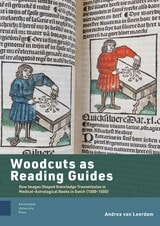
Woodcuts as Reading Guides
How Images Shaped Knowledge Transmission in Medical-Astrological Books in Dutch (1500-1550)Andrea van Leerdam
Amsterdam University Press, 2024
For this book Andrea van Leerdam received the Victorine van Schaick publicatieprijs 2024 and the Menno Hertzberger aanmoedigingsprijs 2026.
Wooden Ritual Artifacts from Chaco Canyon, New Mexico
The Chetro Ketl CollectionR. Gwinn Vivian, Dulce N. Dodgen, and Gayle H. Hartmann
University of Arizona Press, 1978
Woodland Potters and Archaeological Ceramics of the North Carolina Coast
Joseph M. Herbert
University of Alabama Press, 2009
The first comprehensive study of the meaning of pottery as a social activity in coastal North Carolina.
Pottery types, composed of specific sets of attributes, have long been defined for various periods and areas of the Atlantic coast, but their relationships and meanings have not been explicitly examined. In exploring these relationships for the North Carolina coast, this work examines the manner in which pottery traits cross-cut taxonomic types, tests the proposition that communities of practice existed at several scales, and questions the fundamental notion of ceramic types as ethnic markers.
Ethnoarchaeological case studies provide a means of assessing the mechanics of how social structure and gender roles may have affected the transmission of pottery-making techniques and how socio-cultural boundaries are reflected in the distribution of ceramic traditions. Another very valuable source of information about past practices is replication experimentation, which provides a means of understanding the practical techniques that lie behind the observable traits, thereby improving our understanding of how certain techniques may have influenced the transmission of traits from one potter to another. Both methods are employed in this study to interpret the meaning of pottery as an indicator of social activity on the North Carolina coast.
Woodrow Wilson
USABrian Morton
Haus Publishing, 2008
Woody Guthrie, American Radical
Will Kaufman
University of Illinois Press, 2011
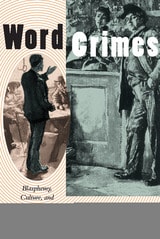
Word Crimes
Blasphemy, Culture, and Literature in Nineteenth-Century EnglandJoss Marsh
University of Chicago Press, 1998
From extensive archival and literary research, Joss Marsh reconstructs a unified and particular account of blasphemy in Victorian England. Rewriting English history from the bottom up, she tells the forgotten stories of more than two hundred working-class "blasphemers," like Foote, whose stubborn refusal to silence their "hooligan" voices helped secure our rights to speak and write freely today. The new standards of criminality used to judge their "word crimes" rewrote the terms of literary judgment, demoting the Bible to literary masterpiece and raising Literature as the primary standard of Victorian cultural value.
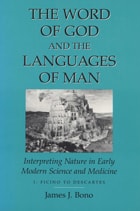
Word Of God & The Languages Of Man
Interpreting Nature In Early Modern Science And Medicine Volume I, Ficino To DescartesJames J. Bono
University of Wisconsin Press, 1995
James J. Bono shows how the new interpretive principles and scientific practices of the sixteenth and seventeenth centuries evolved in response to new views of the relationship between the “Word of God” and the “Languages of Man” fostered by Renaissance Humanism, Neoplatonism, magic, and both the reformed and radical branches of Protestantism. He traces the cultural consequences of these ideas in the thought and work of major and minor actors in the scientific revolution—from Ficino and Paracelsus to Francis Bacon and Descartes. By considering these natural philosophers in light of their own intellectual, religious, philosophical, cultural, linguistic, and especially narrative frameworks, Bono suggests a new way of viewing the sociocultural dynamics of scientific change in the pre–modern period—and ultimately, a new way of understanding the nature and history of scientific thought. The narrative configuration he proposes provides a powerful alternative to the longstanding “revolutionary” metaphor of the history of the scientific revolution.
Word Rides Again
Rereading The Frontier In American FictionJ. David Stevens
Ohio University Press, 2001
With much recent scholarship polarizing frontier novels into “popular” and “literary” camps, The Word Rides Again challenges the critical orthodoxy that such works have little in common, arguing instead that formulaic Western fictions can subtly (and even subversively) share cultural concerns with more highbrow brethren. Each chapter focuses on a writer who has traditionally been classified as either popular or artistic, reading a representative fictional work against prevailing scholarly trends. In this manner, Bret Harte’s sentimental stories become gender-bending experiments in which women assume male roles and even enjoy lesbian relationships. Owen Wister’s The Virginian is transmuted from a misogynistic diatribe into a complex meditation on the peculiarly American relation of violence to male identity. And even Willa Cather’s Death Comes for the Archbishop, rather than the apotheosis of a religious leader, becomes a somewhat standard version of the popular frontier story.
The Word Rides Again represents a significant departure from more traditional studies of frontier literature. It reaffirms the continuum between popular and literary texts and explores the ways that frontier novels have echoed, endorsed, and extended each other from the inception of the genre.
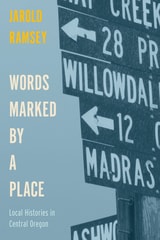
Words Marked by a Place
Local Histories in Central OregonJarold Ramsey
Oregon State University Press, 2018
While telling these local stories, Jarold Ramsey explores alternative ways of engaging history in the act of writing, breaking new ground by discovering and exploring primary sources that bear on the region’s colorful but little-known past. Throughout the collection, he interrogates “local history” as a subject. What is local history? How is it related to mainstream academic history? What are legitimate ways of doing it? How do the details of what we call local history inform “history-at-large,” and vice-versa?
From the opening narrative concerning Lieutenant Henry Larcom Abbot’s “Railroad Survey” of the region in 1855 to the concluding account of Lieutenant Robert Cranston’s last months and dramatic death, when his “Airacobra” fighter plane crashed near Madras in 1944, Words Marked by a Place sheds new light on the ongoing story of central Oregon by illuminating forgotten corners of its past. Through both theory and example, it represents an important contribution to the history of the region and the endeavors of local historians, wherever they happen to work.

Words That Make New Jersey History
A Primary Source Reader, revised and expanded editionEdited by Howard L. Green
Rutgers University Press, 2006
New to this expanded edition is the text of James McGreevey's "I am a Gay American" speech, as well as entries about the Abbott v. Burke court ruling mandating that New Jersey equalize funding of urban and suburban schools districts, sprawl and its effects on water supply, and the state's economic boom in the 1990s.
A balanced survey of New Jersey's history presented in the context of a changing nation, this volume is well suited to general readers who want to explore the primary sources of the state's past, and to U.S. history students at the high school and college levels.

Words Were Bullets and Seeds
Literature, Intellectuals, and Revolution in Angola and Mozambique, 1961–1986Tom Stennett
University of Michigan Press, 2027
Words Were Bullets and Seeds examines the literary and political writings of Mozambican and Angolan Marxist intellectuals that performed crucial roles in the organizations that have come to dominate postcolonial Mozambique and Angola: Frelimo and the MPLA. Tom Stennett draws on archival materials from Portugal, Angola, Mozambique, Cape Verde, Tanzania, and the United Kingdom to reframe our understanding of Angolan and Mozambican liberation struggles through an analysis of the political poetry in Portuguese written by leading intellectuals of the movements. Stennett argues that traditional political forms—speeches, party literature, manifestos—demand a close textual analysis that is sensitive to aesthetics and the specific ways in which Angolan and Mozambican revolutionaries engaged with political idioms and theories such as Négritude, African socialism, Pan-Africanism, and Marxism. Words Were Bullets and Seeds leverages literary texts as historical sources with insights into political ideological struggles to provide a nuanced understanding of Mozambican and Angolan postcolonial debates.
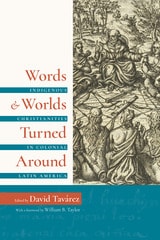
Words and Worlds Turned Around
Indigenous Christianities in Colonial Latin AmericaDavid Tavárez
University Press of Colorado, 2017
A sophisticated, state-of-the-art study of the remaking of Christianity by indigenous societies, Words and Worlds Turned Around reveals the manifold transformations of Christian discourses in the colonial Americas. The book surveys how Christian messages were rendered in indigenous languages; explores what was added, transformed, or glossed over; and ends with an epilogue about contemporary Nahuatl Christianities.
In eleven case studies drawn from eight Amerindian languages—Nahuatl, Northern and Valley Zapotec, Quechua, Yucatec Maya, K'iche' Maya, Q'eqchi' Maya, and Tupi—the authors address Christian texts and traditions that were repeatedly changed through translation—a process of “turning around” as conveyed in Classical Nahuatl. Through an examination of how Christian terms and practices were made, remade, and negotiated by both missionaries and native authors and audiences, the volume shows the conversion of indigenous peoples as an ongoing process influenced by what native societies sought, understood, or accepted.
The volume features a rapprochement of methodologies and assumptions employed in history, anthropology, and religion and combines the acuity of of methodologies drawn from philology and historical linguistics with the contextualizing force of the ethnohistory and social history of Spanish and Portuguese America.
Contributors: Claudia Brosseder, Louise M. Burkhart, Mark Christensen, John F. Chuchiak IV, Abelardo de la Cruz, Gregory Haimovich, Kittiya Lee, Ben Leeming, Julia Madajczak, Justyna Olko, Frauke Sachse, Garry Sparks
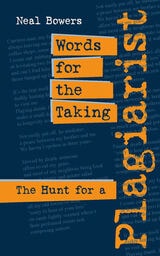
Words for the Taking
The Hunt for a PlagiaristNeal Bowers
Southern Illinois University Press, 2007
In January 1992, poet Neal Bowers received a phone call that changed his life. He learned his poems had been stolen and published under another name. Bowers hired a copyright lawyer and a private detective, and they began the agonizing hunt to track down the person who stole his creative work.
Bowers was dealing with more than the theft of words. He uncovered the plagiarist’s unsavory past when he found convicted child molester David Jones, who published the poems using the name David Sumner.
Determined to hold the plagiarist accountable, Bowers is drawn into a bizarre game of catch-me-if-you-can. His odyssey introduces him to the legal system and a sympathetic female detective, reveals the reactions of fellow poets, and provokes a flood of nationwide publicity and a deluge of letters from strangers interested in the case. Letters from Bowers’s attorney to Jones and phone conversations between the two produce unsatisfactory results. In the end, the plagiarist is not punished, and Bowers deals with the loss of friends, derision from his colleagues, and trouble in his marriage.
Words for the Taking: The Hunt for a Plagiarist, first published in 1997, is as much a commentary on our cultural view of plagiarism as it is a real-life detective story. Bowers’s wry and disturbing account of being the victim of a serial plagiarist offers unexpected twists and startling revelations. This updated edition presents a final consideration of the bizarre case and remains the only book to offer a personal account of the effects of plagiarism.
Ten years after the original publication, Neal Bowers finds his life as a writer altered in ways he could never have foreseen. His responses to the series of events show his vulnerability as an artist and his adjustment to being a victim. In a new chapter, Bowers describes his renewed quest in 2006 for a resolution and explains why he chose to give up writing poetry.
This beautifully written case study about the discovery and attempted resolution of an intellectual crime will appeal to academicians and general readers alike who care about language, the state of poetry, and intellectual property in contemporary America.
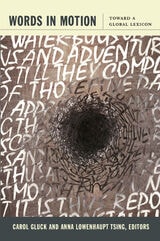
Words in Motion
Toward a Global LexiconCarol Gluck and Anna Lowenhaupt Tsing, eds.
Duke University Press, 2009
Such words as security in Brazil, responsibility in Japan, community in Thailand, and hijāb in France changed the societies in which they moved even as the words were changed by them. Some words threatened to launch wars, as injury did in imperial Britain’s relations with China in the nineteenth century. Others, such as secularism, worked in silence to agitate for political change in twentieth-century Morocco. Words imposed or imported from abroad could be transformed by those who wielded them to oppose the very powers that first introduced them, as happened in Turkey, Indonesia, and the Philippines. Taken together, this selection of fourteen essays reveals commonality as well as distinctiveness across modern societies, making the world look different from the interdisciplinary and transnational perspective of “words in motion.”
Contributors. Mona Abaza, Itty Abraham, Partha Chatterjee, Carol Gluck, Huri Islamoglu, Claudia Koonz, Lydia H. Liu, Driss Maghraoui, Vicente L. Rafael, Craig J. Reynolds, Seteney Shami, Alan Tansman, Kasian Tejapira, Anna Lowenhaupt Tsing
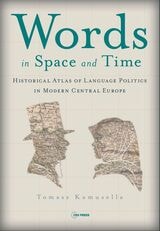
Words in Space and Time
A Historical Atlas of Language Politics in Modern Central EuropeTomasz Kamusella
Central European University Press, 2022
With forty-two extensively annotated maps, this atlas offers novel insights into the history and mechanics of how Central Europe’s languages have been made, unmade, and deployed for political action. The innovative combination of linguistics, history, and cartography makes a wealth of hard-to-reach knowledge readily available to both specialist and general readers. It combines information on languages, dialects, alphabets, religions, mass violence, or migrations over an extended period of time.
The story first focuses on Central Europe’s dialect continua, the emergence of states, and the spread of writing technology from the tenth century onward. Most maps concentrate on the last two centuries. The main storyline opens with the emergence of the Western European concept of the nation, in accord with which the ethnolinguistic nation-states of Italy and Germany were founded. In the Central European view, a “proper” nation is none other than the speech community of a single language. The Atlas aspires to help users make the intellectual leap of perceiving languages as products of human history and part of culture. Like states, nations, universities, towns, associations, art, beauty, religions, injustice, or atheism—languages are artefacts invented and shaped by individuals and their groups.
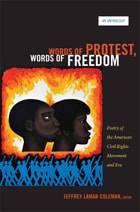
Words of Protest, Words of Freedom
Poetry of the American Civil Rights Movement and EraJeffrey Lamar Coleman, ed.
Duke University Press, 2012
Some of the poems address crucial movement-related events—such as the integration of the Little Rock schools, the murders of Emmett Till and Medgar Evers, the emergence of the Black Panther party, and the race riots of the late 1960s—and key figures, including Martin Luther King Jr., Malcolm X, and John and Robert Kennedy. Other poems speak more broadly to the social and political climate of the times. Along with Jeffrey Lamar Coleman's headnotes, the poems recall the heartbreaking and jubilant moments of a tumultuous era. Altogether, more than 150 poems by approximately 100 poets showcase the breadth of the genre of civil rights poetry.
Selected contributors. Maya Angelou, W. H. Auden, Amiri Baraka, Gwendolyn Brooks, Lucille Clifton Lawrence Ferlinghetti, Allen Ginsberg, Langston Hughes, June Jordan, Philip Levine, Audre Lorde, Robert Lowell, Pauli Murray, Huey P. Newton, Adrienne Rich, Sonia Sanchez, Léopold Sédar Senghor, Derek Walcott, Alice Walker, Yevgeny Yevtushenko
Words that Make New Jersey History
A Primary Source ReaderGreen, Howard L
Rutgers University Press, 1994
Here isa unique collection of documents that spans the history of New Jersey, from the arrival of Dutch traders in the 1600s to the present. The materials touch on a range of subjects such as slavery and abolitionism, the labor movement, race and ethnic relations, and economic and environmental issues. The documents include letters, journals, pamphlets, petitions, artwork, and songs created not only by those who exercised power, but also by men and women of more humble station. Their lively accounts range from descriptions of Native Americans in the seventeenth century to Bruce Springsteen’s lament about a declining factory town.
New to this expanded edition is the text of former governor James McGreevey’s “I am a Gay American” speech, as well as entries about the Abbott v. Burke court ruling mandating that New Jersey equalize funding of urban and suburban schools districts, sprawl and its effects on water supply, and the state’s economic boom in the 1990s.
A balanced survey of New Jersey’s history in the context of a changing nation, this book is ideal for general readers who want to explore the primary sources of the state’s past, and to U.S. history students at the high school and college levels.
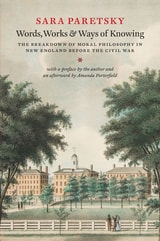
Words, Works, and Ways of Knowing
The Breakdown of Moral Philosophy in New England before the Civil WarSara Paretsky
University of Chicago Press, 2016
What’s less well-known is that before Paretsky began her writing career, she earned a PhD in history from the University of Chicago with a dissertation on moral philosophy and religion in New England in the early and mid-nineteenth century. Now, for the first time, fans of Paretsky can read that earliest work, Words, Works, and Ways of Knowing.
Paretsky here analyzes attempts by theologians at Andover Seminary, near Boston, to square and secure Calvinist religious beliefs with emerging knowledge from history and the sciences. She carefully shows how the open-minded scholasticism of these theologians paradoxically led to the weakening of their intellectual credibility as conventional religious belief structures became discredited, and how this failure then incited reactionary forces within Calvinism. That conflict between science and religion in the American past is of interest on its face, but it also sheds light on contemporary intellectual battles.
Rounding out the book, leading religious scholar Amanda Porterfield provides an afterword discussing where Paretsky’s work fits into the contemporary study of religion. And in a sobering—sometimes shocking—preface, Paretsky paints a picture of what it was like to be a female graduate student at the University of Chicago in the 1970s. A treat for Paretsky’s many fans, this book offers a glimpse of the development of the mind behind the mysteries.
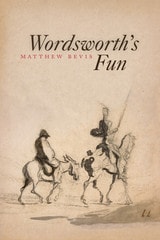
Wordsworth's Fun
Matthew Bevis
University of Chicago Press, 2019
Wordsworth’s Fun explores the writer’s debts to the ludic and the ludicrous in classical tradition; his reworkings of Ariosto, Erasmus, and Cervantes; his engagement with forms of English poetic humor; and his love of comic prose. Combining close reading with cultural analysis, Bevis travels many untrodden ways, studying Wordsworth’s interest in laughing gas, pantomime, the figure of the fool, and the value of play. Intrepid, immersive, and entertaining, Wordsworth’s Fun sheds fresh light on how one poet’s strange humor helped to shape modern literary experiment.
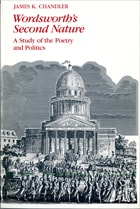
Wordsworth's Second Nature
A Study of the Poetry and PoliticsJames Chandler
University of Chicago Press, 1984
Central to the discussion, which restores Wordsworth to both the French and English contexts in which he matured, is a consideration of his relation to Rousseau and Burke. Chandler maintains that by the time Wordsworth set forth his "program for poetry" in 1798, he had turned away from the Rousseauist idea of nature that had informed his early republican writings. He had already become a poet of what Burke called "second nature"–human nature cultivated by custom, habit, and tradition–and an opponent of the quest for first principles that his friend Coleridge could not forsake. In his analysis of the poetry, Chandler suggests that even Wordsworth's most apparently private moments, the lyrical "spots of time," ideologically embodied the uncalculated habits of an oral narrative discipline and a native English mind.
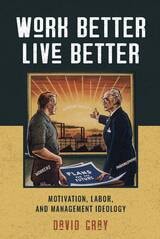
Work Better, Live Better
Motivation, Labor, and Management IdeologyDavid A. Gray
University of Massachusetts Press, 2020
In the United States, a strong work ethic has long been upheld as a necessity, and tributes to motivation abound—from the motivational posters that line the walls of the workplace to the self-help gurus who draw in millions of viewers online. Americans are repeatedly told they can achieve financial success and personal well-being by adopting a motivated attitude toward work. But where did this obsession come from? And whose interests does it serve?
Work Better, Live Better traces the rise of motivational rhetoric in the workplace across the expanse of two world wars, the Great Depression, and the Cold War. Beginning in the early twentieth century, managers recognized that force and coercion—the traditional tools of workplace discipline—inflamed industrial tensions, so they sought more subtle means of enlisting workers' cooperation. David Gray demonstrates how this “motivational project” became a highly orchestrated affair as managers and their allies deployed films, posters, and other media, and drew on the ideas of industrial psychologists and advertising specialists to advance their quests for power at the expense of worker and union interests.
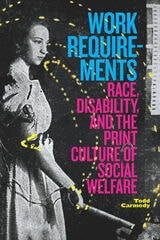
Work Requirements
Race, Disability, and the Print Culture of Social WelfareTodd Carmody
Duke University Press, 2022
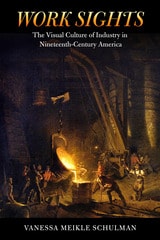
Work Sights
The Visual Culture of Industry in Nineteenth-Century AmericaVanessa Meikle Schulman
University of Massachusetts Press, 2015
Ranging across the fields of art history, visual studies, the history of technology, and American studies, Work Sights captures both the richness of nineteenth-century American visual culture and the extent to which Americans had begun to perceive their country as a modern nation connected by a web of interlocking technological systems.
Work Without End
Abandoning Shorter Hours for the Right to WorkBenjamin Kline Hunnicutt
Temple University Press, 1990

Work and Community in the Jungle
Chicago's Packinghouse Workers, 1894-1922James R. Barrett
University of Illinois Press, 1987
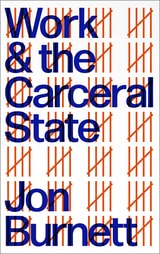
Work and the Carceral State
Jon Burnett
Pluto Press, 2022
During 2019-20 in England and Wales, over 17 million hours of labor were carried out by more than 12,500 people incarcerated in prisons, while many people in immigration detention centers were also put to work. These people constitute a sub-waged, captive workforce who are frequently discarded by the state when done with.
Work and the Carceral State examines these forms of work as part of a broader exploration of the relationship between criminalization, criminal justice, immigration policy and labor, tracing their lineage through the histories of transportation and banishment, of houses of correction and prisons, to the contemporary production of work.
Criminalization has been used to enforce work and to discipline labor throughout the history of England and Wales. This book demands that we recognise the carceral state as operating at the frontier of labor control in the 21st century.
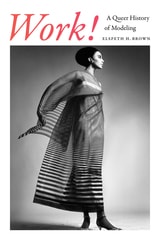
Work!
A Queer History of ModelingElspeth H. Brown
Duke University Press, 2019