Results by title
8642 books match the query '20th Century' and 390 start with w
Warship 1
Cruiser HNLMS TrompJantinus Mulder
Amsterdam University Press, 2012
Warship 3
Frigate HNLMS Jacob van HeemskerckRindert van Zinderen Bakker
Amsterdam University Press, 2017
Warship 4
Frigate USS ClarkRindert van Zinderen Bakker
Amsterdam University Press, 0
Warship 5
Protected Cruiser GelderlandJantinus Mulder
Amsterdam University Press, 0
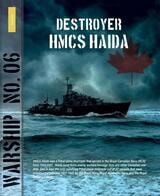
Warship 6
Destroyer HMCS HaidaRindert van Zinderen Bakker
Amsterdam University Press, 0
Nowadays she is the only surviving Tribal-class destroyer out of 27 units that were constructed between 1937-1945 for the Royal Navy, Royal Australian Navy, and the Royal Canadian Navy.

Wartime Diary
Simone de Beauvoir; Translation and Notes by Anne Deing Cordero; Edited by Margaret A. Simons and Sylvie Le Bon de Beauvoir; Foreword by Sylvie Le Bon de Beauvoir
University of Illinois Press, 2021
Provocative insights into Beauvoir's philosophical and personal development during wartime
Written from September 1939 to January 1941, Simone de Beauvoir’s Wartime Diary gives English readers unabridged access to a scandalous text that threatened to overturn traditional views of Beauvoir’s life and work.
Beauvoir's clandestine affair with Jacques Bost and sexual relationships with various young women challenge the conventional picture of Beauvoir as the devoted companion of Jean-Paul Sartre. At the same time, her account of completing her novel She Came to Stay at a time when Sartre had just begun Being and Nothingness questions the traditional view of Beauvoir’s novel as merely illustrating Sartre’s philosophy.
Wartime Diary also traces Beauvoir's philosophical transformation as she broke from the prewar solipsism of She Came to Stay in favor of the postwar political engagement of The Second Sex. Beauvoir's emerging existentialist ethics reflect the dramatic collective experiences of refugees fleeing German invasion and life under Nazi occupation. The evolution of her thought also reveals the courageous reaffirmation of her individuality in constructing a humanist ethics of freedom and solidarity.
This edition also features previously unpublished material, including her musings about consciousness and order, recommended reading lists, and notes on labor unions. In providing new insights into Beauvoir’s philosophical development, the Wartime Diary promises to rewrite a crucial chapter of Western philosophy and intellectual history.
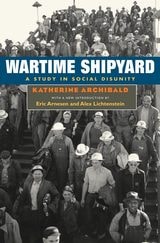
Wartime Shipyard
A STUDY IN SOCIAL DISUNITYKatherine Archibald
University of Illinois Press, 2006
An eye-opening first-hand account of life in a WWII shipyard from a woman's perspective
In 1942, Katherine Archibald, a graduate student at Berkeley, left the halls of academe to spend two years working in a nearby Oakland shipyard. She arrived with a host of preconceptions about the American working class, race relations and the prospect for their improvement, and wartime unity. Her experience working in a shipyard where women were seen as intruders, where "Okies" and black migrants from the South were regarded with barely-disguised hatred, and where trade unions preferred protecting their turf to defending workers' rights, threw much of her liberal faith into doubt.
Archibald's 1947 book about her experiences, Wartime Shipyard: A Study in Social Disunity, remains a classic account of life and labor on the home front. This new edition includes an introduction written by historians Eric Arnesen and Alex Lichtenstein, who explore Archibald's work in light of recent scholarship on women and African Americans in the wartime workplace.
Wartime in Burma
A Diary, January to June 1942Theippan Maung Wa
Ohio University Press, 2009
This diary, begun after the Japanese attack on Pearl Harbor and covering the invasion of Burma up to June 1942, is a moving account of the dilemmas faced by the well-loved and prolific Burmese author Theippan Maung Wa (a pseudonym of U Sein Tin) and his family. At the time of the Japanese invasion, U Sein Tin was deputy secretary in the Ministry of Home and Defense Affairs. An Oxford-trained member of the Indian Civil Service, working for the British administration on the eve of the invasion, he lived with his wife and three small children in Rangoon.
Wartime in Burma is a stirring memoir that presents a personal account of U Sein Tin’s feelings about the war, his anxiety for the safety of his family, the bombing of Rangoon, and what happened to them during the next six chaotic months of the British retreat. The author and his family leave Rangoon to live in a remote forest in Upper Burma with several other Burmese civil servants, their staff, and valuable possessions—rich pickings for robbers. His diary ends abruptly on June 5, his forty-second birthday; U Sein Tin was murdered on June 6 by a gang of Burmese bandits. The diary pages, scattered on the floor of the house, were rescued by his wife and eventually published in Burma in 1966. What survives is a unique account that shines new light on the military retreat from Burma.
Washington's China
The National Security World, the Cold War, and the Origins of GlobalismJames L. Peck
University of Massachusetts Press, 2006
This book addresses a central question about the Cold War that has never been adequately resolved. Why did the United States go to such lengths not merely to “contain” the People's Republic of China but to isolate it from all diplomatic, cultural, and economic ties to other nations? Why, in other words, was American policy more hostile to China than to the Soviet Union, at least until President Nixon visited China in 1972?
The answer, as set out here, lies in the fear of China's emergence as a power capable of challenging the new Asian order the United States sought to shape in the wake of World War II. To meet this threat, American policymakers fashioned an ideology that was not simply or exclusively anticommunist, but one that aimed at creating an integrated, cooperative world capitalism under U.S. leadership—an ideology, in short, designed to outlive the Cold War.
In building his argument, James Peck draws on a wide variety of little-known documents from the archives of the National Security Council and the CIA. He shows how American officials initially viewed China as a “puppet” of the Soviet Union, then as “independent junior partner” in a Sino-Soviet bloc, and finally as “revolutionary model” and sponsor of social upheaval in the Third World. Each of these constructs revealed more about U.S. perceptions and strategic priorities than about actual shifts in Chinese thought and conduct. All were based on the assumption that China posed a direct threat not just to specific U.S. interests and objectives abroad but to the larger vision of a new global order dominated by American economic and military power. Although the nature of “Washington's China” may have changed over the years, Peck contends that the ideology behind it remains unchanged, even today.
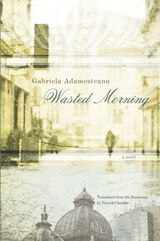
Wasted Morning
A NovelGabriela Adamesteanu
Northwestern University Press, 2011
She's a born storyteller, chatting and gossiping tirelessly. But she also listens, so it is through her that Adamesteanu is able to show us a panoramic portrait of Romanian society as the fortunes of its various strata shift violently. Rich or poor, honest (more or less) or deceitful, all of the characters in this polyphonic novel are brought vividly to life. From Bucharest's aspirations to be the Paris of Eastern Europe to the darkest days of dictatorship, the novel presents a sweeping vision of the personal and collective costs of a turbulent century.
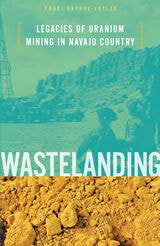
Wastelanding
Legacies of Uranium Mining in Navajo CountryTraci Brynne Voyles
University of Minnesota Press, 2015
Wastelanding tells the history of the uranium industry on Navajo land in the U.S. Southwest, asking why certain landscapes and the peoples who inhabit them come to be targeted for disproportionate exposure to environmental harm. Uranium mines and mills on the Navajo Nation land have long supplied U.S. nuclear weapons and energy programs. By 1942, mines on the reservation were the main source of uranium for the top-secret Manhattan Project. Today, the Navajo Nation is home to more than a thousand abandoned uranium sites. Radiation-related diseases are endemic, claiming the health and lives of former miners and nonminers alike.
Traci Brynne Voyles argues that the presence of uranium mining on Diné (Navajo) land constitutes a clear case of environmental racism. Looking at discursive constructions of landscapes, she explores how environmental racism develops over time. For Voyles, the “wasteland,” where toxic materials are excavated, exploited, and dumped, is both a racial and a spatial signifier that renders an environment and the bodies that inhabit it pollutable. Because environmental inequality is inherent in the way industrialism operates, the wasteland is the “other” through which modern industrialism is established.
In examining the history of wastelanding in Navajo country, Voyles provides “an environmental justice history” of uranium mining, revealing how just as “civilization” has been defined on and through “savagery,” environmental privilege is produced by portraying other landscapes as marginal, worthless, and pollutable.
Wasting a Crisis
Why Securities Regulation FailsPaul G. Mahoney
University of Chicago Press, 2015
With Wasting a Crisis, Paul G. Mahoney offers persuasive research to show that this now almost universally accepted narrative of market failure—broadly similar across financial crises—is formulated by political actors hoping to deflect blame from prior policy errors. Drawing on a cache of data, from congressional investigations, litigation, regulatory reports, and filings to stock quotes from the 1920s and ’30s, Mahoney moves beyond the received wisdom about the financial reforms of the New Deal, showing that lax regulation was not a substantial cause of the financial problems of the Great Depression. As new regulations were formed around this narrative of market failure, not only were the majority largely ineffective, they were also often counterproductive, consolidating market share in the hands of leading financial firms. An overview of twenty-first-century securities reforms from the same analytic perspective, including Dodd-Frank and the Sarbanes-Oxley Act of 2002, shows a similar pattern and suggests that they too may offer little benefit to investors and some measurable harm.
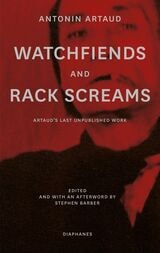
Watchfiends and Rack Screams
Artaud’s Last Unpublished WorkAntonin Artaud
Diaphanes, 2024
Antonin Artaud’s last large-scale work, published in its complete form in English for the first time.
Drawings on texts and letters dating from 1946, some of them written while he was still confined at the Rodez psychiatric hospital, Artaud devoted the months of November 1946 to February 1947 to completing his book through a long series of vocal improvisations titled Interjections, dictated at his pavilion on the edge of Paris. He cursed the assassins he believed were on their way there to steal his semen, to make his brain go “up in smoke as under the action of one of those machines created to suck up filth from the floor,” and finally to erase him. The publisher who had commissioned the book, Louis Broder, was horrified at reading its incandescent, fiercely obscene, and anti-religious manuscript and refused to publish it. Ambitious and experimental in scale, fragmentary and ferocious in intent, it was not published until 1978, in an edition prepared by Artaud’s close friend Paule Thévenin. Artaud commented that it was an “impossible” book, and that “nobody has ever read it from end to end, not even its own author.”
Clayton Eshleman, together with his translation collaborators such as David Rattray, began to work soon after 1978 on an English-language edition, with extracts appearing especially in Eshleman’s poetry magazine, Sulfur. This volume presents his translations with additional ones by Paul Buck, and Catherine Petit it in its complete form in English for the first time.
Watching Jim Crow
The Struggles over Mississippi TV, 1955–1969Steven D. Classen
Duke University Press, 2004
During the 1990s, Classen conducted extensive interviews with more than two dozen African Americans living in Jackson, several of whom, decades earlier, had fought to integrate television programming. He draws on these interviews not only to illuminate their perceptions—of the civil rights movement, what they accomplished, and the present as compared with the past—but also to reveal the inadequate representation of their viewpoints in the legal proceedings surrounding WLBT’s licensing. The story told in Watching Jim Crow has significant implications today, not least because the Telecommunications Act of 1996 effectively undid many of the hard-won reforms achieved by activists—including those whose stories Classen relates here.
Watching Women's Liberation, 1970
Feminism's Pivotal Year on the Network NewsBonnie J. Dow
University of Illinois Press, 2014
In Watching Women's Liberation, 1970: Feminism's Pivotal Year on the Network News, Bonnie J. Dow uses case studies of key media events to delve into the ways national TV news mediated the emergence of feminism's second wave. First legitimized as a big story by print media, the feminist movement gained broadcast attention as the networks’ eagerness to get in on the action was accompanied by feminists’ efforts to use national media for their own purposes. Dow chronicles the conditions that precipitated feminism's new visibility and analyzes the verbal and visual strategies of broadcast news discourses that tried to make sense of the movement.
Groundbreaking and packed with detail, Watching Women's Liberation, 1970 shows how feminism went mainstream--and what it gained and lost on the way.
Watergate's Legacy and the Press
The Investigative ImpulseJon Marshall
Northwestern University Press, 2011
Bob Woodward and Carl Bernstein symbolize an era when investigative reporters were seen as courageous fighters of corruption and injustice. Although many mainstream news outlets no longer have the resources to support expensive investigative reporters on staff, journalists have found other ways to support themselves Marshall’s discussion of the opportunities they have found in blogs, crowd-sourcing, and nonprofit institutions offers hope for the future of investigative journalism.
Watering the Revolution
An Environmental and Technological History of Agrarian Reform in MexicoMikael D. Wolfe
Duke University Press, 2017

Waters of the World
The Story of the Scientists Who Unraveled the Mysteries of Our Oceans, Atmosphere, and Ice Sheets and Made the Planet WholeSarah Dry
University of Chicago Press, 2019
From the glaciers of the Alps to the towering cumulonimbus clouds of the Caribbean and the unexpectedly chaotic flows of the North Atlantic, Waters of the World is a tour through 150 years of the history of a significant but underappreciated idea: that the Earth has a global climate system made up of interconnected parts, constantly changing on all scales of both time and space. A prerequisite for the discovery of global warming and climate change, this idea was forged by scientists studying water in its myriad forms. This is their story.
Linking the history of the planet with the lives of those who studied it, Sarah Dry follows the remarkable scientists who summited volcanic peaks to peer through an atmosphere’s worth of water vapor, cored mile-thick ice sheets to uncover the Earth’s ancient climate history, and flew inside storm clouds to understand how small changes in energy can produce both massive storms and the general circulation of the Earth’s atmosphere. Each toiled on his or her own corner of the planetary puzzle. Gradually, their cumulative discoveries coalesced into a unified working theory of our planet’s climate.
We now call this field climate science, and in recent years it has provoked great passions, anxieties, and warnings. But no less than the object of its study, the science of water and climate is—and always has been—evolving. By revealing the complexity of this history, Waters of the World delivers a better understanding of our planet’s climate at a time when we need it the most.

Waterscapes
Reservoirs, Environment and Identity in Modern England and WalesAndrew McTominey
University of London Press, 2025
Carving vast lakes into the countryside, reservoirs have long reshaped the landscapes and communities of England and Wales. Waterscapes evaluates how these feats of engineering transformed rural and urban environments between the late nineteenth and early twentieth centuries, altering local ecologies and economies. Through studies of Leeds’s Washburn Valley, Liverpool’s Vyrnwy Reservoir, and Birmingham’s Elan Reservoir, Andrew McTominey addresses the environmental consequences of dam construction and the surprising ways in which reservoirs became sites of leisure and tourism.
McTominey explains that water management has never been a simple question of supply and demand, but a story of contested landscapes and the complex interplay between nature and human ambition. Drawing on environmental history and urban studies, Waterscapes demystifies the reservoirs that continue to shape Britain’s countryside and city life.
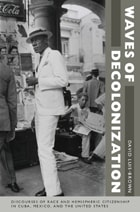
Waves of Decolonization
Discourses of Race and Hemispheric Citizenship in Cuba, Mexico, and the United StatesDavid Luis-Brown
Duke University Press, 2008
Luis-Brown traces unfolding narratives of decolonization across a broad range of texts. He explores how Martí and Du Bois, known as the founders of Cuban and black nationalisms, came to develop anticolonial discourses that cut across racial and national divides. He illuminates how cross-fertilizations among the Harlem Renaissance, Mexican indigenismo, and Cuban negrismo in the 1920s contributed to broader efforts to keep pace with transformations unleashed by ongoing conflicts over imperialism, and he considers how those transformations were explored in novels by McKay of Jamaica, Jesús Masdeu of Cuba, and Miguel Ángel Menéndez of Mexico. Focusing on ethnography’s uneven contributions to decolonization, he investigates how Manuel Gamio, a Mexican anthropologist, and Zora Neale Hurston each adapted metropolitan social science for use by writers from the racialized periphery.

Waves of Opposition
Labor and the Struggle for Democratic RadioElizabeth Fones-Wolf
University of Illinois Press, 2006
Radio sparked the massive upsurge of organized labor during the Great Depression. The powerful new medium became an important weapon in the ideological war between labor and business. Corporations used radio to sing the praises of individualism and consumerism, while unions emphasized equal rights, industrial democracy, and social justice.
Elizabeth Fones-Wolf analyzes the battle to utilize, and control, the airwaves in radio's early era. Working chronologically, she explores the advent of local labor radio stations such as WCFL and WEVD, labor's campaigns against corporate censorship, and union experiments with early FM broadcasting. Using union archives and broadcast industry records, Fones-Wolf demonstrates radio's key role in organized labor's efforts to fight business's domination of political discourse throughout the 1930s, 1940s, and 1950s. She concludes with a look at how labor's virtual disappearance from today's media helps explain why unions have become so marginalized, and offers important historical lessons for revitalizing organized labor.
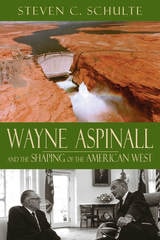
Wayne Aspinall and the Shaping of the American West
Steven C. Schulte
University Press of Colorado, 2002
In Wayne Aspinall and the Shaping of the American West, Steven C. Schulte details a political career that encompassed some of the most crucial years in the development of the twentieth-century West. As chairman of the House Interior and Insular Affairs Committee from 1959 to 1973, Aspinall shaped the nation's reclamation, land, wilderness, and natural resource policies. His crusty and dtermined personality was at the enter of some of the key environmental battles of the twentieth century, including the Echo Park Dam fight, the struggle for the Wilderness Act, and the long controversy over the Central Arizona Project.
Wayward Threads
Robert Goldmann
Northwestern University Press, 1998
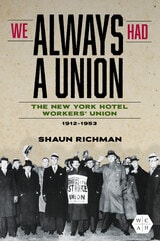
We Always Had a Union
The New York Hotel Workers' Union, 1912-1953Shaun Richman
University of Illinois Press, 2025
From the start, New York’s organized hotel workers experimented with and adapted how they organized and governed members and related to other labor unions. Richman follows union fortunes from early IWW activity through the Communist-led affiliates of the American Federation of Labor in the 1920s and 1930s, the shaping of breakthrough negotiating strategies, and the postwar era. As Richman shows, workers adopted a radicalism and militancy seldom associated with an AFL organization while openly negotiating the Communist Party’s power and influence within the union, until the Party’s eclipse in the 1950s.
An inspiring story of action and perseverance, We Always Had a Union profiles a foundational American labor union and offers lessons for today’s workers and organizers.
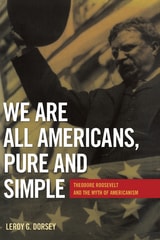
We Are All Americans, Pure and Simple
Theodore Roosevelt and the Myth of AmericanismLeroy G. Dorsey
University of Alabama Press, 2008
Redefining American identity through Roosevelt’s words.
The turn of the 20th century represented one of the most chaotic periods in the nation's history, as immigrants, Native Americans, and African Americans struggled with their roles as Americans while white America feared their encroachments on national identity. This book examines Theodore Roosevelt’s public rhetoric—speeches, essays, and narrative histories—as he attempted to craft one people out of many. Leroy G. Dorsey observes that Roosevelt's solution to the problem appeared straightforward: everyone could become "Americans, pure and simple" if they embraced his notion of "Americanism." Roosevelt grounded his idea of Americanism in myth, particularly the frontier myth—a heroic combination of individual strength and character. When nonwhites and immigrants demonstrated these traits, they would become true Americans, earning an exalted status that they had heretofore been denied.
Dorsey’s analysis illuminates how Roosevelt's rhetoric achieved a number of delicate, if problematic, balancing acts. Roosevelt gave his audiences the opportunity to accept a national identity that allowed "some" room for immigrants and nonwhites, while reinforcing their status as others, thereby reassuring white Americans of their superior place in the nation. Roosevelt’s belief in an ordered and unified nation did not overwhelm his private racist attitudes, Dorsey argues, but certainly competed with them. Despite his private sentiments, he recognized that racist beliefs and rhetoric were divisive and bad for the nation’s progress. The resulting message he chose to propagate was thus one of a rhetorical, if not literal, melting pot.
By focusing on Roosevelt’s rhetorical constructions of national identity, as opposed to his personal exploits or his role as a policy maker, We Are All Americans offers new insights into Roosevelt’s use of public discourse to bind the nation together during one of the most polarized periods in its history.
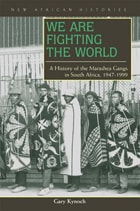
We Are Fighting the World
A History of the Marashea Gangs in South Africa, 1947–1999Gary Kynoch
Ohio University Press, 2005
Since the late 1940s, a violent African criminal society known as the Marashea has operated in and around South Africa’s gold mining areas. With thousands of members involved in drug smuggling, extortion, and kidnapping, the Marashea was more influential in the day-to-day lives of many black South Africans under apartheid than were agents of the state. These gangs remain active in South Africa.
In We Are Fighting the World: A History of the Marashea Gangs in South Africa, 1947–1999, Gary Kynoch points to the combination of coercive force and administrative weakness that characterized the apartheid state. As long as crime and violence were contained within black townships and did not threaten adjacent white areas, township residents were largely left to fend for themselves. The Marashea’s ability to prosper during the apartheid era and its involvement in political conflict led directly to the violent crime epidemic that today plagues South Africa.
Highly readable and solidly researched, We Are Fighting the World is critical to an understanding of South African society, past and present. This pioneering study challenges previous social history research on resistance, ethnicity, urban spaces, and gender in South Africa. Kynoch’s interviews with many current and former gang members give We Are Fighting the World an energy and a realism that are unparalleled in any other published work on gang violence in southern Africa.
We Are Left without a Father Here
Masculinity, Domesticity, and Migration in Postwar Puerto RicoEileen J. Suárez Findlay
Duke University Press, 2015
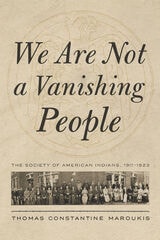
We Are Not a Vanishing People
The Society of American Indians, 1911–1923Thomas Constantine Maroukis
University of Arizona Press, 2021
Historian Thomas Constantine Maroukis discusses the goals, strategies, successes, and failures of the Indigenous intellectuals who came together to form the SAI. They engaged in lobbying, producing publications, informing the media, hundreds of speaking engagements, and annual conferences to argue for reform. Unfortunately, the forces of this era were against reforming federal policies: The group faced racism, a steady stream of negative stereotyping as a so-called vanishing race, and an indifferent federal bureaucracy. They were also beset by internal struggles, which weakened the organization.
This work sheds new light on the origins of modern protest in the twentieth century, and it shows how the intellectuals and activists associated with the SAI were able to bring Indian issues before the American public, challenging stereotypes and the “vanishing people” trope. Maroukis argues that that the SAI was not an assimilationist organization; they were political activists trying to free Indians from government wardship while maintaining their cultural heritage.
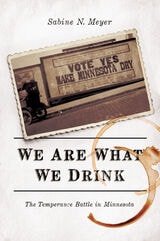
We Are What We Drink
The Temperance Battle in MinnesotaSabine N. Meyer
University of Illinois Press, 2015
Meyer examines the ever-shifting ways that ethnicity, gender, class, religion, and place interacted with each other during the long temperance battle in Minnesota. Her deconstruction of Irish and German ethnic positioning with respect to temperance activism provides a rare interethnic history of the movement. At the same time, she shows how women engaged in temperance work as a way to form public identities and reforges the largely neglected, yet vital link between female temperance and suffrage activism. Relatedly, Meyer reflects on the continuities and changes between how the movement functioned to construct identity in the heartland versus the movement's more often studied roles in the East. She also gives a nuanced portrait of the culture clash between a comparatively reform-minded Minneapolis and dynamic anti-temperance forces in whiskey-soaked St. Paul--forces supported by government, community, and business institutions heavily invested in keeping the city wet.
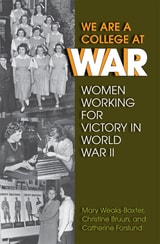
We Are a College at War
Women Working for Victory in World War IIMary Weaks-Baxter, Christine Bruun, and Catherine Forslund
Southern Illinois University Press, 2010
We Are a College at War weaves together the individual World War II experiences of students and faculty at the all-female Rockford College (now Rockford University) in Rockford, Illinois, to draw a broader picture of the role American women and college students played during this defining period in U.S. history. It uses the Rockford community’s letters, speeches, newspaper stories, and personal recollections to demonstrate how American women during the Second World War claimed the right to be everywhere—in factories and other traditionally male workplaces, and even on the front lines—and links their efforts to the rise of feminism and the fight for women’s rights in the 1960s and 1970s.
We Aspired
The Last Innocent AmericansPete Sinclair
University of Utah Press, 2017
Imbued with a sense of place, Pete Sinclair climbed mountains and rescued others trying the same. He thrived on the risky business of ascending sheer rock, of moving from one adrenaline-boosting moment to another. In this book he recounts his mountain-climbing and park ranger days from 1959 to 1970, a time some people call a golden era of climbing in America, a time when climbers knew one another and frequently gathered in Grand Teton National Park. There, Sinclair was the ranger in charge of mountain rescue, a job that, especially when it involved the North Face of Grand Teton, drew on all his young team’s climbing skills. Mixing adventure with personal reflection, Sinclair recounts expeditions taken with friends to scale mountains in Alaska, Mexico, and other parts of North America, as well as his work rescuing injured climbers in the Tetons. The book serves as a history of a past era in mountaineering as well as a meditation on what it all meant. Throughout the book, he challenges readers to consider their relationship with the western landscape. Originally published in 1993, We Aspired was a finalist for the Boardman-Tasker Award for Mountain Literature. The account of one famous rescue on the North Face of the Grand Teton is retold in The Grand Rescue, a film by independent Utah producer Jenny Wilson.
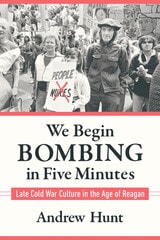
We Begin Bombing in Five Minutes
Late Cold War Culture in the Age of ReaganAndrew Hunt
University of Massachusetts Press, 2021
We Begin Bombing in Five Minutes focuses on a striking array of protest movements that took up issues such as the nuclear arms race, U.S. intervention in Central America, and American investments in South Africa. Hunt's new history of the eighties investigates how film, television, and other facets of popular culture critiqued Washington's Cold War policies and reveals that activists and cultural rebels alike posed a more meaningful challenge to the Cold War's excesses than their predecessors in the McCarthy era.
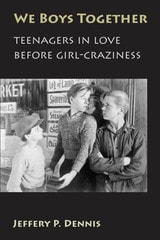
We Boys Together
Teenagers in Love Before Girl-CrazinessJeffery P. Dennis
Vanderbilt University Press, 2007
This book explores romantic relationships between teenage boys as they were portrayed before, during, and immediately after World War II. The author takes the reader through a rich landscape of media -- sci fi pulps, comics, adventure stories, tales of teen sleuths, boys' serial novels, wartime bestsellers, and movies populated by many types of male adolescents: Boys Next Door, Adventure Boys, Jungle Boys, and Lost Boys. In Hollywood movies, Boys Next Door like Jackie Cooper, Ronald Sinclair, and Jimmy Lydon were constantly falling in love, but not with girls. In serial novels, Jungle Boys like Bomba, Sorak, and Og Son of Fire swung through the trees to rescue teenage boys, not teenage girls. In comic strips and on the radio, Adventure Boys like Don Study, Jack Armstrong, and Tim Tyler formed lasting romantic partnerships with other boys or men. Lost Boys like Frankie Darro, Leo Gorcey, and Billy Halop starred in dozens of movies about pairs of poor urban teenagers sticking together, with never a girl in sight.
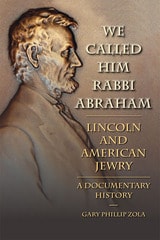
We Called Him Rabbi Abraham
Lincoln and American Jewry, a Documentary HistoryGary Phillip Zola
Southern Illinois University Press, 2014
Over the course of American history, Jews have held many American leaders in high esteem, but they maintain a unique emotional bond with Abraham Lincoln. From the time of his presidency to the present day, American Jews have persistently viewed Lincoln as one of their own, casting him as a Jewish sojourner and, in certain respects, a Jewish role model. This pioneering compendium— The first volume of annotated documents to focus on the history of Lincoln’s image, influence, and reputation among American Jews— considers how Lincoln acquired his exceptional status and how, over the past century and a half, this fascinating relationship has evolved.
Organized into twelve chronological and thematic chapters, these little-known primary source documents—many never before published and some translated into English for the first time—consist of newspaper clippings, journal articles, letters, poems, and sermons, and provide insight into a wide variety of issues relating to Lincoln’s Jewish connection. Topics include Lincoln’s early encounters with Central European Jewish immigrants living in the Old Northwest; Lincoln’s Jewish political allies; his encounters with Jews and the Jewish community as President; Lincoln’s response to the Jewish chaplain controversy; General U. S. Grant’s General Orders No. 11 expelling “Jews, as a class” from the Military Department of Tennessee; the question of amending the U.S. Constitution to legislate the country’s so-called Christian national character; and Jewish eulogies after Lincoln’s assassination. Other chapters consider the crisis of conscience that arose when President Andrew Johnson proclaimed a national day of mourning for Lincoln on the festival of Shavuot (the Feast of Weeks), a day when Jewish law enjoins Jews to rejoice and not to mourn; Lincoln’s Jewish detractors contrasted to his boosters; how American Jews have intentionally “Judaized” Lincoln ever since his death; the leading role that American Jews have played in in crafting Lincoln’s image and in preserving his memory for the American nation; American Jewish reflections on the question “What Would Lincoln Do?”; and how Lincoln, for America’s Jewish citizenry, became the avatar of America’s highest moral aspirations.
With thoughtful chapter introductions that provide readers with a context for the annotated documents that follow, this volume provides a fascinating chronicle of American Jewry’s unfolding historical encounter with the life and symbolic image of Abraham Lincoln, shedding light on how the cultural interchange between American ideals and Jewish traditions influences the dynamics of the American Jewish experience.
Finalist, 2014 National Jewish Book Award
Finalist, 2015 Ohioana Book Award
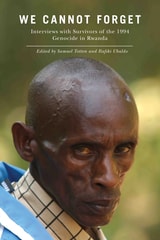
We Cannot Forget
Interviews with Survivors of the 1994 Genocide in RwandaTotten, Samuel
Rutgers University Press, 2011
During a one-hundred-day period in 1994, Hutus murdered between half a million and a million Tutsi in Rwanda. The numbers are staggering; the methods of killing were unspeakable. Utilizing personal interviews with trauma survivors living in Rwandan cities, towns, and dusty villages, We Cannot Forget relates what happened during this period and what their lives were like both prior to and following the genocide.
Through powerful stories that are at once memorable, disturbing, and informative, readers gain a critical sense of the tensions and violence that preceded the genocide, how it erupted and was carried out, and what these people faced in the first sixteen years following the genocide.
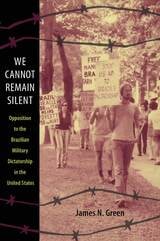
We Cannot Remain Silent
Opposition to the Brazilian Military Dictatorship in the United StatesJames N. Green
Duke University Press, 2010
Green interviewed many of the activists who educated journalists, government officials, and the public about the abuses taking place under the Brazilian dictatorship. Drawing on those interviews and archival research from Brazil and the United States, he describes the creation of a network of activists with international connections, the documentation of systematic torture and repression, and the cultivation of Congressional allies and the press. Those efforts helped to expose the terror of the dictatorship and undermine U.S. support for the regime. Against the background of the political and social changes of the 1960s and 1970s, Green tells the story of a decentralized, international grassroots movement that effectively challenged U.S. foreign policy.
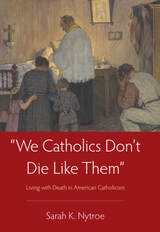
We Catholics Don't Die Like Them
Living with Death Before Vatican IISarah Nytroe
Catholic University of America Press, 2026
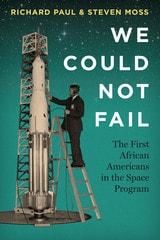
We Could Not Fail
The First African Americans in the Space ProgramBy Richard Paul and Steven Moss
University of Texas Press, 2015
The Space Age began just as the struggle for civil rights forced Americans to confront the long and bitter legacy of slavery, discrimination, and violence against African Americans. Presidents John F. Kennedy and Lyndon Johnson utilized the space program as an agent for social change, using federal equal employment opportunity laws to open workplaces at NASA and NASA contractors to African Americans while creating thousands of research and technology jobs in the Deep South to ameliorate poverty. We Could Not Fail tells the inspiring, largely unknown story of how shooting for the stars helped to overcome segregation on earth.
Richard Paul and Steven Moss profile ten pioneer African American space workers whose stories illustrate the role NASA and the space program played in promoting civil rights. They recount how these technicians, mathematicians, engineers, and an astronaut candidate surmounted barriers to move, in some cases literally, from the cotton fields to the launching pad. The authors vividly describe what it was like to be the sole African American in a NASA work group and how these brave and determined men also helped to transform Southern society by integrating colleges, patenting new inventions, holding elective office, and reviving and governing defunct towns. Adding new names to the roster of civil rights heroes and a new chapter to the story of space exploration, We Could Not Fail demonstrates how African Americans broke the color barrier by competing successfully at the highest level of American intellectual and technological achievement.
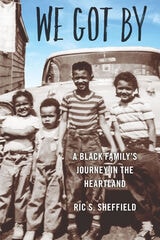
We Got By
A Black Family’s Journey in the HeartlandRic S. Sheffield
The Ohio State University Press, 2022
Spanning four generations and assessing the legacies of traumatic events (arrests, murders, suicide) that are inextricable from the racial dynamics of the small community his family called home, this gripping memoir is a heartfelt, clear-eyed, and rare chronicle of Black life in the rural Midwest. Experiencing the burden of racism among people who refused to accept that such a thing existed only made the isolation feel that much worse to Sheffield and his relatives. And yet, they overcame the obstacles and managed to persist: they got by.
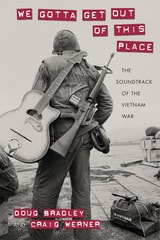
We Gotta Get Out of This Place
The Soundtrack of the Vietnam WarDoug Bradley
University of Massachusetts Press, 2015
Rolling Stone's #1 Music Book of 2015
For a Kentucky rifleman who spent his tour trudging through Vietnam's Central Highlands, it was Nancy Sinatra's “These Boots Are Made for Walkin'.” For a “tunnel rat” who blew smoke into the Viet Cong's underground tunnels, it was Jimi Hendrix's “Purple Haze.” For a Black Marine distraught over the assassination of Martin Luther King Jr., it was Aretha Franklin's “Chain of Fools.” And for countless other Vietnam vets, it was “I Feel Like I'm Fixin' to Die,” “Who'll Stop the Rain,” or the song that gives this book its title.
In We Gotta Get Out of This Place, Doug Bradley and Craig Werner place popular music at the heart of the American experience in Vietnam. They explore how and why U.S. troops turned to music as a way of connecting to each other and the World back home and of coping with the complexities of the war they had been sent to fight. They also demonstrate that music was important for every group of Vietnam veterans—black and white, Latino and Native American, men and women, officers and “grunts”—whose personal reflections drive the book's narrative. Many of the voices are those of ordinary soldiers, airmen, seamen, and marines. But there are also “solo” pieces by veterans whose writings have shaped our understanding of the war—Karl Marlantes, Alfredo Vea, Yusef Komunyakaa, Bill Ehrhart, Arthur Flowers—as well as songwriters and performers whose music influenced soldiers' lives, including Eric Burdon, James Brown, Bruce Springsteen, Country Joe McDonald, and John Fogerty. Together their testimony taps into memories—individual and cultural—that capture a central if often overlooked component of the American war in Vietnam.
We Have All Gone Away
Curtis Harnack
University of Iowa Press, 1973
We Kept Our Towns Going
The Gossard Girls of Michigan's Upper PeninsulaPhyllis Michael Wong
Michigan State University Press, 2022
We Only Know Men
The Rescue of Jews in France during the HolocaustPatrick Henry
Catholic University of America Press, 2007
We Rode the Rhythms as One
On the Poetry of Etheridge KnightEdited by Norman Minnick
University of Michigan Press, 2026
Knight’s story is one of transformation—an odyssey from hardship and incarceration to artistic prominence—anchored by his unwavering belief in the power of poetry to unite and heal. This comprehensive volume is also a historical and cultural exploration, situating Knight’s work amid the Black Arts Movement, the Civil Rights Movement, and the ongoing fight for social justice. Readers will find themselves drawn to Knight’s unfiltered voice, his reflections on Black identity, and his insistence on making poetry accessible to all—whether through intimate letters or reflections on the sociopolitical climate that shaped his art. Suitable for poetry enthusiasts, scholars, and general readers alike, We Rode the Rhythms as One invites us to reconsider Knight’s enduring impact and the vital role of poetry in reflecting and reshaping human experience.
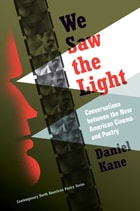
We Saw the Light
Conversations between New American Cinema and PoetryDaniel Kane
University of Iowa Press, 2009
Drawing on unpublished correspondences and personal interviews with key figures in the innovative poetry and film communities, Daniel Kane’s stunningly erudite and accessible work not only provides a fresh look at avant-garde poetry and film but also encourages readers to rethink the artistic scenes of the 1960s and today. We Saw the Light will reframe the very way we talk about how film influences poetry and force us to think anew about the radical ways in which art is created and in turn influences subsequent work.
We Shall Be Free!
Black Communist Protests in Seven VoicesWalter T. Howard
Temple University Press, 2013
Howard draws on FBI files, Moscow documents, and the records of the U.S. Communist Party. He surveys these black Communists addressing a wide range of vital issues such as the Great Depression, World War II, genocide and the Cold War.
We Shall Be Free! presents an important section of the African American community whose thought has been minimized, discounted, or overlooked altogether by the historical profession in general.
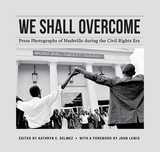
We Shall Overcome
Press Photographs of Nashville during the Civil Rights EraKathryn E. Delmez
Vanderbilt University Press, 2023
Fifty years after Martin Luther King Jr.'s death—and at a time when race relations and social justice are again at the forefront of our country's consciousness—this book expands on a Frist Art Museum exhibition to present a selection of approximately one hundred photographs that document an important period in Nashville's struggle for racial equality. The images were taken between 1957, the year that desegregation in public schools began, and 1968, when the National Guard was called in to surround the state capitol in the wake of the civil rights leader's assassination in Memphis.
Of central significance are photographs of lunch counter sit-ins in early 1960, led by a group of students, including John Lewis (who contributed the book's foreword) and Diane Nash, from local historically black colleges and universities. The demonstrations were so successful that King stated just a few weeks later at Fisk University: "I did not come to Nashville to bring inspiration but to gain inspiration from the great movement that has taken place in this community." The role that Nashville played in the national civil rights movement as a hub for training students in nonviolent protest and as the first Southern city to integrate places of business is a story that warrants reexamination.
The book also provides an opportunity to consider the role of images and the media in shaping public opinion, a relevant subject in today's news-saturated climate. Photographs from the archives of both daily newspapers are included: the Tennessean, which was the more liberal publication, and the Nashville Banner, a conservative paper whose leadership seemed less interested in covering events related to racial issues. Some of the photographs in the exhibition had been selected to be published in the papers, but many were not, and their disclosure reveals insight into the editorial process. In several images, other photojournalists and news crews are visible, serving as a reminder of the almost constant presence of the camera during these historic times.
Essays by Linda Wynn of Fisk University and the Tennessee Historical Commission and Susan H. Edwards, executive director of the Frist Art Museum, offer historical context on Nashville during the civil rights era and on photojournalism, respectively. Congressman John Lewis's foreword recounts memories of his time in Nashville and reminds us that there is still work to be done to build King's Beloved Community.
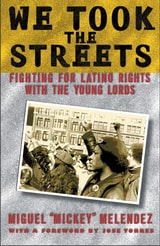
We Took the Streets
Fighting for Latino Rights with the Young LordsMiguel "Mickey" Melendez
Rutgers University Press, 0
In this memoir, Melendez describes with the unsparing eye of an insider the idealism, anger, and vitality of the Lords as they rose to become the most respected and powerful voice of Puerto Rican empowerment in the country. He also traces the internal ideological disputes that led the group, but not the mission, to fracture in 1972. Written with passion and compelling detail, We Took the Streets tells the story of how one group took on the establishment—and won.
In 1968 Miguel “Mickey” Melendez was a college student, developing pride in his Cuban and Puerto Rican cultural identity and becoming increasingly aware of the effects of social inequality on Latino Americans. Joining with other like-minded student activists, Melendez helped form the central committee of the New York branch of the Young Lords, one of the most provocative and misunderstood radical groups to emerge during the 1960s. Incorporating techniques of direct action and community empowerment, the Young Lords became a prominent force in the urban northeast. From their storefront offices in East Harlem, they defiantly took back the streets of El Barrio. In addition to running clothing drives, day-care centers, and food and health programs, they became known for their media-savvy tactics and bold actions, like the takeovers of the First People’s Church and Lincoln Hospital.

We Were Innocents
AN INFANTRYMAN IN KOREAWilliam D. Dannenmaier
University of Illinois Press, 1999
William Dannenmaier served in Korea with the U.S. Army from December 1952 to January 1954, first as a radioman and then as a radio scout with the Fifteenth Infantry Regiment. Eager to serve a cause in which he fervently believed—the safeguarding of South Korea from advancing Chinese Communists—he enlisted in the army with an innocence that soon evaporated. His letters from the front, most of them to his sister, Ethel, provide a springboard for his candid and wry observations of the privations, the boredom, and the devastation of infantry life. At the same time these letters, designed to disguise the true danger of his tasks and his dehumanizing circumstances, reflect a growing failure to communicate with those outside the combat situation.
Woven through the letters is Dannenmaier's narrative account of his combat experiences, including a vivid re-creation of the bloody battle for Outpost Harry, which he describes as "trivial and insignificant—except to the men who fought it."A high-intensity, eight-day battle for a hill American forces would abandon three months later with the signing of the truce, Outpost Harry was largely ignored by the press despite heavy casualties and many official citations for heroism.
From his vantage point as an Everyman, Dannenmaier describes the frustration of men on the front lines who never saw their commanding superiors, the exhaustion of soldiers whose long-promised leaves never materialized, the transitory friendships and shared horrors that left indelible memories. Endangered by minefields and artillery fire, ground down by rumors and constant tension, these men returned—if they returned at all—profoundly and irrevocably changed.
This intimate, revealing memoir, a rare account by a common soldier, is a tribute to the Americans who served in a conflict that has only recently begun to gain a place in official public memory.
We Were Still Ladies
Gender and Industrial Unionism in the Midwest after World War IICoreen Derifield
University of Iowa Press, 2025
How did this transition into industrial work affect a woman’s sense of self? How did this new workforce change the dynamic of families and communities? While women choosing to work outside of the home may seem to have been a mundane decision, it caused tremendous change within families and with household roles. These alterations in daily life rippled throughout midwestern culture and society, even changing the landscape of small towns into decentralized industrial centers.