Results by title
1563 books match the query 'African American & Black Studies' and 65 start with w
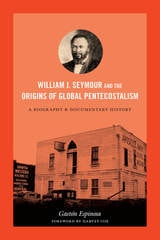
William J. Seymour and the Origins of Global Pentecostalism
A Biography and Documentary HistoryGastón Espinosa
Duke University Press, 2014
The 104 primary sources include all of Seymour's extant writings in full and without alteration and some of Parham's theological, social, and racial writings, which help explain why the two parted company. To capture the revival's diversity and global influence, this book includes Black, Latino, Swedish, and Irish testimonies, along with those of missionaries and leaders who spread Seymour's vision of Pentecostalism globally.
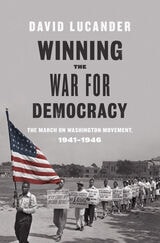
Winning the War for Democracy
The March on Washington Movement, 1941-1946David Lucander
University of Illinois Press, 2014
Winning the War for Democracy: The March on Washington Movement, 1941-1946 recalls that triumph, but also looks beyond Randolph and the MOWM's national leadership to focus on the organization's evolution and actions at the local level. Using the personal papers of previously unheralded MOWM members such as T.D. McNeal, internal government documents from the Roosevelt administration, and other primary sources, David Lucander highlights how local affiliates fighting for a double victory against fascism and racism helped the national MOWM accrue the political capital it needed to effect change.
Lucander details the efforts of grassroots organizers to implement MOWM's program of empowering African Americans via meetings and marches at defense plants and government buildings and, in particular, focuses on the contributions of women activists like Layle Lane, E. Pauline Myers, and Anna Arnold Hedgeman. Throughout he shows how local activities often diverged from policies laid out at MOWM's national office, and how grassroots participants on both sides ignored the rivalry between Randolph and the leadership of the NAACP to align with one another on the ground.
Witchcraft, Violence, and Democracy in South Africa
Adam Ashforth
University of Chicago Press, 2004
In Witchcraft, Violence, and Democracy in South Africa, Adam Ashforth examines how people in Soweto and other parts of post-apartheid South Africa manage their fear of 'evil forces' such as witchcraft. Ashforth examines the dynamics of insecurity in the everyday life of Soweto at the turn of the twenty-first century. He develops a new framework for understanding occult violence as a form of spiritual insecurity and documents new patterns of interpretation attributing agency to evil forces. Finally, he analyzes the response of post-apartheid governments to issues of spiritual insecurity and suggests how these matters pose severe long-term challenges to the legitimacy of the democratic state.
With Pen and Voice
A Critical Anthology of Nineteenth-Century African-American WomenShirley Wilson Logan
Southern Illinois University Press, 1995
"Owoman, woman! upon you I call; for upon your exertions almost entirely depends whether the rising generation shall be any thing more than we have been or not. Owoman, woman! your example is powerful, your influence great."—Maria W. Stewart, "An Address Delivered Before the Afric-American Female Intelligence Society of Boston" (1832)
Here—in the only collection of speeches by nineteenth-century African-American women—is the battle of words these brave women waged to address the social ills of their century. While there have been some scattered references to the unique roles these early "race women" played in effecting social change, until now few scholars have considered the rhetorical strategies they adopted to develop their powerful arguments.
In this chronological anthology, Shirley Wilson Logan highlights the public addresses of these women, beginning with Maria W. Stewart’s speech at Franklin Hall in 1832, believed to be the first delivered to an audience of men and women by an American-born woman. In her speech, she focused on the plight of the Northern free black. Sojourner Truth spoke in 1851 at the Akron, Ohio, Women’s Rights Convention not only for the rights of black women but also for the rights of all oppressed nineteenth-century women. Frances Ellen Watkins Harper struggled with the conflict between universal suffrage and suffrage for black men. Anna Julia Cooper chastised her unique audience of black Episcopalian clergy for their failure to continue the tradition of the elevation of womanhood initiated by Christianity and especially for their failure to support the struggling Southern black woman. Ida B. Wells’s rhetoric targeted mob violence directed at Southern black men. Her speech was delivered less than a year after her inaugural lecture on this issue—following a personal encounter with mob violence in Memphis. Fannie Barrier Williams and Victoria Earle Matthews advocated social and educational reforms to improve the plight of Southern black women. These speeches—all delivered between 1832 and 1895—are stirring proof that, despite obstacles of race and gender, these women still had the courage to mount the platform in defense of the oppressed.
Introductory essays focus on each speaker’s life and rhetoric, considering the ways in which these women selected evidence and adapted language to particular occasions, purposes, and audiences in order to persuade. This analysis of the rhetorical contexts and major rhetorical tactics in the speeches aids understanding of both the speeches and the skill of the speakers. A rhetorical timeline serves as a point of reference.
Historically grounded, this book provides a black feminist perspective on significant events of the nineteenth century and reveals how black women of that era influenced and were influenced by the social problems they addressed.
"A government which can protect and defend its citizens from wrong and outrage and does not is vicious. A government which would do itand cannot is weak; and where human life is insecure through either weakness or viciousness in the administration of law, there must be a lack of justice, and where this is wanting nothing can make up the deficiency."—Frances Ellen Watkins Harper, "Duty to Dependent Races," National Council of Women of the United States, Washington, D.C. (1891)
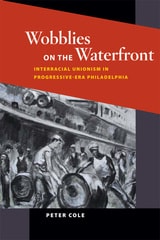
Wobblies on the Waterfront
Interracial Unionism in Progressive-Era PhiladelphiaPeter Cole
University of Illinois Press, 2007
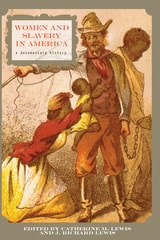
Women and Slavery in America
A Documentary HistoryCatherine M. Lewis
University of Arkansas Press, 2011
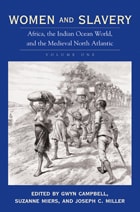
Women and Slavery, Volume One
Africa, the Indian Ocean World, and the Medieval North AtlanticGwyn Campbell
Ohio University Press, 2007
Women enslaved in the Americas came to bear highly gendered reputations among whites—as “scheming Jezebels,” ample and devoted “mammies,” or suffering victims of white male brutality and sexual abuse—that revealed more about the psychology of enslaving than about the courage and creativity of the women enslaved. These strong images of modern New World slavery contrast with the equally expressive virtual invisibility of the women enslaved in the Old—concealed in harems, represented to meddling colonial rulers as “wives” and “nieces,” taken into African families and kin-groups in subtlely nuanced fashion.
Women and Slavery presents papers developed from an international conference organized by Gwyn Campbell.
Volume 1 Contributors: Sharifa Ahjum, Richard B. Allen, Katrin Bromber, Gwyn Campbell, Catherine Coquery-Vidrovitch, Jan-Georg Deutsch, Timothy Fernyhough, Philip J. Havik, Elizabeth Grzymala Jordan, Martin A. Klein, George Michael La Rue, Paul E. Lovejoy, Fred Morton, Richard Roberts, Kirsten A. Seaver
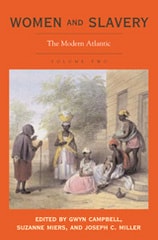
Women and Slavery, Volume Two
The Modern AtlanticGwyn Campbell
Ohio University Press, 2008
Women enslaved in the Americas came to bear highly gendered reputations among whites—as “scheming Jezebels,” ample and devoted “mammies,” or suffering victims of white male brutality and sexual abuse—that revealed more about the psychology of enslaving than about the courage and creativity of the women enslaved. These strong images of modern New World slavery contrast with the equally expressive virtual invisibility of the women enslaved in the Old—concealed in harems, represented to meddling colonial rulers as “wives” and “nieces,” taken into African families and kin-groups in subtlely nuanced fashion.
Volume 2 Contributors: Henrice Altin,k Laurence Brown, Myriam Cottias, Laura F. Edwards, Richard Follett, Tara Inniss, Barbara Krauthamer, Joseph C. Miller, Bernard Moitt, Kenneth Morgan, Claire Robertson, Marsha Robinson, Felipe Smith, and Mariza de Carvalho Soares.
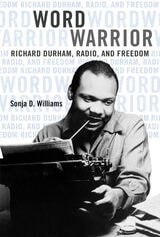
Word Warrior
Richard Durham, Radio, and FreedomSonja D. Williams
University of Illinois Press, 2015
In Word Warrior, award-winning radio producer Sonja D. Williams draws on archives and hard-to-access family records, as well as interviews with family and colleagues like Studs Terkel and Toni Morrison, to illuminate Durham's astounding career. Durham paved the way for black journalists as a dramatist and a star investigative reporter and editor for the pioneering black newspapers the Chicago Defender and Muhammed Speaks. Talented and versatile, he also created the acclaimed radio series Destination Freedom and Here Comes Tomorrow and wrote for popular radio fare like The Lone Ranger. Incredibly, his energies extended still further--to community and labor organizing, advising Chicago mayoral hopeful Harold Washington, and mentoring generations of activists.
Incisive and in-depth, Word Warrior tells the story of a tireless champion of African American freedom, equality, and justice during an epoch that forever changed a nation.
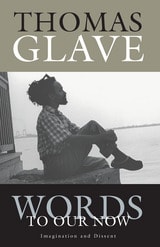
Words to Our Now
Imagination and DissentThomas Glave
University of Minnesota Press, 2007
In these lyrical and powerful essays, Thomas Glave draws on his experiences as a politically committed, gay Jamaican American to deliver a condemnation of the prejudices, hatreds, and inhumanities that persist in the United States and elsewhere. Exposing the hypocrisies of liberal multiculturalism, Glave offers instead a politics of heterogeneity in which difference informs the theory and practice of democracy. At the same time, he experiments with language to provide a model of creative writing as a tool for social change. From the death of black gay poet Essex Hemphill to the revelations of abuse at Abu Ghraib, Glave puts forth an ethical understanding of human rights to make vital connections across nations, races, genders, and sexualities.
Thomas Glave is assistant professor of English at SUNY Binghamton. He is author of Whose Song? and Other Stories.
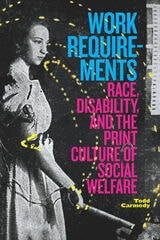
Work Requirements
Race, Disability, and the Print Culture of Social WelfareTodd Carmody
Duke University Press, 2022
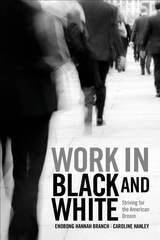
Work in Black and White
Striving for the American DreamEnobong Hannah Branch
Russell Sage Foundation, 2022
The ability to achieve economic security through hard work is a central tenet of the American Dream, but significant shifts in today’s economy have fractured this connection. While economic insecurity has always been a reality for some Americans, Black Americans have historically long experienced worse economic outcomes than Whites. In Work in Black and White, sociologists Enobong Hannah Branch and Caroline Hanley draw on interviews with 80 middle-aged Black and White Americans to explore how their attitudes and perceptions of success are influenced by the stories American culture has told about the American Dream – and about who should have access to it and who should not.
Branch and Hanley find that Black and White workers draw on racially distinct histories to make sense of today’s rising economic insecurity. White Americans have grown increasingly pessimistic and feel that the American Dream is now out of reach, mourning the loss of a sense of economic security which they took for granted. But Black Americans tend to negotiate their present insecurity with more optimism, since they cannot mourn something they never had. All educated workers bemoaned the fact that their credentials no longer guarantee job security, but Black workers lamented the reality that even with an education, racial inequality continues to block access to good jobs for many.
The authors interject a provocative observation into the ongoing debate over opportunity, security, and the American Dream: Among policymakers and the public alike, Americans talk too much about education. The ways people navigate insecurity, inequality, and uncertainty rests on more than educational attainment. The authors call for a public policy that ensures dignity in working conditions and pay while accounting for the legacies of historical inequality.
Americans want the game of life to be fair. While the survey respondents expressed common ground on the ideal of meritocracy, opinions about to achieve economic security for all diverge along racial lines, with the recognition – or not – of differences in current and past access to opportunity in America.
Work in Black and White is a call to action for meaningful policies to make the premise of the American Dream a reality.
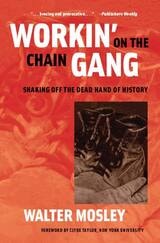
Workin' on the Chain Gang
Shaking Off the Dead Hand of HistoryWalter Mosley
University of Michigan Press, 2006
A passionate examination of the social and economic injustices that continue to shackle the American people
Praise for Workin’ on the Chain Gang:
“. . . bracing and provocative. . . .”
—Publishers Weekly
“. . . clear-sighted . . . Mosley offers chain-breaking ideas. . . .”
—Los Angeles Times Book Review
“[A] thoroughly potent dismantling of Yanqui capitalism, the media, and the entertainment business, and at the same time a celebration of rebellion, truth as a tool for emancipation, and much else besides. . . .”
—Toronto Globe and Mail
“Workin’ on the Chain Gang excels at expressing feelings of ennui that transcend race. . . . beautiful language and penetrating insights into the necessity of confronting the past.”
—Washington Post
“Mosley eloquently examines what liberation from consumer capitalism might look like. . . . readers receptive to a progressive critique of the religion of the market will value Mosley’s creative contribution.”
—Booklist
Walter Mosley’s most recent essay collection is Life Out of Context, published in 2006. He is the best-selling author of the science fiction novel Blue Light, five critically acclaimed mysteries featuring Easy Rawlins, the blues novel RL’s Dream, a finalist for the NAACP Award in Fiction, and winner of the Black Caucus of the American Library Association’s Literary Award. His books have been translated into twenty languages. He lives in New York.
Clyde Taylor is Professor of Africana Studies at NYU’s Gallatin School and author of The Mask of Art: Breaking the Aesthetic Contract—Film and Literature.
Writers of the Black Chicago Renaissance
Edited by Steven C. Tracy
University of Illinois Press, 2011
The volume covers a vast collection of subjects, including many important writers such as Richard Wright, Gwendolyn Brooks, and Lorraine Hansberry as well as cultural products such as black newspapers, music, and theater. The book includes individual entries by experts on each subject; a discography and filmography that highlight important writers, musicians, films, and cultural presentations; and an introduction that relates the Harlem Renaissance, the White Chicago Renaissance, the Black Chicago Renaissance, and the Black Arts Movement.
Contributors are Robert Butler, Robert H. Cataliotti, Maryemma Graham, James C. Hall, James L. Hill, Michael Hill, Lovalerie King, Lawrence Jackson, Angelene Jamison-Hall, Keith Leonard, Lisbeth Lipari, Bill V. Mullen, Patrick Naick, William R. Nash, Charlene Regester, Kimberly Ruffin, Elizabeth Schultz, Joyce Hope Scott, James Smethurst, Kimberly M. Stanley, Kathryn Waddell Takara, Steven C. Tracy, Zoe Trodd, Alan Wald, Jamal Eric Watson, Donyel Hobbs Williams, Stephen Caldwell Wright, and Richard Yarborough.
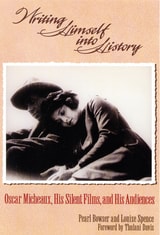
Writing Himself Into History
Oscar Micheaux, His Silent Films, and His AudiencesBowser, Pearl
Rutgers University Press, 2000
Winner of the 2001 Kraszna-Krausz Moving Image Book Awards | Winner of the Theatre Library Association Award
Writing Himself Into History is an eagerly anticipated analysis of the career and artistry surrounding the legendary Black filmmaker Oscar Micheaux. With the exception of Spike Lee, Micheaux is the most famous—and prolific—African American film director. Between 1918 and 1948 he made more than 40 “race pictures,” movies made for and about African Americans. A man of immense creativity, he also wrote seven novels.
Pearl Bowser and Louise Spence concentrate here on the first decade of Micheaux’s career, when Micheaux produced and directed more than twenty silent features and built a reputation as a controversial and maverick entrepreneur. Placing his work firmly within his social and cultural milieu, they also examine Micheaeux’s family and life. The authors provide a close textual analysis of his surviving films (including The Symbol of the Unconquered, Within Our Gates, and Body and Soul), and highlight the rivalry between studios, dilemmas of assimilation versus separatism, gender issues, and class. In Search of Oscar Micheaux also analyzes Micheaux’s career as a novelist in relation to his work as a filmmaker.
This is a much-awaited book that is especially timely as interest in Micheaux’s work increases.