Results by title
941 books match the query 'Military' and 59 start with w
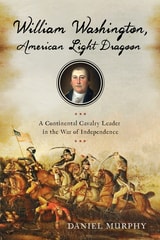
William Washington, American Light Dragoon
A Continental Cavalry Leader in the War of IndependenceDaniel Murphy
Westholme Publishing, 2014
William Washington began the war as a captain of Virginia Militia, was commissioned a junior officer in the Continental Infantry, and slowly rose to field command in the Continental Light Dragoons where he built one of the hardest hitting cavalry regiments to serve in the war. His chief adversary Lord Cornwallis commented, “There could be no more formidable antagonist in a charge, at the head of his cavalry, than Colonel William Washington.” Despite his connection to the commander-in-chief, he suffered his fair share of setbacks, and his relationships varied with not only his legendary cousin George, but many well-known figures of the Revolution including, Henry Lee, Casimir Pulaski, Nathanael Greene, and Daniel Morgan. Relying largely on firsthand accounts and period letters, in William Washington: American Light Dragoon: A Continental Cavalry Leader in the War of Independence, author and avid equestrian Daniel Murphy blends these primary sources with his own working knowledge of period drill, tactics, and terrain to deliver a more complete view of William Washington’s actions throughout the conflict. This perspective traces the often overlooked role of cavalry in the American Revolution and sheds new light on many pivotal battles in of the war, including Trenton, Cowpens, Guilford Courthouse, Hobkirk’s Hill, and William Washington’s final action at Eutaw Springs.
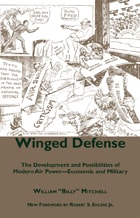
Winged Defense
The Development and Possibilities of Modern Air Power--Economic and MilitaryWilliam "Billy" Mitchell, with a new foreword by Robert S. Ehlers Jr.
University of Alabama Press, 2009
This book is the basis for airpower doctrine in the US, and demonstrates how forward looking Gen Mitchell was even though the technology for conducting air operations was in its infancy when it was written. It is essential reading for anyone concerned with airpower history or aerospace doctrine.
William Lendrum "Billy" Mitchell (December 28, 1879 – February 19, 1936) was an American Army general who is regarded as the father of the U.S. Air Force, and is one of the most famous and most controversial figures in the history of American airpower.
Mitchell served in France during the First World War and, by the conflict's end, commanded all American air combat units in that country. After the war, he was appointed deputy director of the Air Service and began to advocate increased investment in air power, claiming this would prove vital in future wars. He particularly stressed the ability of bombers to sink battleships and organized a series of dramatic bombing runs against stationary ships designed to test the idea that attracted wide notice from the public.
He antagonized many in both the Army and Navy with his arguments and criticism and, in 1925, was demoted to Colonel. Later that year, he was court-martialed for insubordination after accusing military chiefs of an "almost treasonable administration of the national defense." He resigned from the service shortly thereafter.
Mitchell received many honors following his death, including a commission by the President as a Major General. He is also the only individual after whom a type of American military aircraft is named: the B-25 "Mitchell."
Winnipeg's Great War
A City Comes of AgeJim Blanchard
University of Manitoba Press, 2010
Wisconsin Korean War Stories
Veterans Tell Their Stories from the Forgotten WarSarah Larsen
Wisconsin Historical Society Press, 2008
With Tito’s Partisans
Communists and Peasants in War-Torn Yugoslavia, 1941–1945Xavier Bougarel
Central European University Press, 2026
World War 1 in Outline
B. H. Liddell Hart
Westholme Publishing, 1936
An abridgement of the author’s History of the World War, 1914–1918, and first published in 1936, World War I in Outline is a compact but comprehensive history of the “war to end all wars.” Divided into five parts representing each year of the war, Liddell Hart discusses the war on land, at sea, and in the air while skillfully incorporating the political events occurring at the same time. From his own experiences in the war and through studying the conflict in detail, the author developed and expressed his most important observation about military principles: direct attacks against an enemy firmly in position should not be attempted. He also put forth the notion that battles are more often decided by the commander’s actions and not the armies themselves. A lively and engrossing read, World War I in Outline is an ideal overview in time for the centennial of one of the major wars in history.
World War Zoos
Humans and Other Animals in the Deadliest Conflict of the Modern AgeJohn M. Kinder
University of Chicago Press, 2025
As Europe lurched into war in 1939, zookeepers started killing their animals. On September 1, as German forces invaded Poland, Warsaw began with its reptiles. Two days later, workers at the London Zoo launched a similar spree, dispatching six alligators, seven iguanas, sixteen southern anacondas, six Indian fruit bats, a fishing cat, a binturong, a Siberian tiger, five magpies, an Alexandrine parakeet, two bullfrogs, three lion cubs, a cheetah, four wolves, and a manatee over the next few months. Zoos worldwide did the same. The reasons were many, but the pattern was clear: The war that was about to kill so many people started by killing so many animals. Why? And how did zoos, nevertheless, not just survive the war but play a key role in how people did, too?
A harrowing yet surprisingly uplifting chronicle, Kinder’s World War Zoos traces how zoos survived the deadliest decades of global history, from the Great Depression, through the terrors of World War II, to the dawn of the Cold War. More than anything before or since, World War II represented an existential threat to the world’s zoological institutions. Some zoos were bombed; others bore the indignities of foreign occupation. Even zoos that were spared had to wrestle with questions rarely asked in public: What should they do when supplies ran low? Which animals should be killed to protect the lives of others? And how could zoos justify keeping dangerous animals that might escape and run wild during an aerial attack?
Zoos in wartime reveal the shared vulnerabilities of humans and animals during periods of social unrest and environmental peril. World War II–era zoos offered people ways to think about and grapple with imprisonment, powerlessness, and degradation. Viewed today, the story of zoos during World War II can be read as an allegory of twenty-first-century crises, as the effects of climate change threaten all life across the planet.
A one-of-a-kind history, World War Zoos is the story of how the world’s zoos survived the deadliest conflict of the twentieth century—and what was lost along the way.
Wrangling Pelicans
Military Life in Texas PresidiosTim Seiter
University of Texas Press, 2025
2026 Excellence in Historic Preservation Award, Daughters of the American Revolution
2026 Summerlee Book Prize, Center for History and Culture of Southeast Texas and the Upper Gulf Coast
2026 Tejano Book Prize, Tejano Genealogy Society of Austin (TGSA)
A richly detailed history of daily life for colonial Spanish soldiers surviving on the eighteenth-century Texas Gulf Coast.
In 1775, Spanish King Carlos III ordered the capture of American pelicans for his wildlife park in Madrid. The command went to the only Spanish fort on the Texas coast—Presidio Nuestra Señora de Loreto de la Bahía in present-day Goliad. But the overworked soldiers stationed at the fort had little interest indulging a king an ocean away. Their days were consumed with guarding their community against powerful Indigenous peoples and managing the demands of frontier life. The royal order went ignored.
Wrangling Pelicans brings to life the world of Presidio La Bahía’s Hispano soldiers, whose duties ranged from heated warfare to high-stakes diplomacy, while their leisure pursuits included courtship, card playing, and cockfighting. It highlights the lives of presidio women and reveals the ways the Spanish legal system was used by and against the soldiers as they continually negotiated their roles within the empire and their community. Although they were agents of the Spanish crown, soldiers at times defied their king and even their captain as they found ways to assert their autonomy. Offering a fresh perspective on colonial Texas, Wrangling Pelicans recreates the complexities of life at the empire’s edge, where survival mattered more than royal decrees.
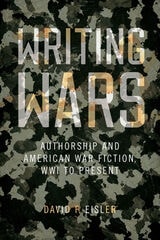
Writing Wars
Authorship and American War Fiction, WWI to PresentDavid F. Eisler
University of Iowa Press, 2022
2024 Senators Bob and Elizabeth Dole Biennial Award for Distinguished Book in Veterans Studies, winner
Who writes novels about war? For nearly a century after World War I, the answer was simple: soldiers who had been there. The assumption that a person must have experienced war in the flesh in order to write about it in fiction was taken for granted by writers, reviewers, critics, and even scholars.
Contemporary American fiction tells a different story. Less than half of the authors of contemporary war novels are veterans. And that’s hardly the only change. Today’s war novelists focus on the psychological and moral challenges of soldiers coming home rather than the physical danger of combat overseas. They also imagine the consequences of the wars from non-American perspectives in a way that defies the genre’s conventions. To understand why these changes have occurred, David Eisler argues that we must go back nearly fifty years, to the political decision to abolish the draft. The ramifications rippled into the field of cultural production, transforming the foundational characteristics— authorship, content, and form—of the American war fiction genre.