Results by title
1947 books match the query 'Music' and 76 start with w
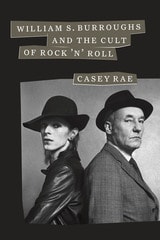
William S. Burroughs and the Cult of Rock 'n' Roll
By Casey Rae
University of Texas Press, 2019
William S. Burroughs's fiction and essays are legendary, but his influence on music's counterculture has been less well documented—until now. Examining how one of America's most controversial literary figures altered the destinies of many notable and varied musicians, William S. Burroughs and the Cult of Rock 'n' Roll reveals the transformations in music history that can be traced to Burroughs.
A heroin addict and a gay man, Burroughs rose to notoriety outside the conventional literary world; his masterpiece, Naked Lunch, was banned on the grounds of obscenity, but its nonlinear structure was just as daring as its content. Casey Rae brings to life Burroughs's parallel rise to fame among daring musicians of the 1960s, '70s, and '80s, when it became a rite of passage to hang out with the author or to experiment with his cut-up techniques for producing revolutionary lyrics (as the Beatles and Radiohead did). Whether they tell of him exploring the occult with David Bowie, providing Lou Reed with gritty depictions of street life, or counseling Patti Smith about coping with fame, the stories of Burroughs's backstage impact will transform the way you see America's cultural revolution—and the way you hear its music.
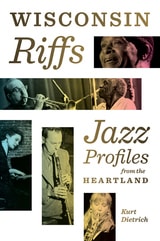
Wisconsin Riffs
Jazz Profiles from the HeartlandKurt Dietrich
Wisconsin Historical Society Press, 2018
Although New York City, Los Angeles, and Chicago are often considered the epicenters of American jazz, this extensive, upbeat compilation of jazz musician biographies details Wisconsin’s rich association the genre since its the inception of the genre in the early 1900s. Iconic musicians Bunny Berigan, Woody Herman, Les Paul, and Al Jarreau all hailed from Wisconsin, as have many other influential players, composers, and teachers. Wisconsin Riffs features these musicians side-by-side—from the world-renowned to obscure regional artists—to portray a comprehensive history of jazz in Wisconsin.
Through meticulous research and more than a hundred interviews, author Kurt Dietrich has assembled a group of musicians who represent a wide range of backgrounds, ages, stylistic schools, and experiences—from leaders of swing-era big bands to legendary Wisconsin Conservatory instructors to today’s up-and-coming practitioners of contemporary jazz and jazz rock. For aspiring musicians, jazz enthusiasts, and fans of Wisconsin culture alike, Wisconsin Riffs presents a compelling, complex, and multi-layered concoction—just like jazz itself.
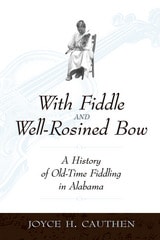
With Fiddle and Well-Rosined Bow
A History of Old-Time Fiddling In AlabamaJoyce H. Cauthen
University of Alabama Press, 2001
Relying on extensive archival research and on sixty interviews with fiddlers and their families and friends, Cauthen tells the rich, full story of old-time fiddling in Alabama.
Writing of life in the Alabama Territory in the late 1700s, A. J. Pickett, the state's first historian, noted that the country abounded in fiddlers, of high and low degree. After the defeat of the Creek Indians at the Battle of Horseshoe Bend in 1813, the number of fiddlers swelled as settlers from the southern states surrounding Alabama claimed the land. The music they played was based on tunes brought from Ireland, Scotland, and England, but in Alabama they developed their own southern accent as their songs became the music of celebration and relaxation for the state's pioneers. Early in the 20th century such music began to be called "old-time fiddling," to distinguish it from the popular music of the day, and the term is still used to distinguish that style from more modern bluegrass and country fiddle styles.
In With Fiddle and Well-Rosined Bow, Cauthen focuses on old-time fiddling in Alabama from the settlement of the state through World War II. Cauthen shows the effects of events, inventions, ethnic groups, and individuals upon fiddlers' styles and what they played. Cauthen gives due weight to the "modest masters of fiddle and bow" who were stars only to their families and communities. The fiddlers themselves tell why they play, how they learned without formal instruction and written music, and how they acquired their instruments and repertoires. Cauthen also tells the stories of "brag" fiddlers such as D.Dix Hollis, Y. Z. Hamilton, Charlie Stripling, "Fiddling" Tom Freeman,"Monkey" Brown, and the Johnson Brothers whose reputations spread beyond their communities through commercial recordings and fiddling contests. Described in vivid detail are the old-style square dances, Fourth of July barbeques and other celebrations, and fiddlers' conventions that fiddler shave reigned over throughout the state's history.
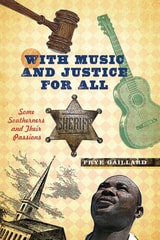
With Music and Justice for All
Some Southerners and Their PassionsFrye Gaillard
Vanderbilt University Press, 2008
But Gaillard examines the South from other angles as well--the religious heritage, for example, that once led Flannery O'Connor to write about a "Christ-haunted" South. We meet Billy Graham, the greatest evangelist of his time, who admitted in the course of interviews with Gaillard that his ministry represented a "very narrow gift." There are profiles here of the Southern Baptist renegade Will Campbell and former President Jimmy Carter, whose commitment to his own understanding of Christianity has sometimes led him into controversy. Gaillard writes also about the revealing power of Southern music--how the great Johnny Cash, for example, became a force for reconciliation in America. In the final section of the book we meet some of the characters Gaillard has covered through the years, including John T. Scopes, whose final public appearance Gaillard wrote about as a young reporter in Nashville.
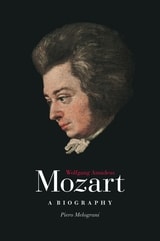
Wolfgang Amadeus Mozart
A BiographyPiero Melograni
University of Chicago Press, 2006
This year marks the 250th anniversary of the birth of Wolfgang Amadeus Mozart, one of the most enduringly popular and celebrated composers to have ever lived. His substantial oeuvre contains works that are considered to be among the most exquisite pieces of symphonic, chamber, and choral music ever written. His operas too cast a long shadow over those staged in their wake. And since his untimely death in 1791, he remains an enigmatic figure—the subject of fascination for aficionados and novices alike.
Piero Melograni here offers a wholly readable account of Mozart’s remarkable life and times. This masterful biography proceeds from the young Mozart’s earliest years as a Wunderkind—the child prodigy who traveled with his family to perform concerts throughout Europe—to his formative years in Vienna, where he fully absorbed the artistic and intellectual spirit of the Enlightenment, to his deathbed, his unfinished Requiem, and the mystery that still surrounds his burial. Melograni’s deft use of Mozart’s letters throughout confers authority and vitality to his recounting, and his expertise brings Mozart’s eighteenth-century milieu evocatively to life. Written with a gifted historian’s flair for narrative and unencumbered by specialized analyses of Mozart’s music, Melograni’s is the most vivid and enjoyable biography available.
At a time when music lovers around the world are paying honor to Mozart and his legacy, Wolfgang Amadeus Mozart will be welcomed by his enthusiasts—or anyone wishing to peer into the mind of one of the greatest composers ever known.
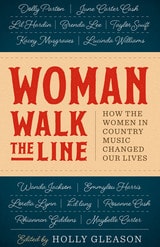
Woman Walk the Line
How the Women in Country Music Changed Our LivesBy Holly Gleason
University of Texas Press, 2017
Full-tilt, hardcore, down-home, and groundbreaking, the women of country music speak volumes with every song. From Maybelle Carter to Dolly Parton, k.d. lang to Taylor Swift—these artists provided pivot points, truths, and doses of courage for women writers at every stage of their lives. Whether it’s Rosanne Cash eulogizing June Carter Cash or a seventeen-year-old Taylor Swift considering the golden glimmer of another precocious superstar, Brenda Lee, it’s the humanity beneath the music that resonates.
Here are deeply personal essays from award-winning writers on femme fatales, feminists, groundbreakers, and truth tellers. Acclaimed historian Holly George Warren captures the spark of the rockabilly sensation Wanda Jackson; Entertainment Weekly’s Madison Vain considers Loretta Lynn’s girl-power anthem “The Pill”; and rocker Grace Potter embraces Linda Ronstadt’s unabashed visual and musical influence. Patty Griffin acts like a balm on a post-9/11 survivor on the run; Emmylou Harris offers a gateway through paralyzing grief; and Lucinda Williams proves that greatness is where you find it.
Part history, part confessional, and part celebration of country, Americana, and bluegrass and the women who make them, Woman Walk the Line is a very personal collection of essays from some of America’s most intriguing women writers. It speaks to the ways in which artists mark our lives at different ages and in various states of grace and imperfection—and ultimately how music transforms not just the person making it, but also the listener.
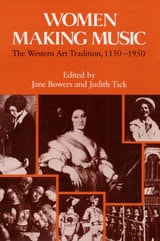
Women Making Music
The Western Art Tradition, 1150-1950Edited by Jane Bowers and Judith Tick
University of Illinois Press, 1986
The first work of its kind, Women Making Music presents biographies of outstanding performers and composers, as well as analyses of women musicians as a class, and provides examples of music from all periods including medieval chant, Renaissance song, Baroque opera, German lieder, and twentieth-century composition. Unlike most standard historical surveys, the book not only sheds light upon the musical achievements of women, it also illuminates the historical contexts that shaped and defined those achievements.
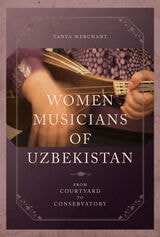
Women Musicians of Uzbekistan
From Courtyard to ConservatoryTanya Merchant
University of Illinois Press, 2015
Drawing on fieldwork and music study carried out between 2001 and 2014, Merchant challenges the Western idea of Central Asian women as sequestered and oppressed. Instead, she notes, Uzbekistan's women stand at the forefront of four prominent genres: maqom, folk music, Western art music, and popular music. Merchant's recounting of the women's experiences, stories, and memories underscores the complex role that these musicians and vocalists play in educational institutions and concert halls, street kiosks and the culturally essential sphere of wedding music. Throughout the book, Merchant ties nationalism and femininity to performances and reveals how the music of these women is linked to a burgeoning national identity.
Important and revelatory, Women Musicians of Uzbekistan looks into music's part in constructing gendered national identity and the complicated role of femininity in a former Soviet republic's national project.
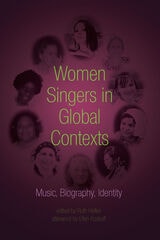
Women Singers in Global Contexts
Music, Biography, IdentityEdited by Ruth Hellier: Afterword by Ellen Koskoff
University of Illinois Press, 2016
Women and Music in Cross-Cultural Perspective
Edited by Ellen Koskoff
University of Illinois Press, 1989
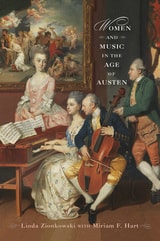
Women and Music in the Age of Austen
Linda Zionkowski
Bucknell University Press, 2024
Published by Bucknell University Press. Distributed worldwide by Rutgers University Press.
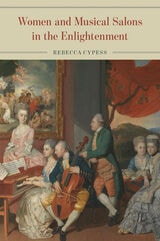
Women and Musical Salons in the Enlightenment
Rebecca Cypess
University of Chicago Press, 2022
In eighteenth-century Europe and America, musical salons—and the women who hosted and made music in them—played a crucial role in shaping their cultural environments. Musical salons served as a testing ground for new styles, genres, and aesthetic ideals, and they acted as a mediating force, bringing together professional musicians and their audiences of patrons, listeners, and performers. For the salonnière, the musical salon offered a space between the public and private spheres that allowed her to exercise cultural agency.
In this book, musicologist and historical keyboardist Rebecca Cypess offers a broad overview of musical salons between 1760 and 1800, placing the figure of the salonnière at its center. Cypess then presents a series of in-depth case studies that meet the salonnière on her own terms. Women such as Anne-Louise Brillon de Jouy in Paris, Marianna Martines in Vienna, Sara Levy in Berlin, Angelica Kauffman in Rome, and Elizabeth Graeme in Philadelphia come to life in multidimensional ways. Crucially, Cypess uses performance as a tool for research, and her interpretations draw on her experience with the instruments and performance practices used in eighteenth-century salons. In this accessible, interdisciplinary book, Cypess explores women’s agency and authorship, reason and sentiment, and the roles of performing, collecting, listening, and conversing in the formation of eighteenth-century musical life.
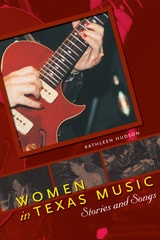
Women in Texas Music
Stories and SongsBy Kathleen Hudson
University of Texas Press, 2007
Across the state and across a wide variety of musical genres, women are making their mark on Texas music. Some have become international superstars, while others are just starting to make their voices heard. But every woman who goes out and plays her music proves that "baring one's heart and soul takes courage, and Texas women artists have a lot of courage," as Lloyd Maines observes in the opening interview of this book. To pay tribute to these dedicated musicians and to capture their unique perspectives on what it means to be a woman in the music business, Kathleen Hudson has spent many years interviewing Texas women musicians for the Texas Heritage Music Foundation.
In Women in Texas Music, Hudson lets us listen in on conversations with thirty-nine musical artists, including Emily Robison, Terri Hendrix, Lee Ann Womack, Rosie Flores, Betty Buckley, Marcia Ball, Lavelle White, and Bobbie Nelson. Hudson encourages and allows the women to tell their own stories as she delves into their life journeys, creative processes, and the importance of writing and performing music, be it blues, rock, country, folk, jazz, or pop. The interviews are warm and open, like good friends sharing the lessons that a life of playing music has taught them.
What emerges from this collection is a solid sense of the strength and integrity that women bring to and gain from Texas music. Everyone who cares about music and culture in Texas will want to join the conversation.
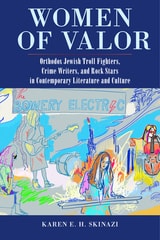
Women of Valor
Orthodox Jewish Troll Fighters, Crime Writers, and Rock Stars in Contemporary Literature and CultureKaren E. H. Skinazi
Rutgers University Press, 2018
Media portrayals of Orthodox Jewish women frequently depict powerless, silent individuals who are at best naive to live an Orthodox lifestyle, and who are at worst, coerced into it. Karen E. H. Skinazi delves beyond this stereotype in Women of Valor to identify a powerful tradition of feminist literary portrayals of Orthodox women, often created by Orthodox women themselves. She examines Orthodox women as they appear in memoirs, comics, novels, and movies, and speaks with the authors, filmmakers, and musicians who create these representations. Throughout the work, Skinazi threads lines from the poem “Eshes Chayil,” the Biblical description of an Orthodox “Woman of Valor.” This proverb unites Orthodoxy and feminism in a complex relationship, where Orthodox women continuously question, challenge, and negotiate Orthodox and feminist values. Ultimately, these women create paths that unite their work, passions, and families under the framework of an “Eshes Chayil,” a woman who situates religious conviction within her own power.
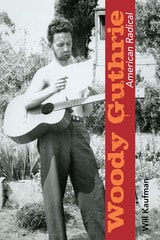
Woody Guthrie, American Radical
Will Kaufman
University of Illinois Press, 2011
Words On Music
From Addison To BarzunJack Sullivan
Ohio University Press, 1990
Words on Music is thus the first book of its kind. Covering instrumental and vocal music from the eighteenth through the twentieth centuries, it features essays distinguished by their literary quality, their readability, and their appeal to a wide audience. Included is writing by novelists, essayists, composers, performers, cultural historians, and others who have written about music with precision and passion.
Here is George Bernard Shaw on Handel, Albert Schweitzer on Bach, Glenn Gould on Scarlatti, E. T. A. Hoffman on Beethoven, Heinrich Heine on Rossini, Aaron Copland on Mozart, George Eliot on Wagner, G. K. Chesterton on Gilbert and Sullivan, Leonard Bernstein on Mahler, Guy Davenport on Ives, Pierre Boulez on Stravinsky, Ned Rorem on Ravel, and more than fifty others. Here also are essays on broader topics—Joseph Addison on opera, Anthony Burgess on music and literature, Jacques Barzun on music criticism, H. L. Mencken on “Music an Sin”—as well as musical memoirs by such masters of the genre as Hector Berlioz, Leigh Hunt, and Ethel Smyth.
Words on Music is a uniquely literary and readable book on music. With its wide range of tones and voices, it is ideal for the general reader, the humanities educator, and the musical specialist. Each article is introduced by an informative headnote on the writer and subject. In addition, the volume offers a bibliography with valuable clues for further reading and a substantial essay introducing the elusive art of writing about music.
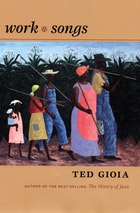
Work Songs
Ted Gioia
Duke University Press, 2006
Now Ted Gioia, author of several acclaimed books on the history of jazz, tells the story of work songs from prehistoric times to the present. Vocation by vocation, Gioia focuses attention on the rhythms and melodies that have attended tasks such as the cultivation of crops, the raising and lowering of sails, the swinging of hammers, the felling of trees. In an engaging, conversational writing style, he synthesizes a breathtaking amount of material, not only from songbooks and recordings but also from travel literature, historical accounts, slave narratives, folklore, labor union writings, and more. He draws on all of these to describe how workers in societies around the world have used music to increase efficiency, measure time, relay commands, maintain focus, and alleviate drudgery.
At the same time, Gioia emphasizes how work songs often soar beyond utilitarian functions. The heart-wringing laments of the prison chain gang, the sailor’s shanties, the lumberjack’s ballads, the field hollers and corn-shucking songs of the American South, the pearl-diving songs of the Persian Gulf, the rich mbube a cappella singing of South African miners: Who can listen to these and other songs borne of toil and hard labor without feeling their sweep and power? Ultimately, Work Songs, like its companion volume Healing Songs, is an impassioned tribute to the extraordinary capacity of music to enter into day-to-day lives, to address humanity’s deepest concerns and most heartfelt needs.
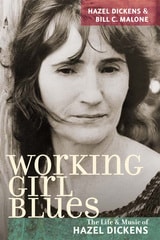
Working Girl Blues
The Life and Music of Hazel DickensHazel Dickens and Bill C. Malone
University of Illinois Press, 2007
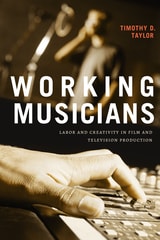
Working Musicians
Labor and Creativity in Film and Television ProductionTimothy D. Taylor
Duke University Press, 2023
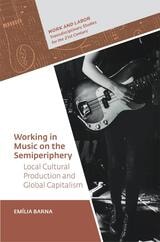
Working in Music on the Semiperiphery
Local Cultural Production and Global CapitalismEmília Barna
Central European University Press, 2025
This book embraces the widest possible range of workers in the music industry. It deals with all music genres from high-flying to commercial and observes various workers in the production chain beyond musicians. Niche segments of the sector, such as YouTube-based commercial hip hop, are given special treatment. Using a variety of empirical research methods, the study examines the trends as workers are pushed towards digital entrepreneurship and platform work, on the one hand, and live performance, on the other. The focus on domestic work and informality offers a feminist analysis of work in music. This approach sheds light on gendered divisions of labor and forms of (self-)exploitation that usually remain invisible. The book proposes a new model of cultural autonomy that takes account of the semiperipheral relationship of music industry workers and institutions to both the market and the state.
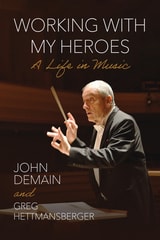
Working with My Heroes
A Life in MusicJohn L. DeMain and Greg Hettmansberger
University of Wisconsin Press, 2026
A Grammy and Tony Award–winning conductor, John DeMain has been a fixture of Madison, Wisconsin, for more than three decades, serving as music director of the Madison Symphony Orchestra and artistic director of the Madison Opera. Before and since then, he has been an internationally recognized conductor, equally at home in the worlds of classical music, opera, and Broadway.
In Working with My Heroes, written with the late Greg Hettmansberger, DeMain recounts incredible experiences—from his days studying piano in Youngstown, Ohio, to his years as an undergraduate and graduate student at Julliard, to his early jobs in summer stock productions, to numerous acclaimed productions—without ever losing sight of the wonder and awe he felt as a young musician first learning his way in the world. With warmth and humor, he provides valuable insight into the business of music making, while also sharing behind-the-scenes stories of entertaining situations he found himself in throughout the years—from playing piano at a gangster’s wedding to an unexpected dressing room encounter with a Broadway star to conducting an opera with circus elephants.
DeMain has had many career-defining moments behind the podium, conducting world premieres of Leonard Bernstein’s A Quiet Place, John Adams’s Nixon in China, and Jeanine Tesoro’s Blue, as well as the U.S. premiere of Philip Glass’s Akhnaten, among others. He guest-conducted symphonies and operas in New York, Chicago, Los Angeles, and elsewhere. DeMain cemented his reputation with the 1976 Houston Grand Opera performances of George and Ira Gershwin’s Porgy and Bess, establishing its stature as a quintessentially American opera. The singers, musicians, and composers DeMain has worked with over the past six decades are a veritable Who’s Who of American classical music. This memoir places readers by his side, allowing them to experience all the wonders and joy of a life spent making music.
World Flutelore
Folktales, Myths, and Other Stories of Magical Flute PowerDale A. Olsen
University of Illinois Press, 2013
Describing and interpreting many examples of flutes as they are found in mythology, poetry, lyrics, and other narrative and literary sources from around the world, veteran ethnomusicologist Dale Olsen seeks to determine what is singularly distinct or unique about flutes, flute playing, and flute players in a global context. He shows how and why flutes are important for personal, communal, religious, spiritual, and secular expression and even, perhaps, existence. This is a book for students, scholars, and any reader interested in the cultural power of flutes.
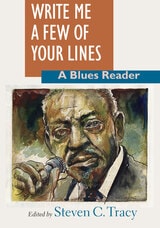
Write Me a Few of Your Lines
A Blues ReaderSteven C. Tracy
University of Massachusetts Press, 1999
Among the signal achievements of African American culture is the style of music known as the blues, an art form evolved from southern black songs of the late nineteenth century. From the field hollers and steel-bodied guitar of its early days to the electric amplification of today's performers, the visceral power of the blues has long been celebrated for its creativity, spontaneity, and ingenuity. It has served as a wellspring for other forms of music, including gospel, jazz, rhythm and blues, soul, rock, and rap, and has exerted an influence on literature and the visual arts as well.
This book brings together some of the most significant writings about the blues published between 1911 and 1998. Included are selections by folklorists, anthropologists, sociologists, literary artists, musicians, critics, and aficionados. The extraordinary appeal of the blues is reflected in the range of contributors to this volume, among them Howard W. Odum, Alan Lomax, Richard Alan Waterman, Langston Hughes, Paul Oliver, Sam Charters, Janheinz Jahn, James Baldwin, Leroi Jones, Charles Keil, Jeff Todd Titon, Houston Baker, Hazel Carby, and Angela Davis. From these various perspectives emerges a new understanding of the blues: its origins in African aesthetics; the impact of slavery and Reconstruction; its early folk manifestations; and the importance of religion, style, gender, audience, protest, and the record business in its development as an art form. Further context is provided by a comprehensive introduction, section overviews, and an extensive bibliography, discography, and videography of blues materials.
Writing on Water
The Sounds of Jewish PrayerJudit Niran Frigyesi
Central European University Press, 2018
Writing on Water grasps the phenomenon of sound in prayer, that is, a meaning in sounds and soundscapes, and a musical essence in the act of praying.
The impetus for the book arose from the author’s fieldwork among traditional Jews during the era of communism in Budapest and Prague. In that period the Jewish religion and Jewishness in general were supressed and rituals became semi-secret and turned inward. The book is a witness to these communities and their rituals, but it goes beyond documentation. The uniqueness of the sounds of the rituals compelled the author to try to comprehend how melodies and soundscapes became the sustaining/protective environment, as well as the vehicle, for the expression of a world-orientation—in a situation where open discourse was inconceivable.
The book is based on extensive interviews, musical recordings, photographs and scholarly analyses. It is unique in its choice of communities, its wealth of original documents, and its novel interpretation of sound.
Writing on Water is creative non-fiction. The presentation is evocative and poetic, but at the same time it transmits knowledge. The book can aid research and serve in courses in philosophy, religion, music, ethnomusicology, anthropology, aesthetics, Jewish studies, folklore, oral history, and performance studies. It is also a work of art and literature.
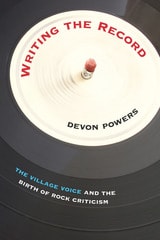
Writing the Record
The Village Voice and the Birth of Rock CriticismDevon Powers
University of Massachusetts Press, 2013
During the mid-1960s, a small group of young journalists made it their mission to write about popular music, especially rock, as something worthy of serious intellectual scrutiny. Their efforts not only transformed the perspective on the era's music but revolutionized how Americans have come to think, talk, and write about popular music ever since.
In Writing the Record, Devon Powers explores this shift by focusing on The Village Voice, a key publication in the rise of rock criticism. Revisiting the work of early pop critics such as Richard Goldstein and Robert Christgau, Powers shows how they stood at the front lines of the mass culture debates, challenging old assumptions and hierarchies and offering pioneering political and social critiques of the music. Part of a college-educated generation of journalists, Voice critics explored connections between rock and contemporary intellectual trends such as postmodernism, identity politics, and critical theory. In so doing, they became important forerunners of the academic study of popular culture that would emerge during the 1970s.
Drawing on archival materials, interviews, and insights from media and cultural studies, Powers not only narrates a story that has been long overlooked but also argues that pop music criticism has been an important channel for the expression of public intellectualism. This is a history that is particularly relevant today, given the challenges faced by criticism of all stripes in our current media environment. Powers makes the case for the value of well-informed cultural criticism in an age when it is often suggested that “everyone is a critic.”
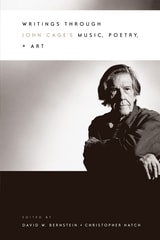
Writings through John Cage's Music, Poetry, and Art
Edited by David W. Bernstein and Christopher Hatch
University of Chicago Press, 2001
The essays in this collection grew out of a pivotal gathering during which a spectrum of participants including composers, music scholars, and visual artists, literary critics, poets, and filmmakers convened to examine Cage's extraordinary artistic legacy. Beginning with David Bernstein's introductory essay on the reception of Cage's music, the volume addresses topics ranging from Cage's reluctance to discuss his homosexuality, to his work as a performer and musician, and his forward-looking, provocative experimentation with electronic and other media. Several of the essays draw upon previously unseen sketches and other source materials. Also included are transcripts of lively panel discussions among some of Cage's former colleagues. Taken together, this collection is a much-needed contribution to the study of one of the most significant American artists of the twentieth century.