Results by title
1441 books match the query 'World' and 60 start with w

World to World
Valerie Martínez
University of Arizona Press, 2004
In her second collection of poems, Valerie Martínez builds on the artistic command of language that characterized her award-winning first volume, Absence, Luminescent. Taking on not only such familiar themes as love and loss, family and culture, but also the creative act of poetry itself, World to World crosses new boundaries to chart a mature poet’s awareness of her own voice and style.
Martínez explores the dynamic of creation/dissolution in original and intriguing ways. Here are the strange and provocative landscapes of the body and its disappearance . . . of matter and the absence of matter . . . of what is formed and what is falling from form. Throughout this compelling cycle, her deft manipulations of poetic structure disclose the boundaries where flesh, matter, and language become spirit, space, and "cataractical brilliance."
In charting the relationships between time, form, body, language, and emptiness, World to World maps the territories where the visible and the invisible meet, offering unexpected discoveries for discerning readers.
[more]
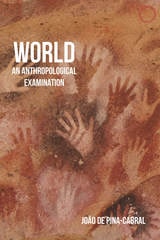
World
An Anthropological ExaminationJoão de Pina-Cabral
HAU, 2016
What do we mean when we refer to world? How does the world relate to the human person? Are the two interdependent and, if so, in what way? What does world mean for an ethnographer or an anthropologist? Much has been said of worlds and worldviews, but do we really know what we mean by these words? Asking these questions and many more, this book explores the conditions of possibility of the ethnographic gesture, and how these shed light on the relationship between humans and the world in the midst of which they find themselves.
As Pina-Cabral shows, recent decades have seen important shifts in the way we relate human thought to human embodiment—the relation between how we think and what we are. The book proposes a novel approach to the human condition: an anthropological outlook that is centered around the notions of personhood and sociality. Through a rich confrontation with ethnographic and historical material, this work contributes to the ongoing task of overcoming the theoretical constraints that have hindered anthropological thinking over the past century.
[more]
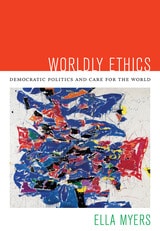
Worldly Ethics
Democratic Politics and Care for the WorldElla Myers
Duke University Press, 2013
What is the spirit that animates collective action? What is the ethos of democracy? Worldly Ethics offers a powerful and original response to these questions, arguing that associative democratic politics, in which citizens join together and struggle to shape shared conditions, requires a world-centered ethos. This distinctive ethos, Ella Myers shows, involves care for "worldly things," which are the common and contentious objects of concern around which democratic actors mobilize. In articulating the meaning of worldly ethics, she reveals the limits of previous modes of ethics, including Michel Foucault's therapeutic model, based on a "care of the self," and Emmanuel Levinas's charitable model, based on care for the Other. Myers contends that these approaches occlude the worldly character of political life and are therefore unlikely to inspire and support collective democratic activity. The alternative ethics she proposes is informed by Hannah Arendt's notion of amor mundi, or love of the world, and it focuses on the ways democratic actors align around issues, goals, or things in the world, practicing collaborative care for them. Myers sees worldly ethics as a resource that can inspire and motivate ordinary citizens to participate in democratic politics, and the book highlights civic organizations that already embody its principles.
[more]
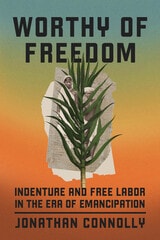
Worthy of Freedom
Indenture and Free Labor in the Era of EmancipationJonathan Connolly
University of Chicago Press, 2024
A study of Indian indentured labor in Mauritius, British Guiana, and Trinidad that explores the history of indenture’s normalization.
In this book, historian Jonathan Connolly traces the normalization of indenture from its controversial beginnings to its widespread adoption across the British Empire during the nineteenth century. Initially viewed as a covert revival of slavery, indenture caused a scandal in Britain and India. But over time, economic conflict in the colonies altered public perceptions of indenture, now increasingly viewed as a legitimate form of free labor and a means of preserving the promise of abolition. Connolly explains how the large-scale, state-sponsored migration of Indian subjects to work on sugar plantations across Mauritius, British Guiana, and Trinidad transformed both the notion of post-slavery free labor and the political economy of emancipation.
Excavating legal and public debates and tracing practical applications of the law, Connolly carefully reconstructs how the categories of free and unfree labor were made and remade to suit the interests of capital and empire, showing that emancipation was not simply a triumphal event but, rather, a deeply contested process. In so doing, he advances an original interpretation of how indenture changed the meaning of “freedom” in a post-abolition world.
[more]
Worthy of Freedom
Indenture and Free Labor in the Era of EmancipationJonathan Connolly
University of Chicago Press, 2024
This is an auto-narrated audiobook version of this book.
A study of Indian indentured labor in Mauritius, British Guiana, and Trinidad that explores the history of indenture’s normalization.
In this book, historian Jonathan Connolly traces the normalization of indenture from its controversial beginnings to its widespread adoption across the British Empire during the nineteenth century. Initially viewed as a covert revival of slavery, indenture caused a scandal in Britain and India. But over time, economic conflict in the colonies altered public perceptions of indenture, now increasingly viewed as a legitimate form of free labor and a means of preserving the promise of abolition. Connolly explains how the large-scale, state-sponsored migration of Indian subjects to work on sugar plantations across Mauritius, British Guiana, and Trinidad transformed both the notion of post-slavery free labor and the political economy of emancipation.
Excavating legal and public debates and tracing practical applications of the law, Connolly carefully reconstructs how the categories of free and unfree labor were made and remade to suit the interests of capital and empire, showing that emancipation was not simply a triumphal event but, rather, a deeply contested process. In so doing, he advances an original interpretation of how indenture changed the meaning of “freedom” in a post-abolition world.
[more]
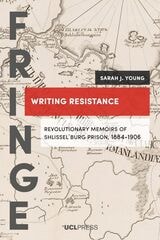
Writing Resistance
Revolutionary Memoirs of Shlissel´burg Prison, 1884-1906Sarah J. Young
University College London, 2021
The first extended study in English of the revolutionary memoirs from Shlissel’burg Fortress.
In 1884, sixty-eight prisoners convicted of terrorism and revolutionary activity were transferred to a new maximum-security prison at Shlissel´burg Fortress near St. Petersburg. Inhuman conditions in the prison caused severe mental and physical deterioration among the prisoners, and over half died. However, the survivors fought back to reform the prison and improve the inmates’ living conditions. Their memoirs enshrined their experience in revolutionary mythology and served as an indictment of the Tsarist autocracy’s loss of moral authority. This book features three of these memoirs—translated into English for the first time—as well as an introductory essay that analyzes the memoirs’ construction of a collective narrative of resilience, resistance, and renewal. The first extended study of these memoirs in English, this book uncovers an important episode in the history of political imprisonment. It will be of interest to scholars and students of the Russian revolution, carceral history, penal practice and behaviors, and prison and life writing.
In 1884, sixty-eight prisoners convicted of terrorism and revolutionary activity were transferred to a new maximum-security prison at Shlissel´burg Fortress near St. Petersburg. Inhuman conditions in the prison caused severe mental and physical deterioration among the prisoners, and over half died. However, the survivors fought back to reform the prison and improve the inmates’ living conditions. Their memoirs enshrined their experience in revolutionary mythology and served as an indictment of the Tsarist autocracy’s loss of moral authority. This book features three of these memoirs—translated into English for the first time—as well as an introductory essay that analyzes the memoirs’ construction of a collective narrative of resilience, resistance, and renewal. The first extended study of these memoirs in English, this book uncovers an important episode in the history of political imprisonment. It will be of interest to scholars and students of the Russian revolution, carceral history, penal practice and behaviors, and prison and life writing.
[more]
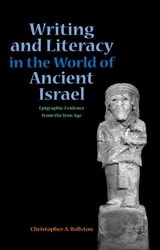
Writing and Literacy in the World of Ancient Israel
Epigraphic Evidence from the Iron AgeChristopher A. Rollston
SBL Press, 2010
Winner of the 2011 Frank Moore Cross Prize as the most substantial volume in the field of Northwest Semitic Epigraphy
Ancient Northwest Semitic inscriptions from Israel, Phoenicia, Syria, Moab, Ammon, Edom, and Philistia enlighten and sharpen our vision of the Old Testament world in various ways. Writing and Literacy in the World of Ancient Israel focuses on this epigraphic evidence in order to broaden our understanding of the techniques and roles of writing, education, and literacy during this biblical period. To that end, the volume systematically covers scribal education; scribal implements; writing media such as stones, potsherds, and plaster; and the religious, administrative, and personal uses of writing. Its “handbook” format makes it easily accessible, including for use as a textbook in courses addressing the cultural context of ancient Israel.
[more]
Writing from the Edge of the World
The Memoirs of Darien, 1514-1527Gonzalo Fernandez de Oviedo
University of Alabama Press, 2006
A stirring account of Spain’s incursion into the New World
Gonzalo Fernández de Oviedo is the 16th-century author of Historia general y natural de las Indias, a general and natural history of the peoples and places he encountered in his travels to Spanish America. Oviedo was educated at the court of King Ferdinand and Queen Isabella and held several early appointments to the royal household, first as page to their son, John. In 1513, he accepted the appointment as warden of the gold mines of Castilla de Oro on the Isthmus of Panama in Darién, the first viable Spanish settlement on the American mainland. His first year at the very edge of the known world converted Oviedo into a lifelong resident of America and, more importantly, marked the beginning of his campaign to appropriate the topic of the Indies and become its interpreter to Europe.
As G. F. Dille points out in his introduction, this work earned Oviedo the title of many firsts—first historian, first enthographer, first naturalist, first anthropologist, and first sociologist of the New World. Dille adds to that list first autobiographer and first novelist of the Americas.
This annotated translation contains the section of Oviedo’s work that recounts his experience in the New World during his service in Panama. Dille includes a brief introduction to Oviedo and provides general information on the political background of Spain and on the Spanish colonial system, the printing history of the text, a description of the reception of Oviedo’s work, and notes on the translation.
[more]
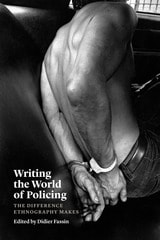
Writing the World of Policing
The Difference Ethnography MakesEdited by Didier Fassin
University of Chicago Press, 2017
As policing has recently become a major topic of public debate, it was also a growing area of ethnographic research. Writing the World of Policing brings together an international roster of scholars who have conducted fieldwork studies of law enforcement in disadvantaged urban neighborhoods on five continents. How, they ask, can ethnography illuminate the role of the police in society? Are there important aspects of policing that are not captured through interviews and statistics? And how can the study of law enforcement shed light on the practice of ethnography? What might studying policing teach us about the epistemological and ethical challenges of participant observation? Beyond these questions of crucial interest for criminology and, more generally, the social sciences, Writing the World of Policing provides a timely discussion of one of the most problematic institutions in contemporary society.
[more]

Writing the World
Understanding William StaffordJudith Kitchen
Oregon State University Press, 1999
[more]