28167 books match the query 'History' and 1118 start with w
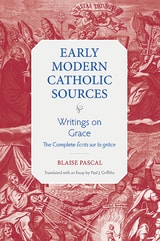
cover of Writings on Grace: The Complete <i>Ecrits sur la grace</i>

Writings on Grace

The Complete <i>Ecrits sur la grace</i>

Blaise Pascal

Catholic University of America Press, 2025

A few years before he died in 1662, Blaise Pascal wrote fifteen interconnected essays on grace, which have collectively come to be known as the Écrits sur la grâce. These were not published before his death, and were not polished and revised by him with an eye to publication, which means that they show his mind at work experimentally, trying out lines of argument and engagements with magisterial and patristic texts without resolving them into anything like a final system. The Écrits are replete with experimental formulations and bursts of literary and intellectual energy; taken together, they provide an intense and extreme presentation of Pascal's version of Augustinianism with respect to grace, election, and predestination, the meaning of the Council of Trent, and much else. These essays provide one of the keys to the entirety of Pascal's thought, and they provide a view of grace's workings -- perhaps better, a grammar of grace -- which still warrants serious attention by Catholic theologians. Less than one-fifth of the Écrits has yet been published in English. This book provides a complete translation, made from the French text provided in Michel Le Guern's edition (1998, 2000) of Pascal's Oeuvres complètes, and annotated to provide full information about Pascal's sources and how he used them. The translation is followed by a substantial interpretive essay in which Pascal's positions and approaches are restated and argued with.
[more]
cover of Writings on Media: History of the Present

Writings on Media

History of the Present

Stuart Hall

Duke University Press, 2021
Writings on Media gathers more than twenty of Stuart Hall's media analyses, from scholarly essays such as “Encoding and Decoding in the Television Discourse” (1973) to other writings addressed to wider publics. Hall explores the practices of news photography, the development of media and cultural studies, the changing role of television, and how the nation imagines itself through popular media. He attends to Britain's imperial history and the politics of race and cultural identity as well as the media's relationship to the political project of the state. Testifying to the range and agility of Hall's critical and pedagogic engagement with contemporary media culture—and also to his collaborative mode of working—this volume reaffirms his stature as an innovative media theorist while demonstrating the continuing relevance of his methods of analysis.
[more]
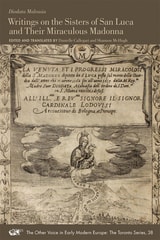
cover of Writings on the Sisters of San Luca and Their Miraculous Madonna

Writings on the Sisters of San Luca and Their Miraculous Madonna

Diodata Malvasia

Iter Press, 2015

The Bolognese nun Diodata Malvasia was presumed to have authored only one work, The Arrival and the Miraculous Workings of the Glorious Image of the Virgin (1617). In her recently discovered second manuscript chronicle, A Brief Discourse on What Occurred to the Most Reverend Sisters of the Joined Convents of San Mattia and San Luca (1575), her writing demonstrates active resistance to Tridentine convent reform. Together, Malvasia’s works read as the bookends to a lifelong crusade on behalf of her convent.
[more]
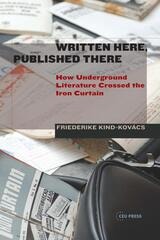
cover of Written Here, Published There: How Underground Literature Crossed the Iron Curtain

Written Here, Published There

How Underground Literature Crossed the Iron Curtain

Friederike Kind-Kovács

Central European University Press, 2015

Written Here, Published There offers a new perspective on the role of underground literature in the Cold War and challenges us to recognize gaps in the Iron Curtain. The book identifies a transnational undertaking that reinforced détente, dialogue, and cultural transfer, and thus counterbalanced the persistent belief in Europe's irreversible division.

It analyzes a cultural practice that attracted extensive attention during the Cold War but has largely been ignored in recent scholarship: tamizdat, or the unauthorized migration of underground literature across the Iron Curtain. Through this cultural practice, I offer a new reading of Cold War Europe's history. Investigating the transfer of underground literature from the 'Other Europe' to Western Europe, the United States, and back illuminates the intertwined fabrics of Cold War literary cultures. Perceiving tamizdat as both a literary and a social phenomenon, the book focuses on how individuals participated in this border-crossing activity and used secretive channels to guarantee the free flow of literature.
[more]
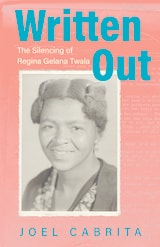
cover of Written Out: The Silencing of Regina Gelana Twala

Written Out

The Silencing of Regina Gelana Twala

Joel Cabrita

Ohio University Press, 2023
Systemic racism and sexism caused one of South Africa’s most important writers to disappear from public consciousness. Is it possible to justly restore her historical presence? Regina Gelana Twala, a Black South African woman who died in 1968 in Swaziland (now Eswatini), was an extraordinarily prolific writer of books, columns, articles, and letters. Yet today Twala’s name is largely unknown. Her literary achievements are forgotten. Her books are unpublished. Her letters languish in the dusty study of a deceased South African academic. Her articles are buried in discontinued publications. Joel Cabrita argues that Twala’s posthumous obscurity has not developed accidentally as she exposes the ways prejudices around race and gender blocked Black African women like Twala from establishing themselves as successful writers. Drawing upon Twala’s family papers, interviews, newspapers, and archival records from Pretoria, Uppsala, and Los Angeles, Cabrita argues that an entire cast of characters—censorious editors, territorial White academics, apartheid officials, and male African politicians whose politics were at odds with her own—conspired to erase Twala’s legacy. Through her unique documentary output, Twala marked herself as a radical voice on issues of gender, race, and class. The literary gatekeepers of the racist and sexist society of twentieth-century southern Africa clamped down by literally writing her out of the region’s history. Written Out also scrutinizes the troubled racial politics of African history as a discipline that has been historically dominated by White academics, a situation that many people within the field are now examining critically. Inspired by this recent movement, Cabrita interrogates what it means for her—a White historian based in the Northern Hemisphere—to tell the story of a Black African woman. Far from a laudable “recovery” of an important lost figure, Cabrita acknowledges that her biography inevitably reproduces old dynamics of White scholarly privilege and dominance. Cabrita’s narration of Twala’s career resurrects it but also reminds us that Twala, tragically, is still not the author of her own life story.
[more]
cover of Written for the Drawer: Leonid Tsypkin, Uncensored Literature, and Soviet Jewishness

Written for the Drawer

Leonid Tsypkin, Uncensored Literature, and Soviet Jewishness

Brett Winestock

University of Wisconsin Press, 2024

Russian-Jewish writer Leonid Tsypkin (1926–82), a doctor by trade, wrote primarily “for the drawer,” fearing professional consequences if he were to publish his fiction. Despite Tsypkin’s almost complete lack of readership during his lifetime, his work has received international posthumous recognition, with Susan Sontag calling his work “among the most beautiful, exalting, and original achievements of a century’s worth of fiction.” 

Tsypkin’s autobiographical writing explored the impossibility of being both a Russian writer and a Soviet Jew, employing indirection and referentiality. In the first book-length appraisal of Tsypkin and his work, Brett Winestock considers Tsypkin’s fiction as part of a transnational literary response to the horrors of the twentieth century, a reception that helps explain his much-belated international readership. Through close readings of Tsypkin’s work in the context of late-Soviet cultural worlds, Winestock makes an important contribution to studies of Jewish Soviet writing and identity.
[more]
cover of Written in Blood: Revolutionary Terrorism and Russian Literary Culture, 1861–1881

Written in Blood

Revolutionary Terrorism and Russian Literary Culture, 1861–1881

Lynn Ellen Patyk

University of Wisconsin Press, 2017

Written in Blood offers a fundamentally new interpretation of the emergence of modern terrorism, arguing that it formed in the Russian literary imagination well before any shot was fired or bomb exploded. In March 1881, Russia stunned the world when a small band of revolutionaries calling themselves "terrorists" assassinated the Tsar-Liberator, Alexander II. Horrified Russians blamed the influence of European political and social ideas, while shocked Europeans perceived something new and distinctly Russian in a strategy of political violence that became known the world over as "terrorism" or "the Russian method."

Lynn Ellen Patyk contends that the prototype for the terrorist was the Russian writer, whose seditious word was interpreted as an audacious deed—and a violent assault on autocratic authority. The interplay and interchangeability of word and deed, Patyk argues, laid the semiotic groundwork for the symbolic act of violence at the center of revolutionary terrorism. While demonstrating how literary culture fostered the ethos, pathos, and image of the revolutionary terrorist and terrorism, she spotlights Fyodor Dostoevsky and his "terrorism trilogy"—Crime and Punishment (1866), Demons (1870–73), and The Brothers Karamazov (1878–80)—as novels that uniquely illuminate terrorism's methods and trajectory. Deftly combining riveting historical narrative with penetrating literary analysis of major and minor works, Patyk's groundbreaking book reveals the power of the word to spawn deeds and the power of literature to usher new realities into the world.
[more]
cover of Written in Blood: Revolutionary Terrorism and Russian Literary Culture, 1861–1881

Written in Blood

Revolutionary Terrorism and Russian Literary Culture, 1861–1881

Lynn Ellen Patyk

University of Wisconsin Press, 2020

Written in Blood offers a fundamentally new interpretation of the emergence of modern terrorism, arguing that it formed in the Russian literary imagination well before any shot was fired or bomb exploded. Lynn Ellen Patyk contends that the prototype for the terrorist was the Russian writer, whose seditious word was interpreted as an audacious deed—and a violent assault on autocratic authority. Deftly combining riveting historical narrative with penetrating literary analysis of major and minor works, Patyk’s groundbreaking book reveals the power of the word to spawn deeds and the power of literature to usher new realities into the world.
[more]
cover of Written in Blood: The History of Fort Worth's Fallen Lawmen, Volume 1, 1861-1909

Written in Blood

The History of Fort Worth's Fallen Lawmen, Volume 1, 1861-1909

Richard F. Selcer

University of North Texas Press, 2010
[more]
cover of Written in Blood: The History of Fort Worth's Fallen Lawmen, Volume 2, 1910-1928

Written in Blood

The History of Fort Worth's Fallen Lawmen, Volume 2, 1910-1928

Richard F. Selcer

University of North Texas Press, 2010

[more]
cover of Written in Stone: Public Monuments in Changing Societies

Written in Stone

Public Monuments in Changing Societies

Sanford Levinson

Duke University Press, 1998

Is it “Stalinist” for a formerly communist country to tear down a statue of Stalin? Should the Confederate flag be allowed to fly over the South Carolina state capitol? Is it possible for America to honor General Custer and the Sioux Nation, Jefferson Davis and Abraham Lincoln? Indeed, can a liberal, multicultural society memorialize anyone at all, or is it committed to a strict neutrality about the quality of the lives led by its citizens?

In Written in Stone, legal scholar Sanford Levinson considers the tangled responses of ever-changing societies to the monuments and commemorations created by past regimes or outmoded cultural and political systems. Drawing on examples from Albania to Zimbabwe, from Moscow to Managua, and paying particular attention to examples throughout the American South, Levinson looks at social and legal arguments regarding the display, construction, modification, and destruction of public monuments. He asks what kinds of claims the past has on the present, particularly if the present is defined in dramatic opposition to its past values. In addition, he addresses the possibilities for responding to the use and abuse of public spaces and explores how a culture might memorialize its historical figures and events in ways that are beneficial to all its members.

Written in Stone is a meditation on how national cultures have been or may yet be defined through the deployment of public monuments. It adds a thoughtful and crucial voice into debates surrounding historical accuracy and representation, and will be welcomed by the many readers concerned with such issues.
[more]
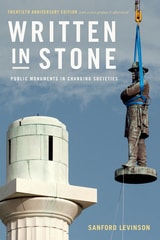
cover of Written in Stone: Public Monuments in Changing Societies

Written in Stone

Public Monuments in Changing Societies

Sanford Levinson

Duke University Press, 1998

Twentieth Anniversary Edition with a new preface and afterword

From the removal of Confederate monuments in New Orleans in the spring of 2017 to the violent aftermath of the white nationalist march on the Robert E. Lee monument in Charlottesville later that summer, debates and conflicts over the memorialization of Confederate “heroes” have stormed to the forefront of popular American political and cultural discourse. In Written in Stone Sanford Levinson considers the tangled responses to controversial monuments and commemorations while examining how those with political power configure public spaces in ways that shape public memory and politics. Paying particular attention to the American South, though drawing examples as well from elsewhere in the United States and throughout the world, Levinson shows how the social and legal arguments regarding the display, construction, modification, and destruction of public monuments mark the seemingly endless confrontation over the symbolism attached to public space.

This twentieth anniversary edition of Written in Stone includes a new preface and an extensive afterword that takes account of recent events in cities, schools and universities, and public spaces throughout the United States and elsewhere. Twenty years on, Levinson's work is more timely and relevant than ever.
[more]
cover of Written in the Sky: Lessons of a Southern Daughter

Written in the Sky

Lessons of a Southern Daughter

Patricia Foster

University of Alabama Press, 2023

"A powerful, often heart-wrenching collection of essays tackling the history of the American South."  —Kirkus Reviews
 
In Written in the Sky: Lessons of a Southern Daughter, Patricia Foster presents a double portrait of place and family, a book of deeply personal essays that interrogate the legacy of racial tensions in the South, the constriction of caste and gender, and the ways race, class, and white privilege are entwined in her family story. After interviewing girls at Booker T. Washington High School in Tuskegee, Alabama, visiting the National Memorial for Peace and Justice in Montgomery, Alabama, and exploring Africatown in Plateau, Alabama, Patricia Foster was moved to reflect on the racial scars and crossroads in her southern past as well as to reckon with the intimate places of her own wounding and grief.

The story of place, she discovers, emerges not only from family histories and cultural traditions but also from wrestling with a culture’s irreconcilable ideas: the hard push to determine what matters. What matters to her are the shadow stories beneath our mythologies, the complicated and radiant narratives that must be excavated and reckoned with, stories that have no neat or binary resolution, stories full of luminous moments and riveting facts, and stories where the secrets hide. Written in the Sky presents the best of nonfiction storytelling: searingly honest portraits, dramatic encounters, and lyrical narratives that will interest teachers and students as well as social justice advocates, policymakers, and readers compelled by stories of awakening and the white-hot beauty of language.
 
[more]
cover of Written on Bamboo and Silk: The Beginnings of Chinese Books and Inscriptions, Second Edition

Written on Bamboo and Silk

The Beginnings of Chinese Books and Inscriptions, Second Edition

Tsuen-Hsuin Tsien

University of Chicago Press, 2004

Paleography, which often overlaps with archaeology, deciphers ancient inscriptions and modes of writing to reveal the knowledge and workings of earlier societies. In this now-classic paleographic study of China, Tsuen-Hsuin Tsien traces the development of Chinese writing from the earliest inscriptions to the advent of printing, with specific attention to the tools and media used. This edition includes material that treats the many major documents and ancient Chinese artifacts uncovered over the forty years since the book’s first publication, as well as an afterword by Edward L. Shaughnessy.
Written on Bamboo and Silk has long been considered a landmark in its field. Critical in this regard is the excavation of numerous sites throughout China, where hundreds of thousands of documents written on bamboo and silk—as well as other media—were found, including some of the earliest copies of historical, medical, astronomical, military, and religious texts that are now essential to the study of early Chinese literature, history, and philosophy. Discoveries such as these have made the amount of material evidence on the origins and evolution of communication throughout Chinese history exceedingly broad and rich, and yet Tsien succeeds in tackling it all and building on the earlier classic work that changed
[more]
cover of Written to the Lamanites: Indigenous Perspectives on Mormon Narratives of Indigeneity

Written to the Lamanites

Indigenous Perspectives on Mormon Narratives of Indigeneity

Farina King and Michael Ing

University of Utah Press, 2027
[more]
cover of Wrong Turnings: How the Left Got Lost

Wrong Turnings

How the Left Got Lost

Geoffrey M. Hodgson

University of Chicago Press, 2017

The Left is in crisis. Despite global economic turbulence, left-wing political parties in many countries have failed to make progress in part because they have grown too ideologically fragmented. Today, the term Left is associated with state intervention and public ownership, but this has little in common with the original meaning of the term. What caused what we mean by the Left to change, and how has that hindered progress?

With Wrong-Turnings, Geoffrey M. Hodgson tracks changes in the meaning of the Left and offers suggestions for how the Left might reclaim some of its core values. The term Left originated during the French Revolution, when revolutionaries sought to abolish the monarchy and privilege and to introduce a new society based on liberty, equality, fraternity, and universal rights. Over time, however, the meaning radically changed, especially through the influence of socialism and collectivism. Hodgson argues that the Left must rediscover its roots in the Enlightenment and readopt Enlightenment values it has abandoned, such as those concerning democracy and universal human rights. Only then will it be prepared to address contemporary problems of inequality and the survival of democracy. Possible measures could include enhanced educational provisions, a guaranteed basic income, and a viable mechanism for fair distribution of wealth.

Wrong-Turnings is a truly pathbreaking work from one of our most prolific and respected institutional theorists. It will change our understanding of how the left got lost.
 
[more]
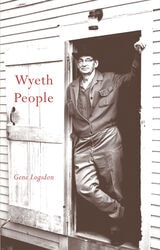
cover of Wyeth People

Wyeth People

Gene Logsdon

Ohio University Press, 2003
In the 1960s, just beginning his career as a writer, Gene Logsdon read a magazine article about Andrew Wyeth in which the artist commented at length on his own creative impulse. What he said seemed so true and right and so directly applicable to writing as well as to painting that the young writer was transfixed. He was resolved to talk to Andrew Wyeth, even though warned that the artist could be as elusive as a wild rabbit. Not quite by accident, the writer and the painter met in a roadside diner, and what happened from then on is what Wyeth People is about—an effort to explain a famous artist, his work, and the people who love it, by an intrigued outsider. Wyeth People is the result of Gene Logsdon’s search to find the colorful people Wyeth painted and to interview them. Originally published in 1969, Wyeth People describes how the author solved the mystery of the creative impulse, at least to his own satisfaction. As Logsdon writes: “The story of my search for why I (and millions of other people) find Wyeth’s art among the greatest that human culture has produced, is ongoing. I may never fully end my quest. But this I know. I was lucky enough to have participated in some small way in the cultural process by which an artist and his work became a classic part of American tradition. "That I was able to talk to people like Karl Kuerner and Forrest Wall produced in me the same kind of knowledge and exhilaration that I would gain if I were viewing Michelangelo’s David and David came alive and spoke to me.”
[more]
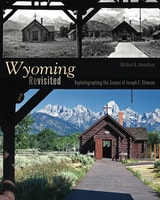
cover of Wyoming Revisited: Rephotographing the Scenes of Joseph E. Stimson

Wyoming Revisited

Rephotographing the Scenes of Joseph E. Stimson

Michael A. Amundson

University Press of Colorado, 2014

In Wyoming Revisited, Michael A. Amundson uses the power of rephotography to show how landscapes across the state have endured over the last century. Three sets of photographs—the original black-and-white photographs taken by famed Wyoming photographer Joseph E. Stimson more than a century ago, repeat black-and-white images taken by Amundson in the 1980s, and a third view in color taken by the author in 2007–2008—are accompanied by captions explaining the history and importance of each site as well as information on the process of repeat photographic fieldwork.

The 117 locations feature street views of Wyoming towns and cities, as well as views from the state's famous natural landmarks like Yellowstone National Park, Grand Teton National Park, Devil's Tower National Monument, Hot Springs State Park, and Big Horn and Shoshone National Forests. In addition, Amundson provides six in-depth essays that explore the life of Joseph E. Stimson, the rephotographic process and how it has evolved, and how repeat photography can be used to understand history, landscape, historic preservation, and globalization.

Wyoming Revisited highlights the historic evolution of the American West over the past century and showcases the significant changes that have occurred over the past twenty-five years. This book will appeal to photographers, historians of the American West, and anyone interested in Wyoming's history or landscape.

The publication of this book is supported in part by the Wyoming Cultural Trust Fund.


[more]