Results by title
28250 books match the query 'History' and 1124 start with w
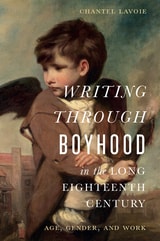
Writing through Boyhood in the Long Eighteenth Century
Age, Gender, and WorkChantel Lavoie
University of Delaware Press, 2024
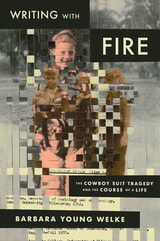
Writing with Fire
The Cowboy Suit Tragedy and the Course of a LifeBarbara Young Welke
University of Chicago Press, 2026
A cultural and legal history intertwined with a deeply emotional meditation on the course of life, memory, and the documents that define us.
During the 1940s and 1950s, an untold number of American children suffered devastating injuries when the fur-like fabric on the chaps of their Gene Autry–branded cowboy playsuits exploded into flame. Barbara Young Welke was researching this history when her teenage daughter unexpectedly died.
The shock of Welke’s loss transformed her understanding of the children and their families. Her experience also led her to question the norms of scholarship and of writing. Historians are trained to separate the personal from the intellectual, to be suspicious of emotion. These and other norms are embedded in and reinforced by the calling card of academics, the curriculum vitae. Welke wondered how that cold document—with its literal meaning, “the course of life”—had become a form that excludes so much of what gives life meaning. What impact did that have on what we know, how we know it, and how we understand ourselves? Similarly, Welke wondered, what might we see if we looked at the history of the cowboy suit tragedy as more than a matter of lawsuits brought by grieving families? Here, Welke traces the making, marketing, and selling of the cowboy suits; the lengths the defendants went to avoid and limit liability; and the meaning of the injuries, deaths, and legal settlements in the course of these children’s and families’ lives.
Writing with Fire interweaves the histories of the cowboy suit tragedy and the curriculum vitae. Grounded in archival and legal research, oral histories, and letters Welke wrote her daughter following her death, Welke offers an inimitable examination of trauma, law, autobiography, and identity. The result is revelatory and unforgettable: a provocative historical reflection on life and death, depression and war, markets and families, law, power, and precarity in modern America.
Writing, Law, and Kingship in Old Babylonian Mesopotamia
Dominique Charpin
University of Chicago Press, 2010
Ancient Mesopotamia, the fertile crescent between the Tigris and Euphrates rivers in what is now western Iraq and eastern Syria, is considered to be the cradle of civilization—home of the Babylonian and Assyrian empires, as well as the great Code of Hammurabi. The Code was only part of a rich juridical culture from 2200–1600 BCE that saw the invention of writing and the development of its relationship to law, among other remarkable firsts.
Though ancient history offers inexhaustible riches, Dominique Charpin focuses here on the legal systems of Old Babylonian Mesopotamia and offers considerable insight into how writing and the law evolved together to forge the principles of authority, precedent, and documentation that dominate us to this day. As legal codes throughout the region evolved through advances in cuneiform writing, kings and governments were able to stabilize their control over distant realms and impose a common language—which gave rise to complex social systems overseen by magistrates, judges, and scribes that eventually became the vast empires of history books. Sure to attract any reader with an interest in the ancient Near East, as well as rhetoric, legal history, and classical studies, this book is an innovative account of the intertwined histories of law and language.
Writings
Saint John of Damascus
Catholic University of America Press, 1958
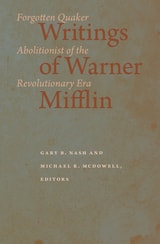
Writings of Warner Mifflin
Forgotten Quaker Abolitionist of the Revolutionary EraGary B. Nash
University of Delaware Press, 2021
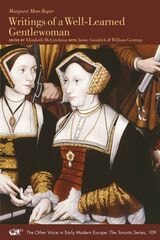
Writings of a Well-Learned Gentlewoman
Margaret More Roper
Iter Press, 2024
Margaret More Roper (1505–44) was, at the age of nineteen, the first early modern woman writer in Tudor England and the first nonroyal woman to have a book printed in the English language. As the eldest daughter of Sir Thomas More, Roper received a cutting-edge education in Latin and Greek that was virtually unprecedented for a woman. Besides gaining an international reputation for her outstanding erudition, Roper served as More’s confidante during his imprisonment. Her correspondence from this period offers valuable insight into a key moment in English history.
This Other Voice series edition recognizes Margaret More Roper as a notable historical figure in her own right and as one of the most learned women of her time. It publishes all her extant writings in modernized spelling, with annotations, a glossary, and a current bibliography of studies about her.
Writings on Grace
The Complete <i>Ecrits sur la grace</i>Blaise Pascal
Catholic University of America Press, 2025

Writings on Media
History of the PresentStuart Hall
Duke University Press, 2021
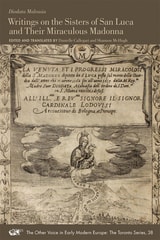
Writings on the Sisters of San Luca and Their Miraculous Madonna
Diodata Malvasia
Iter Press, 2015
The Bolognese nun Diodata Malvasia was presumed to have authored only one work, The Arrival and the Miraculous Workings of the Glorious Image of the Virgin (1617). In her recently discovered second manuscript chronicle, A Brief Discourse on What Occurred to the Most Reverend Sisters of the Joined Convents of San Mattia and San Luca (1575), her writing demonstrates active resistance to Tridentine convent reform. Together, Malvasia’s works read as the bookends to a lifelong crusade on behalf of her convent.
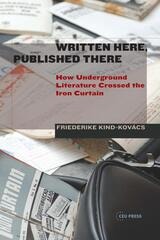
Written Here, Published There
How Underground Literature Crossed the Iron CurtainFriederike Kind-Kovács
Central European University Press, 2015
Written Here, Published There offers a new perspective on the role of underground literature in the Cold War and challenges us to recognize gaps in the Iron Curtain. The book identifies a transnational undertaking that reinforced détente, dialogue, and cultural transfer, and thus counterbalanced the persistent belief in Europe's irreversible division.
It analyzes a cultural practice that attracted extensive attention during the Cold War but has largely been ignored in recent scholarship: tamizdat, or the unauthorized migration of underground literature across the Iron Curtain. Through this cultural practice, I offer a new reading of Cold War Europe's history. Investigating the transfer of underground literature from the 'Other Europe' to Western Europe, the United States, and back illuminates the intertwined fabrics of Cold War literary cultures. Perceiving tamizdat as both a literary and a social phenomenon, the book focuses on how individuals participated in this border-crossing activity and used secretive channels to guarantee the free flow of literature.
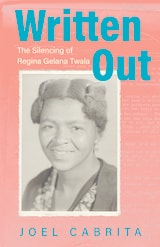
Written Out
The Silencing of Regina Gelana TwalaJoel Cabrita
Ohio University Press, 2023

Written for the Drawer
Leonid Tsypkin, Uncensored Literature, and Soviet JewishnessBrett Winestock
University of Wisconsin Press, 2024
Tsypkin’s autobiographical writing explored the impossibility of being both a Russian writer and a Soviet Jew, employing indirection and referentiality. In the first book-length appraisal of Tsypkin and his work, Brett Winestock considers Tsypkin’s fiction as part of a transnational literary response to the horrors of the twentieth century, a reception that helps explain his much-belated international readership. Through close readings of Tsypkin’s work in the context of late-Soviet cultural worlds, Winestock makes an important contribution to studies of Jewish Soviet writing and identity.
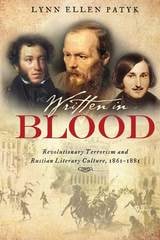
Written in Blood
Revolutionary Terrorism and Russian Literary Culture, 1861–1881Lynn Ellen Patyk
University of Wisconsin Press, 2017
Lynn Ellen Patyk contends that the prototype for the terrorist was the Russian writer, whose seditious word was interpreted as an audacious deed—and a violent assault on autocratic authority. The interplay and interchangeability of word and deed, Patyk argues, laid the semiotic groundwork for the symbolic act of violence at the center of revolutionary terrorism. While demonstrating how literary culture fostered the ethos, pathos, and image of the revolutionary terrorist and terrorism, she spotlights Fyodor Dostoevsky and his "terrorism trilogy"—Crime and Punishment (1866), Demons (1870–73), and The Brothers Karamazov (1878–80)—as novels that uniquely illuminate terrorism's methods and trajectory. Deftly combining riveting historical narrative with penetrating literary analysis of major and minor works, Patyk's groundbreaking book reveals the power of the word to spawn deeds and the power of literature to usher new realities into the world.
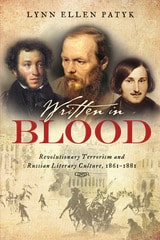
Written in Blood
Revolutionary Terrorism and Russian Literary Culture, 1861–1881Lynn Ellen Patyk
University of Wisconsin Press, 2020

Written in Blood
The History of Fort Worth's Fallen Lawmen, Volume 1, 1861-1909Richard F. Selcer
University of North Texas Press, 2010
Written in Blood
The History of Fort Worth's Fallen Lawmen, Volume 2, 1910-1928Richard F. Selcer
University of North Texas Press, 2010
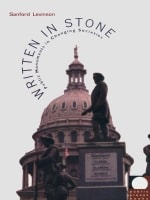
Written in Stone
Public Monuments in Changing SocietiesSanford Levinson
Duke University Press, 1998
In Written in Stone, legal scholar Sanford Levinson considers the tangled responses of ever-changing societies to the monuments and commemorations created by past regimes or outmoded cultural and political systems. Drawing on examples from Albania to Zimbabwe, from Moscow to Managua, and paying particular attention to examples throughout the American South, Levinson looks at social and legal arguments regarding the display, construction, modification, and destruction of public monuments. He asks what kinds of claims the past has on the present, particularly if the present is defined in dramatic opposition to its past values. In addition, he addresses the possibilities for responding to the use and abuse of public spaces and explores how a culture might memorialize its historical figures and events in ways that are beneficial to all its members.
Written in Stone is a meditation on how national cultures have been or may yet be defined through the deployment of public monuments. It adds a thoughtful and crucial voice into debates surrounding historical accuracy and representation, and will be welcomed by the many readers concerned with such issues.
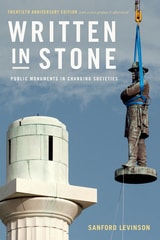
Written in Stone
Public Monuments in Changing SocietiesSanford Levinson
Duke University Press, 1998
From the removal of Confederate monuments in New Orleans in the spring of 2017 to the violent aftermath of the white nationalist march on the Robert E. Lee monument in Charlottesville later that summer, debates and conflicts over the memorialization of Confederate “heroes” have stormed to the forefront of popular American political and cultural discourse. In Written in Stone Sanford Levinson considers the tangled responses to controversial monuments and commemorations while examining how those with political power configure public spaces in ways that shape public memory and politics. Paying particular attention to the American South, though drawing examples as well from elsewhere in the United States and throughout the world, Levinson shows how the social and legal arguments regarding the display, construction, modification, and destruction of public monuments mark the seemingly endless confrontation over the symbolism attached to public space.
This twentieth anniversary edition of Written in Stone includes a new preface and an extensive afterword that takes account of recent events in cities, schools and universities, and public spaces throughout the United States and elsewhere. Twenty years on, Levinson's work is more timely and relevant than ever.
Written in the Sky
Lessons of a Southern DaughterPatricia Foster
University of Alabama Press, 2023
In Written in the Sky: Lessons of a Southern Daughter, Patricia Foster presents a double portrait of place and family, a book of deeply personal essays that interrogate the legacy of racial tensions in the South, the constriction of caste and gender, and the ways race, class, and white privilege are entwined in her family story. After interviewing girls at Booker T. Washington High School in Tuskegee, Alabama, visiting the National Memorial for Peace and Justice in Montgomery, Alabama, and exploring Africatown in Plateau, Alabama, Patricia Foster was moved to reflect on the racial scars and crossroads in her southern past as well as to reckon with the intimate places of her own wounding and grief.
The story of place, she discovers, emerges not only from family histories and cultural traditions but also from wrestling with a culture’s irreconcilable ideas: the hard push to determine what matters. What matters to her are the shadow stories beneath our mythologies, the complicated and radiant narratives that must be excavated and reckoned with, stories that have no neat or binary resolution, stories full of luminous moments and riveting facts, and stories where the secrets hide. Written in the Sky presents the best of nonfiction storytelling: searingly honest portraits, dramatic encounters, and lyrical narratives that will interest teachers and students as well as social justice advocates, policymakers, and readers compelled by stories of awakening and the white-hot beauty of language.
Written on Bamboo and Silk
The Beginnings of Chinese Books and Inscriptions, Second EditionTsuen-Hsuin Tsien
University of Chicago Press, 2004

Written to the Lamanites
Indigenous Perspectives on Mormon Narratives of IndigeneityFarina King and Michael Ing
University of Utah Press, 2027
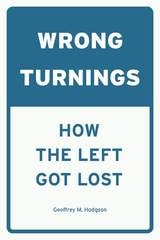
Wrong Turnings
How the Left Got LostGeoffrey M. Hodgson
University of Chicago Press, 2017
With Wrong-Turnings, Geoffrey M. Hodgson tracks changes in the meaning of the Left and offers suggestions for how the Left might reclaim some of its core values. The term Left originated during the French Revolution, when revolutionaries sought to abolish the monarchy and privilege and to introduce a new society based on liberty, equality, fraternity, and universal rights. Over time, however, the meaning radically changed, especially through the influence of socialism and collectivism. Hodgson argues that the Left must rediscover its roots in the Enlightenment and readopt Enlightenment values it has abandoned, such as those concerning democracy and universal human rights. Only then will it be prepared to address contemporary problems of inequality and the survival of democracy. Possible measures could include enhanced educational provisions, a guaranteed basic income, and a viable mechanism for fair distribution of wealth.
Wrong-Turnings is a truly pathbreaking work from one of our most prolific and respected institutional theorists. It will change our understanding of how the left got lost.
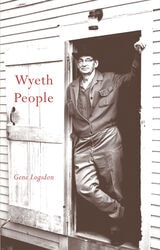
Wyeth People
Gene Logsdon
Ohio University Press, 2003
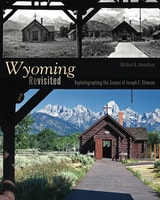
Wyoming Revisited
Rephotographing the Scenes of Joseph E. StimsonMichael A. Amundson
University Press of Colorado, 2014
The 117 locations feature street views of Wyoming towns and cities, as well as views from the state's famous natural landmarks like Yellowstone National Park, Grand Teton National Park, Devil's Tower National Monument, Hot Springs State Park, and Big Horn and Shoshone National Forests. In addition, Amundson provides six in-depth essays that explore the life of Joseph E. Stimson, the rephotographic process and how it has evolved, and how repeat photography can be used to understand history, landscape, historic preservation, and globalization.
Wyoming Revisited highlights the historic evolution of the American West over the past century and showcases the significant changes that have occurred over the past twenty-five years. This book will appeal to photographers, historians of the American West, and anyone interested in Wyoming's history or landscape.
The publication of this book is supported in part by the Wyoming Cultural Trust Fund.