3258 books match the query 'Performing Arts' and 107 start with w
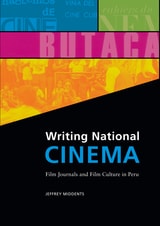
cover of Writing National Cinema: Film Journals and Film Culture in Peru

Writing National Cinema

Film Journals and Film Culture in Peru

Jeffrey Middents

Dartmouth College Press, 2009
Writing National Cinema traces the twenty-year history of the Peruvian film journal Hablemos de cine alongside that of Peruvian filmmaking and film culture. Similar to the influential French journal Cahiers du cinéma, Hablemos de cine began with a group of young critics interested in claiming the director’s use of mise-en-scène as the exclusive method of film analysis rather than thematic or star-oriented topics — hence, the title of the publication, derived from their battle cry at post-screening discussions: “Let’s talk about film.” Their critical authority grew with the rise of local filmmaking and the nationalist fervor of the late 1960s and early 1970s. When government sponsorship spurred feature filmmaking in the mid-1970s, their perspective eschewed the politically militant readings that characterized most writing and film from the rest of Latin America at the time. By the 1980s, the critics at Hablemos de cine had helped to engender a commercial, Hollywood-influenced cinematic vision—best exemplified by Peruvian auteur Francisco Lombardi—and stimulated a unique, if isolating, national identity through film. The first book-length study of Peruvian film culture to appear in English, Middents’s work offers thoughtful consideration of the impact of criticism on the visual stylings of a national cinema.
[more]
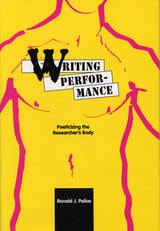
cover of Writing Performance: Poeticizing the Researcher's Body

Writing Performance

Poeticizing the Researcher's Body

Ronald J. Pelias

Southern Illinois University Press, 1999

Ronald J. Pelias is concerned with writing about performance, from the everyday performative routines to the texts on stage. He seeks to write performatively, to offer poetic or aesthetic renderings of performance events in order to capture some sense of their nature. In his quest for the spirit of theatrical performances, Pelias asks more of the written word than the word can deliver. Yet the attempt is both desirable—and necessary. To discuss performance without some accounting for its essence as art, he asserts, is at best misleading, at worst, fraud.

Pelias divides his efforts to present performance events into three general categories: "Performing Every Day," "On Writing and Performing," and "Being a Witness." "Performing Every Day" focuses on performances ranging from the daily business of enacting roles to the telling of tales that make life meaningful. It incorporates essays about the ongoing process of presenting oneself in everyday life; the gender script that insists that men enact manly performances; the classroom performances of teachers and students; stories of gender, class, and race that mark identity; and a performance installation entitled "A Day’s Talk."

"On Writing and Performing" examines the written script and performance practices. It includes a description of a struggle between a writer and a performer as they protect their own interests; an intimate look at an apprehensive performer; a short play entitled "The Audition"; and a chronicle of performance process from the perspective of an actor.

"Being a Witness" examines performance from the perspective of the audience and the director: being an audience member; viewing theatre in the context of New York City; directing and being directed by actors’ bodies; and watching The DEF Comedy Jam.
[more]
cover of Writing and Rewriting National Theatre Histories

Writing and Rewriting National Theatre Histories

S.E. Wilmer

University of Iowa Press, 2004
Historians of theatre face the same temptations and challenges as other historians: they negotiate assumptions (their own and those of others) about national identity and national character; they decide what events and actors to highlight--or omit--and what framework and perspective to use for telling the story. Personal biases, trends in scholarship, and sociopolitical contexts influence all histories; and theatre histories, too, are often revised to reflect changing times and interests. This significant collection examines the problems and challenges of formulating national theatre histories.The essayists included here--leading theatre scholars from all over the world, many of whom wrote essays specifically for this volume--provide an international context for national theatre histories as well as studies of individual nations. They cover a wide geographical area: Asia, the Middle East, Africa, Europe, and North America. The essays contrast large countries (India, Indonesia) with small (Ireland), newly independent (Slovenia) with established (U.S.A.), developed (Canada) with developing (Mexico, South Africa), capitalist (U.S.A.) with formerly communist (Russia), monolingual (Sweden) with multilingual (Belgium, Canada), and countries with stable historical boundaries (Sweden) with those whose borders have shifted (Germany).The essays also explore such sociopolitical issues as the polarization of language groups, the importance of religion, the invisibility of ethnic minorities, the redrawing of geographical borders, changes in ideology, and the dismantling of colonial legacies. Finally, they examine such common problems of history writing as types of evidence, periodization, canonization, styles of narrative, and definitions of key terms.Writing and Rewriting National Theatre Histories will be of special interest to students and scholars of theatre, cultural studies, and historiography.
[more]
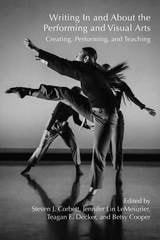
cover of Writing in and about the Performing and Visual Arts: Creating, Performing, and Teaching

Writing in and about the Performing and Visual Arts

Creating, Performing, and Teaching

Steven J. Corbett

University Press of Colorado, 2020
The performing and visual arts have much to offer writing studies in terms of process, creativity, design, delivery, and habits of mind (and body). This collection is intended for teachers and researchers of writing in and across the disciplines, in both secondary and post-secondary settings, and for those outside of writing studies who wish to infuse more writing into their performing and visual arts curriculums and courses. Filled with evocative images and vivid descriptions, contributors showcase ways of knowing and doing in the performing and visual arts. Contributors also offer teachers in the performing and visual arts go-to practical designs and strategies for teaching writing in their fields.
[more]
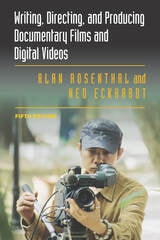
cover of Writing, Directing, and Producing Documentary Films and Digital Videos

Writing, Directing, and Producing Documentary Films and Digital Videos

Alan Rosenthal and Ned Eckhardt

Southern Illinois University Press, 2016

In a new edition of this popular guidebook, filmmakers Alan Rosenthal and Ned Eckhardt show readers how to utilize the latest innovations in equipment, technologies, and production techniques for success in the digital, web-based world of documentary film.
 
All twenty-four chapters of the volume have been revised to reflect the latest advances in documentary filmmaking. Rosenthal and Eckhardt discuss the myriad ways in which technological changes have impacted the creation process of documentary films, including how these evolving technologies both complicate and enrich filmmaking today. The book provides crucial insights for the filmmaker from the film’s conception to distribution of the finished film. Topics include creating dynamic proposals, writing narration, and navigating the murky world of contracts. Also included are many practical tips for first-time filmmakers. To provide context and to illustrate techniques, Rosenthal and Eckhardt reference more than one hundred documentaries in detail.
 
A new appendix, “Using the Web and Social Media to Prepare for Your Career,” guides filmmakers through the process of leveraging social media and crowdsourcing for success in filmmaking, fund-raising, and promotion. A day-to-day field manual packed with invaluable lessons, this volume is essential reading for both novice and experienced documentary filmmakers.
[more]
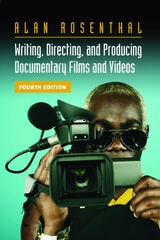
cover of Writing, Directing, and Producing Documentary Films and Videos, Fourth Edition

Writing, Directing, and Producing Documentary Films and Videos, Fourth Edition

Alan Rosenthal

Southern Illinois University Press, 2007

As Alan Rosenthal states in the preface to this new edition of his acclaimed resource for filmmakers, Writing, Directing, and Producing Documentary Films and Videos is “a book about storytelling—how to tell great and moving stories about fascinating people, whether they be villains or heroes.”
 
In response to technological advances and the growth of the documentary hybrid in the past five years, Rosenthal reconsiders how one approaches documentary filmmaking in the twenty-first century. Simply and clearly, he explains how to tackle day-to-day problems, from initial concept through distribution. He demonstrates his ideas throughout the book with examples from key filmmakers’ work.
 
New aspects of this fourth edition include a vital new chapter titled "Making Your First Film," and a considerable enlargement of the section for producers, "Staying Alive," which includes an extensive discussion of financing, marketing, festivals, and distribution. This new edition offers a revised chapter on nonlinear editing, more examples of precise and exacting proposals, and the addition of a complex budget example with explanation of the budgeting process. Discussion of documentary hybrids, with suggestions for mastering changes and challenges, has also been expanded, while the “Family Films” chapter includes updated information that addresses rapid expansion in this genre.
[more]
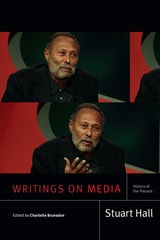
cover of Writings on Media: History of the Present

Writings on Media

History of the Present

Stuart Hall

Duke University Press, 2021

Writings on Media gathers more than twenty of Stuart Hall's media analyses, from scholarly essays such as “Encoding and Decoding in the Television Discourse” (1973) to other writings addressed to wider publics. Hall explores the practices of news photography, the development of media and cultural studies, the changing role of television, and how the nation imagines itself through popular media. He attends to Britain's imperial history and the politics of race and cultural identity as well as the media's relationship to the political project of the state. Testifying to the range and agility of Hall's critical and pedagogic engagement with contemporary media culture—and also to his collaborative mode of working—this volume reaffirms his stature as an innovative media theorist while demonstrating the continuing relevance of his methods of analysis.
[more]