3027 books match the query 'Sociology' and 115 start with w

cover of World-Systems Analysis: An Introduction

World-Systems Analysis

An Introduction

Immanuel Wallerstein

Duke University Press, 2004

In World-Systems Analysis, Immanuel Wallerstein provides a concise and accessible introduction to the comprehensive approach that he pioneered thirty years ago to understanding the history and development of the modern world. Since Wallerstein first developed world-systems analysis, it has become a widely utilized methodology within the historical social sciences and a common point of reference in discussions of globalization. Now, for the first time in one volume, Wallerstein offers a succinct summary of world-systems analysis and a clear outline of the modern world-system, describing the structures of knowledge upon which it is based, its mechanisms, and its future.

Wallerstein explains the defining characteristics of world-systems analysis: its emphasis on world-systems rather than nation-states, on the need to consider historical processes as they unfold over long periods of time, and on combining within a single analytical framework bodies of knowledge usually viewed as distinct from one another—such as history, political science, economics, and sociology. He describes the world-system as a social reality comprised of interconnected nations, firms, households, classes, and identity groups of all kinds. He identifies and highlights the significance of the key moments in the evolution of the modern world-system: the development of a capitalist world-economy in the sixteenth-century, the beginning of two centuries of liberal centrism in the French Revolution of 1789, and the undermining of that centrism in the global revolts of 1968. Intended for general readers, students, and experienced practitioners alike, this book presents a complete overview of world-systems analysis by its original architect.
[more]
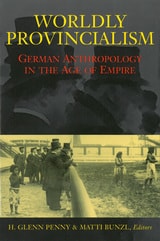
cover of Worldly Provincialism: German Anthropology in the Age of Empire

Worldly Provincialism

German Anthropology in the Age of Empire

H. Glenn Penny and Matti Bunzl, Editors

University of Michigan Press, 2003

Worldly Provincialism introduces readers to the intellectual history that drove the emergence of German anthropology. Drawing on the most recent work on the history of the discipline, the contributors rethink the historical and cultural connections between German anthropology, colonialism, and race. By showing that German intellectual traditions differed markedly from those of Western Europe, they challenge the prevalent assumption that Europeans abroad shared a common cultural code and behaved similarly toward non-Europeans. The eloquent and well-informed essays in this volume demonstrate that early German anthropology was fueled by more than a simple colonialist drive. Rather, a wide range of intellectual history shaped the Germans' rich and multifarious interest in the cultures, religions, physiognomy, physiology, and history of non-Europeans, and gave rise to their desire to connect with the wider world.
Furthermore, this volume calls for a more nuanced understanding of Germany's standing in postcolonial studies. In contrast to the prevailing view of German imperialism as a direct precursor to Nazi atrocities, this volume proposes a key insight that goes to the heart of German historiography: There is no clear trajectory to be drawn from the complex ideologies of imperial anthropology to the race science embraced by the Nazis. Instead of relying on a nineteenth-century explanation for twentieth-century crimes, this volume ultimately illuminates German ethnology and anthropology as local phenomena, best approached in terms of their own worldly provincialism.
H. Glenn Penny is Assistant Professor of History at the University of Missouri, Kansas City.
Matti Bunzl Assistant Professor of Anthropology and History at the University of Illinois at Urbana-Champaign.
[more]
cover of Worst Cases: Terror and Catastrophe in the Popular Imagination

Worst Cases

Terror and Catastrophe in the Popular Imagination

Lee Clarke

University of Chicago Press, 2005

Al Qaeda detonates a nuclear weapon in Times Square during rush hour, wiping out half of Manhattan and killing 500,000 people. A virulent strain of bird flu jumps to humans in Thailand, sweeps across Asia, and claims more than fifty million lives. A single freight car of chlorine derails on the outskirts of Los Angeles, spilling its contents and killing seven million. An asteroid ten kilometers wide slams into the Atlantic Ocean, unleashing a tsunami that renders life on the planet as we know it extinct.

We consider the few who live in fear of such scenarios to be alarmist or even paranoid. But Worst Cases shows that such individuals—like Cassandra foreseeing the fall of Troy—are more reasonable and prescient than you might think. In this book, Lee Clarke surveys the full range of possible catastrophes that animate and dominate the popular imagination, from toxic spills and terrorism to plane crashes and pandemics. Along the way, he explores how the ubiquity of worst cases in everyday life has rendered them ordinary and mundane. Fear and dread, Clarke argues, have actually become too rare: only when the public has more substantial information and more credible warnings will it take worst cases as seriously as it should.

A timely and necessary look into how we think about the unthinkable, Worst Cases will be must reading for anyone attuned to our current climate of threat and fear.
[more]
cover of Worst Cases: Terror and Catastrophe in the Popular Imagination

Worst Cases

Terror and Catastrophe in the Popular Imagination

Lee Clarke

University of Chicago Press, 2005

This is an auto-narrated audiobook edition of this book.

Al Qaeda detonates a nuclear weapon in Times Square during rush hour, wiping out half of Manhattan and killing 500,000 people. A virulent strain of bird flu jumps to humans in Thailand, sweeps across Asia, and claims more than fifty million lives. A single freight car of chlorine derails on the outskirts of Los Angeles, spilling its contents and killing seven million. An asteroid ten kilometers wide slams into the Atlantic Ocean, unleashing a tsunami that renders life on the planet as we know it extinct.

We consider the few who live in fear of such scenarios to be alarmist or even paranoid. But Worst Cases shows that such individuals—like Cassandra foreseeing the fall of Troy—are more reasonable and prescient than you might think. In this book, Lee Clarke surveys the full range of possible catastrophes that animate and dominate the popular imagination, from toxic spills and terrorism to plane crashes and pandemics. Along the way, he explores how the ubiquity of worst cases in everyday life has rendered them ordinary and mundane. Fear and dread, Clarke argues, have actually become too rare: only when the public has more substantial information and more credible warnings will it take worst cases as seriously as it should.

A timely and necessary look into how we think about the unthinkable, Worst Cases will be must reading for anyone attuned to our current climate of threat and fear.
[more]
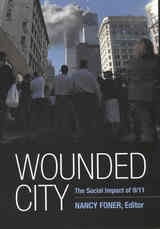
cover of Wounded City: The Social Impact of 9/11 on New York City

Wounded City

The Social Impact of 9/11 on New York City

Nancy Foner

Russell Sage Foundation, 2005
New York has eight million deeply personal and unique stories of pain and perseverance from September 11, 2001. But the toll of tragedy is greater than the anguish it inflicts on individuals—communities suffer as well. In Wounded City, editor Nancy Foner brings together an accomplished group of scholars to document how a broad range of communities—residential, occupational, ethnic, and civic—were affected and changed by the World Trade Center attacks. Using survey data and in-depth ethnographies, the book offers sophisticated analysis and gives voice to the human experiences behind the summary statistics, revealing how the nature of these communities shaped their response to the disaster. Sociologists Philip Kasinitz, Gregory Smithsimon, and Binh Pok highlight the importance of physical space in the recovery process by comparing life after 9/11 in two neighborhoods close to ground zero—Tribeca, which is nestled close to the city's downtown, and Battery Park City, which is geographically and structurally separated from other sections of the city. Melanie Hildebrandt looks at how social solidarity changed in a predominantly Irish, middle class community that was struck twice with tragedy: the loss of many residents on 9/11 and a deadly plane crash two months later. Jennifer Bryan shows that in the face of hostility and hate crimes, many Arab Muslims in Jersey City stressed their adherence to traditional Islam. Contributor Karen Seeley interviews psychotherapists who faced the challenge of trying to help patients deal with a tragedy that they themselves were profoundly affected by. Economist Daniel Beunza and sociologist David Stark paint a picture of organizational resilience as they detail how securities traders weathered successive crises after evacuating their downtown office and moving temporarily to New Jersey. Francesca Polletta and Lesley Wood look at a hopeful side of a horrible tragedy: civic involvement in town meetings and public deliberations to discuss what should be done to rebuild at ground zero and help New Yorkers create a better future in the footprints of disaster. New Yorkers suffered tremendous losses on September 11, 2001: thousands of lives, billions of dollars, the symbols of their skyline, and their peace of mind. But not lost in the rubble of the World Trade Center were the residential, ethnic, occupational, and organizational communities that make up New York's rich mosaic. Wounded City gives voice to some of those communities, showing how they dealt with unforeseen circumstances that created or deepened divisions, yet at the same brought them together in suffering and hope. It is a unique look at the aftermath of a devastating day and the vitality of a diverse city. A Russell Sage Foundation September 11 Initiative Volume
[more]
cover of Wrecked: How the American Automobile Industry Destroyed Its Capacity to Compete

Wrecked

How the American Automobile Industry Destroyed Its Capacity to Compete

Joshua Murray

Russell Sage Foundation, 2019

At its peak in the 1950s and 1960s, automobile manufacturing was the largest, most profitable industry in the United States and residents of industry hubs like Detroit and Flint, Michigan had some of the highest incomes in the country. Over the last half-century, the industry has declined, and American automakers now struggle to stay profitable. How did the most prosperous industry in the richest country in the world crash and burn? In Wrecked, sociologists Joshua Murray and Michael Schwartz offer an unprecedented historical-sociological analysis of the downfall of the auto industry. Through an in-depth examination of labor relations and the production processes of automakers in the U.S. and Japan both before and after World War II, they demonstrate that the decline of the American manufacturers was the unintended consequence of their attempts to weaken the bargaining power of their unions.
 
Today Japanese and many European automakers produce higher quality cars at lower cost than their American counterparts thanks to a flexible form of production characterized by long-term sole suppliers, assembly and supply plants located near each other, and just-in-time delivery of raw materials. While this style of production was, in fact, pioneered in the U.S. prior to World War II, in the years after the war, American automakers deliberately dismantled this system. As Murray and Schwartz show, flexible production accelerated innovation but also facilitated workers’ efforts to unionize plants and carry out work stoppages. To reduce the efficacy of strikes and combat the labor militancy that flourished between the Depression and the postwar period, the industry dispersed production across the nation, began maintaining large stockpiles of inventory, and eliminated single sourcing. While this restructuring of production did ultimately reduce workers’ leverage, it also decreased production efficiency and innovation. The U.S. auto industry has struggled ever since to compete with foreign automakers, and formerly thriving motor cities have suffered the consequences of mass deindustrialization.
 
Murray and Schwartz argue that new business models that reinstate flexible production and prioritize innovation rather than cheap labor could stem the outsourcing of jobs and help revive the auto industry. By clarifying the historical relationships between production processes, organized labor, and industrial innovation, Wrecked provides new insights into the inner workings and decline of the U.S. auto industry.
 
[more]
cover of Writing Cities: Exploring Early Modern Urban Discourse

Writing Cities

Exploring Early Modern Urban Discourse

James S. Amelang

Central European University Press, 2020
Only one out of ten early modern Europeans lived in cities. Yet cities were crucial nodes, joining together producers and consumers, rulers and ruled, and believers in diverse faiths and futures. They also generated an enormous amount of writing, much of which focused on civic life itself. But despite its obvious importance, historians have paid surprisingly little attention to urban discourse; its forms, themes, emphases and silences all invite further study. This book explores three dimensions of early modern citizens’ writing about their cities: the diverse social backgrounds of the men and women who contributed to urban discourse; their notions of what made for a beautiful city; and their use of dialogue as a literary vehicle particularly apt for expressing city life and culture. Amelang concludes that early modern urban discourse increasingly moves from oral discussion to take the form of writing. And while the dominant tone of those who wrote about cities continued to be one of celebration and glorification, over time a more detached and less judgmental mode developed. More and more they came to see their fundamental task as presenting a description that was objective.
[more]
cover of Writing Ethnographic Fieldnotes, Second Edition

Writing Ethnographic Fieldnotes, Second Edition

Robert M. Emerson, Rachel I. Fretz, and Linda L. Shaw

University of Chicago Press, 2011
In Writing Ethnographic Fieldnotes, Robert M. Emerson, Rachel I. Fretz, and Linda L. Shaw present a series of guidelines, suggestions, and practical advice for creating useful fieldnotes in a variety of settings, demystifying a process that is often assumed to be intuitive and impossible to teach. Using actual unfinished notes as examples, the authors illustrate options for composing, reviewing, and working fieldnotes into finished texts. They discuss different organizational and descriptive strategies and show how transforming direct observations into vivid descriptions results not simply from good memory but from learning to envision scenes as written. A good ethnographer, they demonstrate, must learn to remember dialogue and movement like an actor, to see colors and shapes like a painter, and to sense moods and rhythms like a poet.
 
This new edition reflects the extensive feedback the authors have received from students and instructors since the first edition was published in 1995. As a result, they have updated the race, class, and gender section, created new sections on coding programs and revising first drafts, and provided new examples of working notes. An essential tool for budding social scientists, the second edition of Writing Ethnographic Fieldnotes will be invaluable for a new generation of researchers entering the field.
[more]
cover of Writing for Social Scientists, Third Edition: How to Start and Finish Your Thesis, Book, or Article

Writing for Social Scientists, Third Edition

How to Start and Finish Your Thesis, Book, or Article

Howard S. Becker

University of Chicago Press, 2020

For more than thirty years, Writing for Social Scientists has been a lifeboat for writers in all fields, from beginning students to published authors. It starts with a powerful reassurance: Academic writing is stressful, and even accomplished scholars like sociologist Howard S. Becker struggle with it. And it provides a clear solution: In order to learn how to write, take a deep breath and then begin writing. Revise. Repeat.
This is not a book about sociological writing. Instead, Becker applies his sociologist’s eye to some of the common problems all academic writers face, including trying to get it right the first time, failing, and therefore not writing at all; getting caught up in the trappings of “proper” academic writing; writing to impress rather than communicate with readers; and struggling with the when and how of citations. He then offers concrete advice, based on his own experiences and those of his students and colleagues, for overcoming these obstacles and gaining confidence as a writer.

While the underlying challenges of writing have remained the same since the book first appeared, the context in which academic writers work has changed dramatically, thanks to rapid changes in technology and ever greater institutional pressures. This new edition has been updated throughout to reflect these changes, offering a new generation of scholars and students encouragement to write about society or any other scholarly topic clearly and persuasively.

As Becker writes in the new preface, “Nothing prepared me for the steady stream of mail from readers who found the book helpful. Not just helpful. Several told me the book had saved their lives; less a testimony to the book as therapy than a reflection of the seriousness of the trouble writing failure could get people into.” As academics are being called on to write more often, in more formats, the experienced, rational advice in Writing for Social Scientists will be an important resource for any writer’s shelf.

[more]
cover of Writing for Social Scientists: How to Start and Finish Your Thesis, Book, or Article

Writing for Social Scientists

How to Start and Finish Your Thesis, Book, or Article

Howard S. Becker

University of Chicago Press, 1986

Social scientists, whether earnest graduate students or tenured faculty members, clearly know the rules that govern good writing. But for some reason they choose to ignore those guidelines and churn out turgid, pompous, and obscure prose. Distinguished sociologist Howard S. Becker, true to his calling, looks for an explanation for this bizarre behavior not in the psyches of his colleagues but in the structure of his profession. In this highly personal and inspirational volume he considers academic writing as a social activity.

Both the means and the reasons for writing a thesis or article or book are socially structured by the organization of graduate study, the requirements for publication, and the conditions for promotion, and the pressures arising from these situations create the writing style so often lampooned and lamented. Drawing on his thirty-five years' experience as a researcher, writer, and teacher, Becker exposes the foibles of the academic profession to the light of sociological analysis and gentle humor. He also offers eminently useful suggestions for ways to make social scientists better and more productive writers. Among the topics discussed are how to overcome the paralyzing fears of chaos and ridicule that lead to writer's block; how to rewrite and revise, again and again; how to adopt a persona compatible with lucid prose; how to deal with that academic bugaboo, "the literature." There is also a chapter by Pamela Richards on the personal and professional risks involved in scholarly writing.

In recounting his own trials and errors Becker offers his readers not a model to be slavishly imitated but an example to inspire. Throughout, his focus is on the elusive work habits that contribute to good writing, not the more easily learned rules of grammar and punctuation. Although his examples are drawn from sociological literature, his conclusions apply to all fields of social science, and indeed to all areas of scholarly endeavor. The message is clear: you don't have to write like a social scientist to be one.

[more]
cover of Writing for Social Scientists: How to Start and Finish Your Thesis, Book, or Article: Second Edition

Writing for Social Scientists

How to Start and Finish Your Thesis, Book, or Article: Second Edition

Howard S. Becker

University of Chicago Press, 2007

Students and researchers all write under pressure, and those pressures—most lamentably, the desire to impress your audience rather than to communicate with them—often lead to pretentious prose, academic posturing, and, not infrequently, writer’s block.

Sociologist Howard S. Becker has written the classic book on how to conquer these pressures and simply write. First published nearly twenty years ago, Writing for Social Scientists has become a lifesaver for writers in all fields, from beginning students to published authors. Becker’s message is clear: in order to learn how to write, take a deep breath and then begin writing. Revise. Repeat.

It is not always an easy process, as Becker wryly relates. Decades of teaching, researching, and writing have given him plenty of material, and Becker neatly exposes the foibles of academia and its “publish or perish” atmosphere. Wordiness, the passive voice, inserting a “the way in which” when a simple “how” will do—all these mechanisms are a part of the social structure of academic writing. By shrugging off such impediments—or at the very least, putting them aside for a few hours—we can reform our work habits and start writing lucidly without worrying about grades, peer approval, or the “literature.”

In this new edition, Becker takes account of major changes in the computer tools available to writers today, and also substantially expands his analysis of how academic institutions create problems for them. As competition in academia grows increasingly heated, Writing for Social Scientists will provide solace to a new generation of frazzled, would-be writers.
[more]
cover of Writing the Black Diasporic City in the Age of Globalization

Writing the Black Diasporic City in the Age of Globalization

Carol Bailey

Rutgers University Press, 2023

Writing the Black Diasporic City in the Age of Globalization theorizes the city as a generative, “semicircular” social space, where the changes of globalization are most profoundly experienced. The fictive accounts analyzed here configure cities as spaces where movement is simultaneously restrictive and liberating, and where life prospects are at once promising and daunting. In their depictions of the urban experiences of peoples of African descent, writers and other creative artists offer a complex set of renditions of twentieth- and twenty-first-century Black urban citizens’ experience in European or Euro-dominated cities such as Boston, London, New York, and Toronto, as well as Global South cities such as Accra, Kingston, and Lagos—that emerged out of colonial domination, and which have emerged as hubs of current globalization. Writing the Black Diasporic City draws on critical tools of classical postcolonial studies as well as those of globalization studies to read works by Ama Ata Aidoo, Amma Darko, Marlon James, Cecil Foster, Zadie Smith, Michael Thomas, Chika Unigwe, and other contemporary writers. The book also engages the television series Call the Midwife, the Canada carnival celebration Caribana, and the film series Small Axe to show how cities are characterized as open, complicated spaces that are constantly shifting. Cities collapse boundaries, allowing for both haunting and healing, and they can sever the connection from kin and community, or create new connections.
[more]
cover of Writing the Ghetto: Class, Authorship, and the Asian American Ethnic Enclave

Writing the Ghetto

Class, Authorship, and the Asian American Ethnic Enclave

Chang, Yoonmee

Rutgers University Press, 2010

In the United States, perhaps no minority group is considered as "model" or successful as the Asian American community. Rather than living in ominous "ghettoes," Asian Americans are described as residing in positive-sounding "ethnic enclaves." Writing the Ghetto helps clarify the hidden or unspoken class inequalities faced by Asian Americans, while insightfully analyzing the effect such notions have had on their literary voices.


Yoonmee Chang examines the class structure of Chinatowns, Koreatowns, Little Tokyos, and Little Indias, arguing that ghettoization in these spaces is disguised. She maintains that Asian American literature both contributes to and challenges this masking through its marginalization by what she calls the "ethnographic imperative." Chang discusses texts from the late nineteenth century to the present, including those of Sui Sin Far, Winnifred Eaton, Monica Sone, Fae Myenne Ng, Chang-rae Lee, S. Mitra Kalita, and Nam Le. These texts are situated in the contexts of the Chinese Exclusion Era, Japanese American internment during World War II, the globalization of Chinatown in the late twentieth century, the Vietnam War, the 1992 Los Angeles riots, and the contemporary emergence of the "ethnoburb."
[more]
cover of Writing the World of Policing: The Difference Ethnography Makes

Writing the World of Policing

The Difference Ethnography Makes

Edited by Didier Fassin

University of Chicago Press, 2017
As policing has recently become a major topic of public debate, it was also a growing area of ethnographic research. Writing the World of Policing brings together an international roster of scholars who have conducted fieldwork studies of law enforcement in disadvantaged urban neighborhoods on five continents. How, they ask, can ethnography illuminate the role of the police in society? Are there important aspects of policing that are not captured through interviews and statistics? And how can the study of law enforcement shed light on the practice of ethnography? What might studying policing teach us about the epistemological and ethical challenges of participant observation? Beyond these questions of crucial interest for criminology and, more generally, the social sciences, Writing the World of Policing provides a timely discussion of one of the most problematic institutions in contemporary society.
[more]
cover of Wrong-Doing, Truth-Telling: The Function of Avowal in Justice

Wrong-Doing, Truth-Telling

The Function of Avowal in Justice

Michel Foucault

University of Chicago Press, 2014

Three years before his death, Michel Foucault delivered a series of lectures at the Catholic University of Louvain that until recently remained almost unknown. These lectures—which focus on the role of avowal, or confession, in the determination of truth and justice—provide the missing link between Foucault’s early work on madness, delinquency, and sexuality and his later explorations of subjectivity in Greek and Roman antiquity.

Ranging broadly from Homer to the twentieth century, Foucault traces the early use of truth-telling in ancient Greece and follows it through to practices of self-examination in monastic times. By the nineteenth century, the avowal of wrongdoing was no longer sufficient to satisfy the call for justice; there remained the question of who the “criminal” was and what formative factors contributed to his wrong-doing. The call for psychiatric expertise marked the birth of the discipline of psychiatry in the nineteenth and twentieth centuries as well as its widespread recognition as the foundation of criminology and modern criminal justice.
 
Published here for the first time, the 1981 lectures have been superbly translated by Stephen W. Sawyer and expertly edited and extensively annotated by Fabienne Brion and Bernard E. Harcourt. They are accompanied by two contemporaneous interviews with Foucault in which he elaborates on a number of the key themes. An essential companion to Discipline and Punish, Wrong-Doing, Truth-Telling will take its place as one of the most significant works of Foucault to appear in decades, and will be necessary reading for all those interested in his thought.
[more]