Results by title
2817 books match the query 'Nature' and 163 start with w
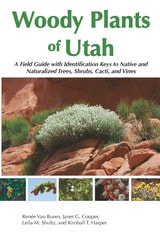
Woody Plants of Utah
A Field Guide with Identification Keys to Native and Naturalized Trees, Shrubs, Cacti, and VinesRenée Van Buren, Janet G. Cooper, Leila M. Shultz, and Kimball T. Harper
Utah State University Press, 2011
A comprehensive guide that includes a vast range of species and plant communities and employs thorough, original keys. Based primarily on vegetative characteristics, the keys don't require that flowers or other reproductive features be present, like many plant guides. And this guide's attention to woody plants as a whole allows one to identify a much greater variety of plants. That especially suits an arid region such as Utah with less diverse native trees. Woody plants are those that have stems that persist above ground even through seasons that don't favor growth, due to low precipitation or temperatures.
Woody Plants of Utah employs dichotomous identification keys that are comparable to a game of twenty questions. They work through a process of elimination by choosing sequential alternatives.
Detailed, illustrated plant descriptions complement the keys and provide additional botanical and environmental information in relation to a useful introductory categorization of Utah plant communities. Supplementary tools include photos, distribution maps, and an illustrated glossary.
Working Watersheds
Water and Energy in the Lackawanna ValleyWilliam Conlogue
Temple University Press, 2025
Offering a fresh way to think about the Anthropocene, this distinctive history of water and coal in the Lackawanna Valley discusses how both water abundance and scarcity might play out as global temperatures rise. Working Watersheds is designed to trigger debates about the nature of history, the significance of literature, and the importance of linking person, place, and planet in an era of climate change.
Working on Earth
Class and Environmental JusticeChristina Robertson
University of Nevada Press, 2015
The authors challenge prevailing cultural narratives that separate ecological and human health from the impacts of modern industrial capitalism. Essay themes range from how human survival is linked to nature to how the use and abuse of nature benefit the wealthy elite at the expense of working-class people and the working poor as well as how climate change will affect cultures deeply rooted in the land.
Ultimately, Working on Earth calls for a working-class ecology as an integral part of achieving just and sustainable human development.
Working with Your Woodland
A Landowner’s GuideMollie Beattie, Charles Thompson, and Lynn Levine
University Press of New England, 1993
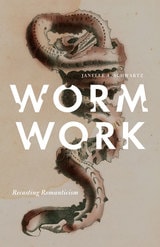
Worm Work
Recasting RomanticismJanelle A. Schwartz
University of Minnesota Press, 2012
Worms. Natural history is riddled with them. Literature is crawling with them. From antiquity to today, the ubiquitous and multiform worm provokes an immediate discomfort and unconscious distancing: it remains us against them in anthropocentric anxiety. So there is always something muddled, or dirty, or even offensive when talking about worms. Rehabilitating the lowly worm into a powerful aesthetic trope, Janelle A. Schwartz proposes a new framework for understanding such a strangely animate nature. Worms, she declares, are the very matter with which the Romantics rethought the relationship between a material world in constant flux and the human mind working to understand it.
Worm Work studies the lesser-known natural historical records of Abraham Trembley and his contemporaries and the familiar works of Erasmus Darwin, Charles Darwin, William Blake, Mary Shelley, and John Keats, to expose the worm as an organism that is not only reviled as a taxonomic terror but revered as a sign of great order in nature as well as narrative. This book traces a pattern of cultural production, a vermiculture that is as transformative of matter as it is of mind. It distinguishes decay or division as positive processes in Romantic era writings, compounded by generation or renewal and used to represent the biocentric, complex structuring of organicism.
Offering the worm as an archetypal figure through which to recast the evolution of a literary order alongside questions of taxonomy from 1740 to 1820 and on, Schwartz unearths Romanticism as a rich humus of natural historical investigation and literary creation.
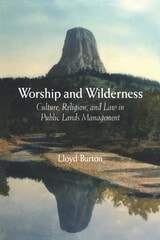
Worship and Wilderness
Culture, Religion, and Law in Public Lands ManagementLloyd Burton
University of Wisconsin Press, 2002
Questions about land use, conservation, and preservation—already so perplexing and contentious—take on a new complexity and greater urgency when the land in question is understood as sacred. This is a view increasingly held, as adherents of mainstream religions come to recognize what indigenous peoples knew centuries ago—that the sacred inheres in nature itself. What such a trend means and how it involves the forces of culture, religion, and constitutional law (especially First Amendment clauses concerning the free exercise of religion) are considered with a remarkable breadth and depth of understanding in this important new work.
Drawing on case studies of national parks and monuments, national forests, and other public lands and resources, Lloyd Burton gives a clear and comprehensive account of how the intertwining influences of culture, religion, and law have affected the management of public lands and resources in the recent past and how they may do so in the future. In a unique and unprecedented way, his book weaves together teachings on nature and the sacred among indigenous and immigrant culture groups in the United States; the relevant constitutional history of religion and government action; and analysis of contemporary conflicts over culture, religion, and public lands management. As such, Worship and Wilderness is essential reading not only for public land managers and environmental policy makers but also for anyone interested in the growing significance of religious interests in the use of resources that constitute our national commons and our common natural heritage.
Woven Shades of Green
An Anthology of Irish Nature LiteratureTim Wenzell
Bucknell University Press, 2019
Published by Bucknell University Press. Distributed worldwide by Rutgers University Press.
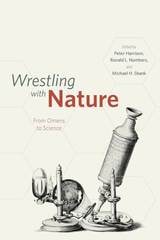
Wrestling with Nature
From Omens to ScienceEdited by Peter Harrison, Ronald L. Numbers, and Michael H. Shank
University of Chicago Press, 2011
When and where did science begin? Historians have offered different answers to these questions, some pointing to Babylonian observational astronomy, some to the speculations of natural philosophers of ancient Greece. Others have opted for early modern Europe, which saw the triumph of Copernicanism and the birth of experimental science, while yet another view is that the appearance of science was postponed until the nineteenth century.
Rather than posit a modern definition of science and search for evidence of it in the past, the contributors to Wrestling with Nature examine how students of nature themselves, in various cultures and periods of history, have understood and represented their work. The aim of each chapter is to explain the content, goals, methods, practices, and institutions associated with the investigation of nature and to articulate the strengths, limitations, and boundaries of these efforts from the perspective of the researchers themselves. With contributions from experts representing different historical periods and different disciplinary specializations, this volume offers a fresh perspective on the history of science and on what it meant, in other times and places, to wrestle with nature.
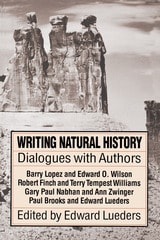
Writing Natural History
Dialogue with AuthorsEdward Lueders
University of Utah Press, 1989
Writing Natural History is the edited record of four public dialogues held at the University of Utah in 1988 between eminent writers in the fields of natural history. In these interchanges the writers discussed their traditions, perspectives, values, purposes, techniques, and personal insights. Their conversations, like their work, link the sciences with the humanities in surprising ways, enhancing our understanding and appreciation of both. This volume maintains the vitality of the spoken dialogues and conveys a lively sense of each speaker’s concern with the processes of the natural world and our human position in it.
Half of the authors began as professionals in the natural sciences before becoming recognized for their literary skills; the other half are established writers whose works reflect their vital human affinity with and respect for nature. Writing Natural History will appeal to all readers involved in conservation, nature study, creative writing, environmental issues, the natural sciences, the outdoors, and the ecological politics of Earth.
Authors dialogues feature Barry Lopez and Edward O. Wilson, Robert Finch and Terry Tempest Williams, Gary Paul Nabhan and Ann Zwinger, Paul Brooks and Edward Lueders.
Writing Nature
Henry Thoreau's JournalSharon Cameron
University of Chicago Press, 1989
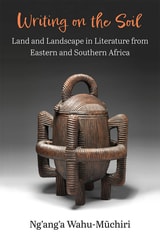
Writing on the Soil
Land and Landscape in Literature from Eastern and Southern AfricaNg’ang’a Wahu-Muchiri
University of Michigan Press, 2023
Across contiguous nation-states in Eastern Africa, the geographic proximity disguises an ideological complexity. Land has meant something fundamental in the sociocultural history of each country. Those concerns, however, have manifested into varied political events, and the range of struggles over land has spawned a multiplicity of literary interventions. While Kenya and Uganda were both British colonies, Kenya's experience of settler land alienation made for a much more violent response against efforts at political independence. Uganda's relatively calm unyoking from the colonial burden, however, led to a tumultuous post-independence. Tanzania, too, like Kenya and Uganda, resisted British colonial administration—after Germany's defeat in World War 1.
In Writing on the Soil, author Ng’ang’a Wahu-Mũchiriargues that representations of land and landscape perform significant metaphorical labor in African literatures, and this argument evolves across several geographical spaces. Each chapter's analysis is grounded in a particular locale: western Kenya, colonial Tanganyika, post-independence Tanzania, Zimbabwe, Nairobi, Dar es Salaam, Anam Ka'alakol (Lake Turkana), Kampala, and Kitgum in Northern Uganda. Moreover, each section contributes to a deeper understanding of the aesthetic choices that authors make when deploying tropes revolving around land, landscape, and the environment. Mũchiri disentangles the numerous connections between geography and geopolitical space on the one hand, and ideology and cultural analysis on the other. This book embodies a multi-layered argument in the sphere of African critical scholarship, while adding to the growing field of African land rights scholarship—an approach that foregrounds the close reading of Africa’s literary canon.
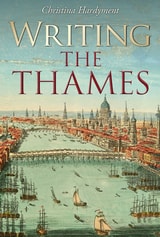
Writing the Thames
Christina Hardyment
Bodleian Library Publishing, 2016
Beautifully illustrated with seventy full-color illustrations, this book tells the river’s remarkable story through art, poetry, and prose, while celebrating the writers who helped form its enduring legacy.
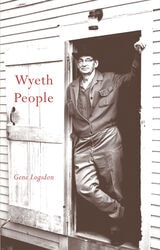
Wyeth People
Gene Logsdon
Ohio University Press, 2003