Results by title
18284 books match the query 'United States' and 882 start with w
When Freedom Speaks
The Boundaries and the Boundlessness of Our First Amendment RightLynn Greenky
Brandeis University Press, 2022
When Freedom Speaks chronicles the stories behind our First Amendment right to speak our minds. Lynn Levine Greenky’s background as a lawyer, rhetorician, and teacher gives her a unique perspective on the protection we have from laws that abridge our right to the freedom of speech. Rhetoricians focus on language and how it influences perception and moves people to action. Powerfully employing that rhetorical approach, this book explores concepts related to free speech as moral narratives that proscribe the boundaries of our constitutionally protected right. Using the characters and drama embedded in legal cases that elucidate First Amendment principles, When Freedom Speaks makes the concepts easier to understand and clearly applicable to our lives. With a wide range of examples and accessible language, this book is the perfect overview of the First Amendment.
When Friends Come From Afar
The Remarkable Story of Bernie Wong and Chicago's Chinese American Service LeagueSusan Blumberg-Kason
University of Illinois Press, 2024
At once intimate and broad in scope, When Friends Come from Afar uses one woman’s life to illuminate a bedrock Chicago institution.

When Grandpa Delivered Babies and Other Ozarks Vignettes
Benjamin G. Rader
University of Illinois Press, 2024
An alluring blend of remembering and reflection, When Grandpa Delivered Babies and Other Ozarks Vignettes provides a vivid portrait of a fading time.

When Home Is a Photograph
Blackness and Belonging in the WorldLeigh Raiford
Duke University Press, 2026
When Horses Pulled the Plow
Life of a Wisconsin Farm Boy, 1910–1929Olaf F. Larson
University of Wisconsin Press, 2011

When Kids Get Arrested
What Every Adult Should KnowSandra Simkins, Esq.
Rutgers University Press, 2009
Sandra Simkins provides straight answers to common questions such as:
- Should I let my child talk to the police without a lawyer?
- How can I help my child succeed on probation?
- Should my child admit to the charges or take the case to trial?
- How will this case impact my child's future? Will it prevent him from getting a job or going into the army?
- My child has mental health issues. Can the juvenile justice system help?
- My daughter is out of control. Should I call the police?
- My son got arrested at school and is now suspended. What should I do next?
Simkins takes complicated legal concepts and breaks them down into easy-to-understand guidelines. She includes information on topics such as police interrogation, detention hearings, and bail, along with state-by-state specifics. When Kids Get Arrested is a perfect resource for parents, social workers, guidance counselors, teachers, principals, coaches, and anyone else who works with children.
When Law Goes Pop
The Vanishing Line between Law and Popular CultureRichard K. Sherwin
University of Chicago Press, 2000
"Sherwin offers insightful, intriguing analyses of movies and other cultural products. His examination of legal discourse and popular culture will inform, enlighten, and even entertain."—William Halton, The Law and Politics Book Review
"[Sherwin's] knowledge of how media culture affects the courtroom is valuable, as is his rigorous examination. Can we prevent America's legal system from going 'pop'—losing its legitimacy by becoming just another part of popular culture? Given America's courtroom obsession . . . it's about time someone did some explaining."—Julie Scelfo, Brill's Content
"[A] brilliant analysis of the jury system in our media-saturated age. . . . [D]iscerning readers will see a truly integrative intelligence at work, proposing possible solutions rather than simply bemoaning problems."—Publishers Weekly
When Lincoln Came to Egypt
George W. Smith, with a Foreword by Daniel W. Stowell
Southern Illinois University Press, 2017

When Mexicans Could Play Ball
Basketball, Race, and Identity in San Antonio, 1928–1945By Ignacio M. García
University of Texas Press, 2014
Winner, Al Lowman Memorial Prize, Texas State Historical Association, 2014
In 1939, a team of short, scrappy kids from a vocational school established specifically for Mexican Americans became the high school basketball champions of San Antonio, Texas. Their win, and the ensuing riot it caused, took place against a backdrop of shifting and conflicted attitudes toward Mexican Americans and American nationalism in the WWII era. “Only when the Mexicans went from perennial runners-up to champs,” García writes, “did the emotions boil over.”
The first sports book to look at Mexican American basketball specifically, When Mexicans Could Play Ball is also a revealing study of racism and cultural identity formation in Texas. Using personal interviews, newspaper articles, and game statistics to create a compelling narrative, as well as drawing on his experience as a sports writer, García takes us into the world of San Antonio’s Sidney Lanier High School basketball team, the Voks, which became a two-time state championship team under head coach William Carson “Nemo” Herrera. An alumnus of the school himself, García investigates the school administrators’ project to Americanize the students, Herrera’s skillful coaching, and the team’s rise to victory despite discrimination and violence from other teams and the world outside of the school. Ultimately, García argues, through their participation and success in basketball at Lanier, the Voks players not only learned how to be American but also taught their white counterparts to question long-held assumptions about Mexican Americans.
When Middle-Class Parents Choose Urban Schools
Class, Race, and the Challenge of Equity in Public EducationLinn Posey-Maddox
University of Chicago Press, 2014
Drawing on in-depth research at an urban elementary school, Posey-Maddox examines parents’ efforts to support the school through their outreach, marketing, and volunteerism. She shows that when middle-class parents engage in urban school communities, they can bring a host of positive benefits, including new educational opportunities and greater diversity. But their involvement can also unintentionally marginalize less-affluent parents and diminish low-income students’ access to the improving schools. In response, Posey-Maddox argues that school reform efforts, which usually equate improvement with rising test scores and increased enrollment, need to have more equity-focused policies in place to ensure that low-income families also benefit from—and participate in—school change.
When Protest Makes Policy
How Social Movements Represent Disadvantaged GroupsS. Laurel Weldon
University of Michigan Press, 2012
"A must-read for scholars across a broad sweep of disciplines. Laurel Weldon weaves together skillfully the theoretical strands of gender equality policy, intersectionality, social movements, and representation in a multimethod/level comparative study that unequivocally places women's movements at the center of our understanding of democracy and social change."
---Amy G. Mazur, Washington State University
"Laurel Weldon's When Protest Makes Policy expands and enriches our understanding of representation by stressing social movements as a primary avenue for the representation of marginalized groups. With powerful theory backed by persuasive analysis, it is a must-read for anyone interested in democracy and the representation of marginalized groups."
---Pamela Paxton, University of Texas at Austin
"This is a bold and exciting book. There are many fine scholars who look at women's movements, political theorists who make claims about democracy, and policy analysts who do longitudinal treatments or cross-sectional evaluations of various policies. I know of no one, aside from Weldon, who is comfortable with all three of these roles."
---David Meyer, University of California, Irvine
What role do social movements play in a democracy? Political theorist S. Laurel Weldon demonstrates that social movements provide a hitherto unrecognized form of democratic representation, and thus offer a significant potential for deepening democracy and overcoming social conflict.
Through a series of case studies of movements conducted by women, women of color, and workers in the United States and other member nations of the Organisation for Economic Co-operation and Development (OECD), Weldon examines processes of representation at the local, state, and national levels. She concludes that, for systematically disadvantaged groups, social movements can be as important---sometimes more important---for the effective articulation of a group perspective as political parties, interest groups, or the physical presence of group members in legislatures.
When Protest Makes Policy contributes to the emerging scholarship on civil society as well as the traditional scholarship on representation. It will be of interest to anyone concerned with advancing social cohesion and deepening democracy and inclusion as well as those concerned with advancing equality for women, ethnic and racial minorities, the working class, and poor people.
S. Laurel Weldon is Professor of Political Science at Purdue University.
When Public Sector Workers Unionize
Edited by Richard B. Freeman and Casey Ichniowski
University of Chicago Press, 1988
Contributors to When Public Sector Workers Unionize—which was developed from the NBER's program on labor studies—examine these and other questions using newly collected data on public sector labor laws, labor relations practices of state and local governments, and labor market outcomes. Topics considered include the role, effect, and evolution of public sector labor law and the effects that public sector bargaining has on both wage and nonwage issues.
Several themes emerge from the studies in this volume. Most important, public sector labor law has a strong and pervasive effect on bargaining and on wage and employment outcomes in public sector labor markets. Also, public sector unionism affects the economy in ways that are different from, and in many cases opposite to, the ways private sector unionism does, appearing to stimulate rather than reduce employment, reducing rather than increasing layoff rates, and developing innovate ways to settle labor disputes such as compulsory interest arbitration instead of strikes and lockouts found in the private sector.
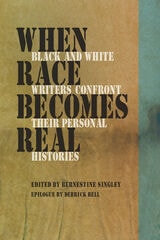
When Race Becomes Real
Black and White Writers Confront Their Personal HistoriesEdited by Bernestine Singley
Southern Illinois University Press, 2002
When Race Becomes Real is a critically acclaimed collection that pushes the boundaries of current discussions about race. In these personal and evocative essays, thirty contemporary black and white writers describe their own intimate experiences with race and discrimination, taking an unflinching look at both society and themselves. The result is an incisive and powerful anthology that rethinks what it means to be black—and white—in the modern world.
Only through frank and tough conversation, Singley tells us, can America hope to realize its goals of justice and racial equality. This collection opens that much needed honest dialogue, exploring a wide range of racial experiences in relation to a myriad of topics: from crime and religion to humor, history, and desire. Readers will find within these pages examinations of the roots of racial beliefs and the origins of the language and rules that have heretofore governed discussion; analysis of the reasons behind our reticence to discuss the subject openly; and suggestions for solutions to the problems that plague open racial discourse. The writers of When Race Becomes Real demonstrate the progress that can be made when our ingrained wariness on the subject of race is abandoned, and we instead confront the issue openly and personally. Included are contributions by a variety of authors, from Pulitzer Prize winners such as Robert Coles, Leonard Pitts, and Natalie Angier to popular writers and emerging voices. In each essay the author sweeps aside the cautious rules that often dominate racial discussions to address what race really means in the twenty-first century.
When Race Becomes Real directly tackles one of our most taboo subjects with bravery, wit, and emotion. Sometimes shocking, sometimes amusing but always honest, this collection encourages readers to move beyond the ineffective reluctance and objectivity that hinder contemporary conversations and in doing so forge a new path in racial consciousness.
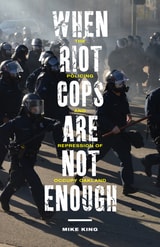
When Riot Cops Are Not Enough
The Policing and Repression of Occupy OaklandKing, Mike
Rutgers University Press, 2017
Drawn from King’s intensive field work, the book focuses on the physical, legal, political, and ideological dimensions of repression—in the streets, in courtrooms, in the media, in city hall, and within the movement itself—When Riot Cops Are Not Enough highlights the central role of political legitimacy, both for mass movements seeking to create social change, as well as for governmental forces seeking to control such movements. Although Occupy Oakland was different from other Occupy sites in many respects, King shows how the contradictions it illuminated within both social movement and police strategies provide deep insights into the nature of protest policing generally, and a clear map to understanding the full range of social control techniques used in North America in the twenty-first century.
When Roe Fell
How Barriers, Inequities, and Systemic Failures of Justice in Abortion Became VisibleKatrina Kimport
Rutgers University Press, 2026
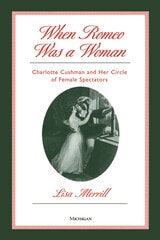
When Romeo Was a Woman
Charlotte Cushman and Her Circle of Female SpectatorsLisa Merrill
University of Michigan Press, 2000
Lisa Merrill examines Cushman's personal correspondence to shed new light on the actress's relationships and in turn on our understandings of the nature of women's "romantic friendships." She demonstrates how Cushman's androgynous presence served as a symbol to many of her contemporaries, and revealed their multiple and often contradictory attitudes toward female performers, women, and the unspeakable possibilities of same-sex desire.
The biography draws upon unpublished archival material as well as on current critical work to view Cushman's career, relationships, and posthumous reception. When Romeo Was a Woman examines as autobiographical performance Cushman's own narratives, the stories she authorized others to write, and the letters she wrote to intimates. The book is richly illustrated with many previously unpublished portraits of Cushman in her various stage roles, including Romeo and Lady Macbeth, and other revealing photographs of her family, lovers and friends.
When Romeo Was a Woman will find an appreciative audience among general readers as well as specialists in gay/lesbian history, women's history, theater and performance, popular culture, Victorian studies, and American studies.
"A fascinating story, and a major contribution to our understanding of lesbian history. . . . The work done on archival resources is both impressive in its extent and wholly convincing in its effect." --Jacky Bratton, University of London
Lisa Merrill is Associate Professor of Communication and Performance Studies, Hofstra University. She is the coauthor of The Power to Communicate: Gender Differences as Barriers, and the author of Untying the Tongue: Power, Gender, and the Word, forthcoming.
When Roosevelt Planned to Govern France
Charles L. Robertson
University of Massachusetts Press, 2011
This book tells the story of a plan put forth by President Franklin Roosevelt during World War II for an Allied military occupation of France in the aftermath of liberation, and of General Charles de Gaulle's efforts as self-appointed leader of the Free French Movement to thwart FDR's intentions. Charles L. Robertson frames the narrative as a mystery in which he plays the role of detective. He begins at a dinner party thirty years ago, where he first learned of the alleged plan from an elderly former aide to de Gaulle. Yet it wasn't until 2004, when he heard the same story repeated during the 60th commemoration of D-Day, that he set out to investigate whether it was true.
Many French are aware of this episode and believe, on the basis of later Gaullist officials' writings, that until the last moment a military occupation of their country was imminent. This view, across the years, has helped darken relations between France and the United States. Yet few if any Americans have ever heard of this plan, and in the event, no Allied military government of France was ever established.
How and why it never came to be, and why the French still believe it almost did, is the subject of this book. Robertson recounts how the president of the most powerful nation in the world was outmaneuvered in both his earlier plans for an occupation of France and his subsequent attempts to keep General de Gaulle from “seizing” power—in a France that ultimately, despite Roosevelt's intentions and expectations, regained its place among the victorious powers under de Gaulle's leadership.

When Rules Change
The Economics of RetroactivityDaniel Shaviro
University of Chicago Press, 2000
Daniel Shaviro tackles these tough questions, bringing legal, economic, and political perspectives to bear on a persistent problem not often given serious attention. When Rules Change: An Economic and Political Analysis of Transition Relief and Retroactivity focuses on tax law changes to develop an in-depth understanding of the transitional issues inherent in any substantive rule change and also to advance a set of normative policy guidelines applicable to any such circumstance. Shaviro reframes traditional approaches to the problem of retroactivity and offers new insights into both the theory and policy of legislative transitions.
When Sex Changed
Birth Control Politics and Literature between the World WarsLayne Parish Craig
Rutgers University Press, 2013
In When Sex Changed, Layne Parish Craig analyzes the ways literary texts responded to the political, economic, sexual, and social values put forward by the birth control movements of the 1910s to the 1930s in the United States and Great Britain.
Discussion of contraception and related topics (including feminism, religion, and eugenics) changed the way that writers depicted women, marriage, and family life. Tracing this shift, Craig compares disparate responses to the birth control controversy, from early skepticism by mainstream feminists, reflected in Charlotte Perkins Gilman’s Herland, to concern about the movement’s race and class implications suggested in Nella Larsen’s Quicksand, to enthusiastic speculation about contraception’s political implications, as in Virginia Woolf’s Three Guineas.
While these texts emphasized birth control’s potential to transform marriage and family life and emancipate women from the “slavery” of constant childbearing, birth control advocates also used less-than-liberatory language that excluded the poor, the mentally ill, non-whites, and others. Ultimately, Craig argues, the debates that began in these early political and literary texts—texts that document both the birth control movement’s idealism and its exclusionary rhetoric—helped shape the complex legacy of family planning and women’s rights with which the United States and the United Kingdom still struggle.
When Students Have Power
Negotiating Authority in a Critical PedagogyIra Shor
University of Chicago Press, 1996
Shor provides the reader with a reenactment of one semester that shows what really can happen when one applies the theory and democratizes the classroom. This is the story of one class in which Shor tried to fully share with his students control of the curriculum and of the classroom. After twenty years of practicing critical teaching, he unexpectedly found himself faced with a student uprising that threatened the very possibility of learning. How Shor resolves these problems, while remaining true to his commitment to power-sharing and radical pedagogy, is the crux of the book. Unconventional in both form and substance, this deeply personal work weaves together student voices and thick descriptions of classroom experience with pedagogical theory to illuminate the power relations that must be negotiated if true learning is to take place.
When This Cruel War Is Over
The Civil War Letters of Charles Harvey BrewsterDavid W. Blight
University of Massachusetts Press, 1992
“I am scared most to death every battle we have, but I don't think you need be afraid of my sneaking away unhurt.” Thus wrote Adjutant Charles Harvey Brewster of the 10th Massachusetts to his sister Martha in 1864, in one of over 200 letters he would pen during his four years of service.
Born and raised in Northampton, Massachusetts, Brewster was a twenty-seven-year-old store clerk when he enlisted in Company C of the 10th Massachusetts Volunteers in April 1861. During the next three and a half years he fought in many of the major battles of the Virginia campaigns—Fair Oaks, the Seven Days, Chancellorsville, Gettysburg, the Wilderness, the “Bloody Angle” at Spotsylvania—rising through the ranks to become second lieutenant and later adjutant of his regiment. His letters, most of which were written to his mother and two sisters, record not only the horrors he witnessed on the battlefield, but also his inner struggle with his own values, convictions, and sense of manhood.
In a thoughtful and illuminating introductory essay, David W. Blight explores the evolution of Brewster's understanding of the terrible conflict in which he was engaged. Blight shows how Brewster's attitudes toward race and slavery gradually changed, in part as a result of his contact with escaped slaves and his experience recruiting black troops. He also examines the shift in Brewster's conception of courage, as the realities of war collided with the romantic ideals he had previously embraced. This recently discovered and exceptionally literate collection of 137 letters chronicles the experiences of an ordinary Union soldier caught up in extraordinary events. At times naive and sentimental, at times mature and realistic, Brewster's correspondence not only provides remarkable insight into the meaning of the Civil War for the average Yankee, but also testifies to the persistent power of war to attract and repel the human imagination.
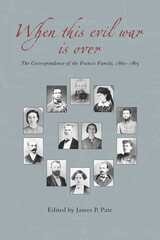
When This Evil War is Over
The Correspondence of the Francis FamilyJames P. Pate
University of Alabama Press, 2006
Six of the seven Francis brothers served in the Confederate army, as did their uncle, four servants, and other kinsmen, and all twelve members of the immediate family of Dr. James Carrington Francis and Amy Ingram Francis—as well as several members of their extended family—are represented in this volume. While the letters refer to the war and the brothers’ military service, they also shed light on this family’s struggle to survive the profound cultural, economic, and political upheaval that ensued.
When Tutor Meets Student
Martha Maxwell, Editor
University of Michigan Press, 1994
When War Becomes Personal
Soldiers' Accounts from the Civil War to IraqDonald Anderson
University of Iowa Press, 2008
The thirteen essays in When War Becomes Personal tell the enduring truths of battle, stripping away much of the romance, myth, and fantasy.
Soldiers more than anyone know what they are capable of destroying; when they write about war, they are trying to preserve the world.
When We Imagine Grace
Black Men and Subject MakingSimone C. Drake
University of Chicago Press, 2016
In When We Imagine Grace, Drake borrows from Toni Morrison’s Beloved to bring imagination to the center of black masculinity studies—allowing individual black men to exempt themselves and their fates from a hateful, ignorant society and open themselves up as active agents at the center of their own stories. Against a backdrop of crisis, Drake brings forth the narratives of black men who have imagined grace for themselves. We meet African American cowboy, Nat Love, and Drake’s own grandfather, who served in the first black military unit to fight in World War II. Synthesizing black feminist and black masculinity studies, Drake analyzes black fathers and daughters, the valorization of black criminals, the black entrepreneurial pursuits of Marcus Garvey, Berry Gordy, and Jay-Z, and the denigration and celebration of gay black men: Cornelius Eady, Antoine Dodson, and Kehinde Wiley. With a powerful command of its subjects and a passionate dedication to hope, When We Imagine Grace gives us a new way of seeing and knowing black masculinity—sophisticated in concept and bracingly vivid in telling.
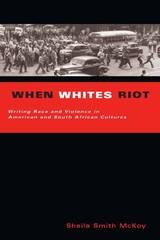
When Whites Riot
Writing Race and Violence in American and South African CulturesSheila Smith McKoy
University of Wisconsin Press, 2001
In a bold work that cuts across racial, ethnic, cultural, and national boundaries, Sheila Smith McKoy reveals how race colors the idea of violence in the United States and in South Africa—two countries inevitably and inextricably linked by the central role of skin color in personal and national identity.
Although race riots are usually seen as black events in both the United States and South Africa, they have played a significant role in shaping the concept of whiteness and white power in both nations. This emerges clearly from Smith McKoy's examination of four riots that demonstrate the relationship between the two nations and the apartheid practices that have historically defined them: North Carolina's Wilmington Race Riot of 1898; the Soweto Uprising of 1976; the Los Angeles Rebellion in 1992; and the pre-election riot in Mmabatho, Bhoputhatswana in 1994. Pursuing these events through narratives, media reports, and film, Smith McKoy shows how white racial violence has been disguised by race riots in the political and power structures of both the United States and South Africa.
The first transnational study to probe the abiding inclination to "blacken" riots, When Whites Riot unravels the connection between racial violence—both the white and the "raced"—in the United States and South Africa, as well as the social dynamics that this connection sustains.
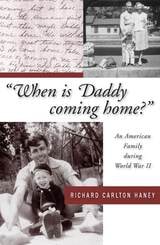
When is Daddy Coming Home?
An American Family during World War IIRichard Carlton Haney
Wisconsin Historical Society Press, 2024
World War II was coming to a close in Europe and Richard Haney was only four years old when the telegram arrived at his family's home in Janesville, Wisconsin. That moment, when Haney learned of his father's death in the final months of fighting, changed his and his mother's lives forever.
In this powerful book, Haney explores the impact of war on an American family. He skillfully weaves together those memories with his parents' wartime letters and his mother's recollections to create a unique blend of history and memoir. Through his father's letters he reveals the war's effect on a man who fought in the Battle of the Bulge with the 17th Airborne but wanted nothing more than to return home. Haney illuminates life on the home front in small-town America as well, describing how profoundly the war changed such communities.
With When Is Daddy Coming Home?, Richard Haney makes an exceptional contribution to the literature on the Greatest Generation—one that is both devastatingly personal and representative of what families all over America endured during that testing time.
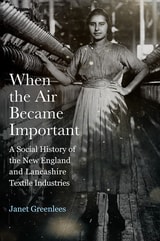
When the Air Became Important
A Social History of the New England and Lancashire Textile IndustriesJanet Greenlees
Rutgers University Press, 2019

When the Girls Came Out to Play
The Birth Of American SportswearPatricia C. Warner
University of Massachusetts Press, 2006
A study of the evolution of American women's clothing, When the Girls Came Out to Play traces the history of modern sportswear as a universal style that broke down traditional gender roles. Patricia Warner shows how this profound cultural shift, which did not reach fruition until World War II, originated during the previous century with the gradual expansion of socially acceptable physical activity for women. Behind this development was a growing interest in sports and exercise that was further nurtured by the establishment of schools of higher education for women. The participation of women in athletic pursuits previously reserved for men began with the relatively genteel sports of croquet and tennis. With the founding of women's colleges, these “ladylike” games were supplemented by more vigorous activities and competitive team sports, from gymnastics to swimming to basketball. At first, Warner points out, women literally had nothing to wear for these activities. Whereas such fashionable attire as corsets, petticoats, hats, and gloves could be worn while playing outdoor lawn games, more strenuous athletic endeavors required less physically restrictive clothing. Even so, change came only gradually, as women's colleges, shielded from public scrutiny and prying male eyes, permitted the adoption of looser, more comfortable apparel for physical education. Many of these new outfits featured trousers, garments considered taboo for women, though they often remained hidden beneath voluminous skirts.
Over time, however, the practicality and versatility of such clothing led to social acceptance, laying the foundation for the emergence of the now ubiquitous yet distinctly American style known as sportswear. Although we take it for granted, Warner observes, this is the first time in the history of the world that such universality has existed in clothing, and it has lasted now for well over half a century—in itself a marvel, considering the speed of fashion change in an era of instant messages and images.

When the Good Life Goes Bad
The US and Its Seven Deadly SinsStacey M. Floyd-Thomas Foreword by Michael Eric Dyson
University of Illinois Press, 2026
Stacey M. Floyd-Thomas examines how the Seven Deadly Sins have shaped the moral strivings and sociopolitical condition of American society and culture in the twenty-first century. Drawing on a multidimensional approach, Floyd-Thomas uses race, gender, class, and other lenses to break down the moral crises that define the American Dream. Her critique exposes the harm done by individual and collective practices of sexual objectification, capitalist materialism, wealth inequality, and technological hubris before pivoting to the rise of right-wing populism, white Christian nationalism, and the politics of cruelty. But Floyd-Thomas also proposes an ethic that emphasizes truth-telling, community engagement, and values rooted in humility, justice, and mercy—a new path for the US to overcome systemic oppression and create a more just society.
Evocative and ambitious, When the Good Life Goes Bad takes readers on a wide-ranging journey through US life and culture to explain what corrupted the American dream.
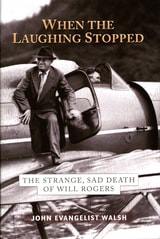
When the Laughing Stopped
The Strange, Sad Death of Will RogersJohn Evangelist Walsh
University of Alaska Press, 2008
The plane carrying Rogers and aviator Wiley Post crashed in a lagoon just outside Barrow, Alaska on August 15, 1935. Walsh retells the tragic tale from various angles, primarily alternating between Rogers and Post’s journey and the actions of the two men’s families on that fateful day. In particular, Walsh reveals moving details about the families and their struggle with grief, such as the fact that Post’s daughter was in a stage play about plane crashes at the time of the crash, or how Will Rogers’s daughter Mary never fully recovered from her father’s death and subsequently abandoned her promising acting career.
When the Laughing Stopped is a gripping and poignant retelling of the death of a beloved American legend, and it shines a humanizing light upon a pivotal moment in American history and culture.
When the Messenger Is Hot
StoriesElizabeth Crane, foreword by Lisa Lucas
Northwestern University Press, 2026
A beloved, smart, and bold story collection surges back to life in a new print edition
Hailed as “revolutionary fiction,” When the Messenger Is Hot gleefully upends the short-story form, rendering the absurdities and possibilities of modern urban life with disarming humor and keen perception as Crane weaves through grief and womanhood. The women in Elizabeth Crane’s world are fierce and kind, damaged and optimistic. They are jilted lovers, absent daughters, twelve-steppers, and smart-asses, recovering from loss, addiction, or betrayal. From a woman who decides to live on the rooftop of her friend’s apartment (why not?), to a writer whose identity is compromised by the actress who portrays her, to a daughter who believes her deceased mother is still alive and living at the bus depot, these characters experience love and loss in a way that is both profoundly universal and uniquely theirs.
When the News Broke
Chicago 1968 and the Polarizing of AmericaHeather Hendershot
University of Chicago Press, 2022
“The whole world is watching!” cried protestors at the 1968 Democratic convention as Chicago police beat them in the streets. When some of that violence was then aired on network television, another kind of hell broke loose. Some viewers were stunned and outraged; others thought the protestors deserved what they got. No one—least of all Chicago mayor Richard J. Daley—was happy with how the networks handled it.
In When the News Broke, Heather Hendershot revisits TV coverage of those four chaotic days in 1968—not only the violence in the streets but also the tumultuous convention itself, where Black citizens and others forcefully challenged southern delegations that had excluded them, anti-Vietnam delegates sought to change the party’s policy on the war, and journalists and delegates alike were bullied by both Daley’s security forces and party leaders. Ultimately, Hendershot reveals the convention as a pivotal moment in American political history, when a distorted notion of “liberal media bias” became mainstreamed and nationalized.
At the same time, she celebrates the values of the network news professionals who strived for fairness and accuracy. Despite their efforts, however, Chicago proved to be a turning point in the public’s trust in national news sources. Since those critical days, the political Right in the United States has amplified distrust of TV news, to the point where even the truest and most clearly documented stories can be deemed “fake.” As Hendershot demonstrates, it doesn’t matter whether the “whole world is watching” if people don’t believe what they see.

When the Phone Rings, My Bed Shakes
The Memoirs of a Deaf DoctorPhilip Zazove
Gallaudet University Press, 1993
Born almost totally deaf, Philip Zazove has spent his entire life beating the odds first by excelling in public schools during an era when most deaf children went to special schools, then by aspiring to become a medical doctor. When the Phone Rings, My Bed Shakes is the remarkable story of his determination and achievement in realizing his dreams.
Despite his stellar record at Northwestern University, Zazove was rejected by a host of medical schools. This only caused him to press harder, which won him acceptance at Rutgers University. He transferred to Washington University in St. Louis where, again against all advice, he decided to specialize in family practice. In vignettes of his patients, some amusing, others moving, he reveals the dedication and humanity that have made him a respected and well-loved doctor. His story will inspire all who read it.
When the Press Fails
Political Power and the News Media from Iraq to KatrinaW. Lance Bennett, Regina G. Lawrence, and Steven Livingston
University of Chicago Press, 2007
“The hand-in-glove relationship of the U.S. media with the White House is mercilessly exposed in this determined and disheartening study that repeatedly reveals how the press has toed the official line at those moments when its independence was most needed.”—George Pendle, Financial Times
“Bennett, Lawrence, and Livingston are indisputably right about the news media’s dereliction in covering the administration’s campaign to take the nation to war against Iraq.”—Don Wycliff, Chicago Tribune
When the River Burned
The Untold Story of the Jupiter ExplosionJoey Oliver
Michigan State University Press, 2026
On September 16, 1990, the tanker ship Jupiter exploded while unloading gasoline at a Bay City pier on the Saginaw River. The blast killed one worker, injured eleven others, and triggered what the U.S. Coast Guard later described as an unprecedented crisis on the Great Lakes. For weeks, the disaster commanded national attention as officials worked to contain the damage and investigate the cause. Then, like so many industrial accidents, the story faded from public memory.
When the River Burned tells the story of this overlooked chapter in Great Lakes maritime history. Drawing on newspaper archives, Coast Guard investigations, and eyewitness accounts, Joey Oliver reconstructs how a series of small oversights—in equipment, procedure, and human judgment—aligned to produce catastrophe.
The book places the Jupiter explosion within a broader history of the Saginaw River, tracing its evolution into a vital artery of Michigan industry. Oliver examines the fragile interdependence of ships, piers, and river traffic, revealing how disasters emerge not from single causes but from the breakdown of complex systems. When the River Burned is not only the account of a deadly tanker explosion; it is a reflection on what caused it, on the safety changes that followed, and on changes that never came.
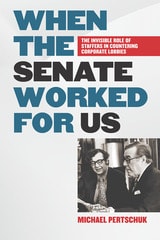
When the Senate Worked for Us
The Invisible Role of Staffers in Countering Corporate LobbiesMichael Pertschuk
Vanderbilt University Press, 2017
What has remained untold is the major behind-the-scenes contribution of entrepreneurial Congressional staff, who planted the seeds of public interest bills in their bosses' minds and maneuvered to counteract the influence of lobbyists to pass laws in consumer protection, public health, and other policy arenas crying out for effective government regulation. They infuriated Nixon's advisor, John Ehrlichman, who called them "bumblebees," a name they wore as a badge of honor.
For his insider account, Pertschuk draws on many interviews, as well as his fifteen years serving on the staff of the Senate Commerce Committee that Senator Warren Magnuson chaired and as the committee's Democratic Staff Director. That committee became, in Ralph Nader's words, "the Grand Central Station for consumer protection advocates."
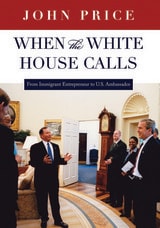
When the White House Calls
From Immigrant Entrepreneur to U.S. AmbassadorJohn Price
University of Utah Press, 2011
When the White House Calls tells the life story of John Price, one of Utah’s most prominent citizens, beginning with his birth in Germany through his years as a successful builder and real estate developer—with business interests in broadcasting, manufacturing, distribution, and banking—to his life as a diplomat. Born in Berlin on August 18, 1933, Hans Joachim Praiss was five years old when he and his family fled Nazi Germany in April 1939. The family found temporary refuge in Panama, finally arriving at Ellis Island in September 1940 and settling in New York City. Following the advice of a professor at CCNY, Price traveled west to fulfill a geology fieldwork course requirement, but upon seeing the snow-capped mountains surrounding Salt Lake City, knew he would stay. He earned his Bachelor of Science in Geological Engineering from the University of Utah in 1956. He practiced in that field before tiring of the often rigorous travel requirements and the desolate nature of the work. He soon turned to new opportunities.
Years later, after operating successful business enterprises throughout the Intermountain region and nationally, and serving on numerous local, state, and national boards, Price had become the consummate entrepreneur, businessman, and community leader. He was ready to serve his country when the White House called. In February 2002 he was sworn in as U.S. Ambassador to the Republic of Mauritius, the Republic of Seychelles, and the Union of the Comoros, three Indian Ocean island nations off the east coast of Africa, where he served until 2005.
In this telling autobiography, John Price focuses on his years as an ambassador and includes his thoughts on the future of sub-Saharan Africa. The account of his service as a diplomat offers readers a view of the daily life of an ambassador—the protocol for official meetings with heads of state, the routine of the office, the process of handling official communications, and the intricacies of diplomacy. More than that, in a world concerned with the global war on terror, he reflects on the three island nations where he served and on the region’s increasing strategic importance to the national security of the United States.
In the years since the 2001 attacks on the World Trade Center and the Pentagon, the al-Qaeda movement has grown and its members have dispersed throughout the world, including the region known as the Horn of Africa and East Africa. Price calls attention to the vulnerability of sub-Saharan Africa as a haven for terrorists, and the critical need for our engagement of this desperate continent with economic development, health care, and education to counter this threat. His concern for this region of Africa is carefully articulated in the text, as well as in interviews (included as appendixes) with notable country leaders. When the White House Calls is a compelling story of the American Dream realized, and the importance of service to country. This is a book that will both educate and inspire young people, their mentors, and others, as they work to make a difference in the world.
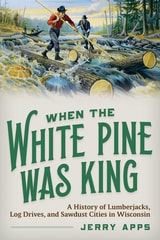
When the White Pine Was King
A History of Lumberjacks, Log Drives, and Sawdust Cities in WisconsinJerry Apps
Wisconsin Historical Society Press, 2020
For more than half a century, logging, lumber production, and affiliated enterprises in Wisconsin’s Northwoods provided jobs for tens of thousands of Wisconsinites and wealth for many individuals. The industry cut through the lives of nearly every Wisconsin citizen, from an immigrant lumberjack or camp cook in the Chippewa Valley to a Suamico sawmill operator, an Oshkosh factory worker to a Milwaukee banker.
When the White Pine Was King tells the stories of the heyday of logging: of lumberjacks and camp cooks, of river drives and deadly log jams, of sawmills and lumber towns and the echo of the ax ringing through the Northwoods as yet another white pine crashed to the ground. He explores the aftermath of the logging era, including efforts to farm the cutover (most of them doomed to fail), successful reforestation work, and the legacy of the lumber and wood products industries, which continue to fuel the state’s economy.
Enhanced with dozens of historic photos, When the White Pine Was King transports readers to the lumber boom era and reveals how the lessons learned in the vast northern forestlands continue to shape the region today.
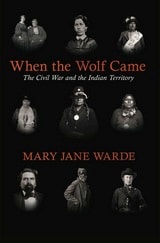
When the Wolf Came
The Civil War and the Indian TerritoryMary Jane Warde
University of Arkansas Press, 2013
Winner of the 2014 Pate Award from the Fort Worth Civil War Round Table.
When the peoples of the Indian Territory found themselves in the midst of the American Civil War, squeezed between Union Kansas and Confederate Texas and Arkansas, they had no way to escape a conflict not of their choosing--and no alternative but to suffer its consequences. When the Wolf Came explores how the war in the Indian Territory involved almost every resident, killed many civilians as well as soldiers, left the country stripped and devastated, and cost Indian nations millions of acres of land. Using a solid foundation of both published and unpublished sources, including the records of Cherokee, Choctaw, and Creek nations, Mary Jane Warde details how the coming of the war set off a wave of migration into neighboring Kansas, the Red River Valley, and Texas. She describes how Indian Territory troops in Unionist regiments or as Confederate allies battled enemies--some from their own nations--in the territory and in neighboring Kansas, Missouri, and Arkansas. And she shows how post-war land cessions forced by the federal government on Indian nations formerly allied with the Confederacy allowed the removal of still more tribes to the Indian Territory, leaving millions of acres open for homesteads, railroads, and development in at least ten states. Enhanced by maps and photographs from the Oklahoma Historical Society's photographic archives, When the Wolf Came will be welcomed by both general readers and scholars interested in the signal public events that marked that tumultuous era and the consequences for the territory's tens of thousands of native peoples.
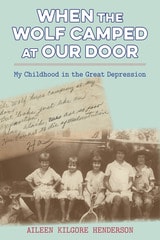
When the Wolf Camped at Our Door
My Childhood in the Great DepressionAileen Kilgore Henderson
University of Alabama Press, 2022
Recounts the hardships and joys the Kilgore family and their neighbors experienced in a close-knit southern rural community during the Great Depression
As the Great Depression tightened its grip on the world, six members of the Kilgore family were living in a cramped farmhouse in Brookwood, Alabama. Crops didn’t grow well, food was scarce, shoes were in short supply, and the few clothes they had were all hand-me-downs. The Kilgores struggled to make ends meet, cobbling together odd jobs and working the land by hand.
Despite all of this, young Aileen thought life was full of hope. She longed to hold on to it and scribbled down daily events on whatever odds and ends of paper she could find. In her new memoir, When the Wolf Camped at Our Door, Aileen Kilgore Henderson creates a vivid portrait of what life was like for so many living in the rural South during the Depression. The book begins when Aileen is ten years old and follows her into her teenage years over the course of twenty-seven episodic chapters. Drawing on her girlhood diaries and told through the charismatic voice of her younger self, Henderson’s nuanced storytelling sheds light on the common struggle for survival during a time when people were at their most vulnerable.
Against the backdrop of a world where hard work and harsh conditions like hunger, privation, sickness, and early death were everyday realities, Henderson’s stories are nevertheless tinged with young Aileen’s lively sense of humor and optimistic faith in people and in the promise of life despite trying circumstances. We follow her rambles in the woods, her visits with friends, a trip to a fortune teller, and a search for the Howton Horror, a mysterious monster rumored to live deep in the Alabama backwoods.
When the World Explodes
EssaysAmy Lee Scott
The Ohio State University Press, 2025
Where Are All the Good Jobs Going?
What National and Local Job Quality and Dynamics Mean for U.S. WorkersHarry J. Holzer
Russell Sage Foundation, 2011
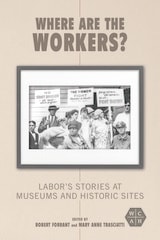
Where Are the Workers?
Labor's Stories at Museums and Historic SitesEdited by Robert Forrant and Mary Anne Trasciatti
University of Illinois Press, 2022
A wide-ranging blueprint for change, Where Are the Workers? shows how working-class perspectives can expand our historical memory and inform and inspire contemporary activism.
Contributors: Jim Beauchesne, Rebekah Bryer, Rebecca Bush, Conor Casey, Rachel Donaldson, Kathleen Flynn, Elijah Gaddis, Susan Grabski, Amanda Kay Gustin, Karen Lane, Rob Linné, Erik Loomis, Tom MacMillan, Lou Martin, Scott McLaughlin, Kristin O’Brassill-Kulfan, Karen Sieber, and Katrina Windon
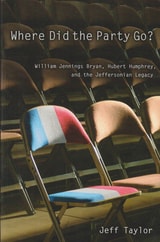
Where Did the Party Go?
William Jennings Bryan, Hubert Humphrey, and the Jeffersonian LegacyJeff Taylor
University of Missouri Press, 2006

Where I Must Go
A NovelAngela Jackson
Northwestern University Press, 2009
Lyrical, penetrating, and highly charged, this novel displays a delicately tuned sense of difference and belonging. Poet Angela Jackson brings her superb sense of language and of human possibility to the story of young Magdalena Grace, whose narration takes readers through both privilege and privation at the time of the American civil rights movement.
The novel moves from the privileged yet racially exclusive atmosphere of the fictional Eden University to the black neighborhoods of a Midwestern city and to ancestral Mississippi. Magdalena’s story includes a wide range of characters—black and white, male and female, favored with opportunity or denied it, the young in love and elders wise with hope. With and through each other, they struggle to understand the history they are living and making. With dazzling perceptiveness, Jackson’s narrator Magdalena tells of the complex interactions of people around her who embody the personal and the political at a crucial moment in their own lives and in the making of America.

Where Is Ana Mendieta?
Identity, Performativity, and ExileJane Blocker
Duke University Press, 1999
Taken from banners carried in a 1992 protest outside the Guggenheim Museum in New York, the title phrase “Where is Ana Mendieta?” evokes not only the suspicious and tragic circumstances surrounding her death but also the conspicuous absence of women artists from high-profile exhibitions. Drawing on the work of such theorists as Judith Butler, Joseph Roach, Edward Said, and Homi Bhabha, Blocker discusses the power of Mendieta’s earth-and-body art to alter, unsettle, and broaden the terms of identity itself. She shows how Mendieta used exile as a discursive position from which to disrupt dominant categories, analyzing as well Mendieta’s use of mythology and anthropology, the ephemeral nature of her media, and the debates over her ethnic, gender, and national identities.
As the first major critical examination of this enigmatic artist’s work, Where Is Ana Mendieta? will interest a broad audience, particularly those involved with the production, criticism, theory, and history of contemporary art.
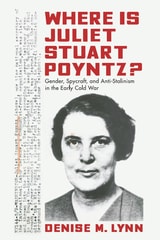
Where Is Juliet Stuart Poyntz?
Gender, Spycraft, and Anti-Stalinism in the Early Cold WarDenise Lynn
University of Massachusetts Press, 2021
In Where Is Juliet Stuart Poyntz?, Denise M. Lynn argues that Poyntz's sudden disappearance was the final straw for many on the American political left, who then abandoned Marxism and began to embrace anti-communism. In the years to follow, the left crafted narratives of her disappearance that became central to the Cold War. While scholars have thoroughly analyzed the influence of the political right in the anti-communism of this era, this captivating and compelling study is unique in exploring the influence of the political left.
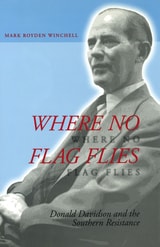
Where No Flag Flies
Donald Davidson and the Southern ResistanceMark Royden Winchell
University of Missouri Press, 2000
Donald Davidson (1893-1968) may well be the most unjustifiably neglected figure in twentieth-century southern literature. One of the most important poets of the Fugitive movement, he also produced a substantial body of literary criticism, the libretto for an American folk opera, a widely used composition textbook, and the recently discovered novel The Big Ballad Jamboree. As a social and political activist, Davidson had significant impact on conservative thought in this century, imfluencing important scholars from Cleanth Brooks to M. E. Bradford.
Despite these accomplishments, Donald Davidson has received little critical attention from either the literary or the southern scholarly community. Where No Flag Flies is Mark Royden Winchell's redress of this critical disservice. A comprehensive intellectual biography of Davidson, this seminal work offers a complete narrative of Davidson's life with all of its triumphs and losses, frustrations and fulfillments.
Winchell provides the reader with more than a simple study of a man and his achievements; he paints a complete portrait of the times in which Davidson published, from the 1930s to the early 1960s. Davidson was more directly involved in political and social activities than most writers of his generation, and Winchell provides the context, both literary and historical, in which Davidson's opinions and works developed. At the same time, Winchell offers detailed evaluations of Davidson's poetry, fiction, historical writings, and essays.
Drawing upon a wealth of previously unpublished archival material, including Davidson's letters and diary, Where No Flag Flies provides unique access to one of the most original minds of the twentieth-century South. Donald Davidson may not have achieved the recognition he deserved, but this remarkable biography finally makes it possible for a considerable literary audience to discover his true achievement.

Where Roads Will Never Reach
Wilderness and Its Visionaries in the Northern RockiesFrederick H. Swanson
University of Utah Press, 2015
The Rocky Mountains of Idaho and Montana are home to some of the most important remaining American wilderness areas, preserved because of citizens who stood against massive development schemes that would have diminished important wildlife habitat and the abiding sense of remoteness found in such places. Where Roads Will Never Reach tells the stories of hunters, anglers, outfitters, scientists, and other concerned citizens who devoted themselves to protecting remnant wild lands and ecosystems in the Northern Rockies. Environmental historian Frederick Swanson argues that their heartfelt, dedicated work helped boost the American wilderness movement to its current prominence.
Based on newly available archival sources and interviews with many of the participants, this groundbreaking study explores for the first time the grassroots campaigns that yielded some of the largest designated wilderness areas in America.