Results by title
8128 books match the query 'Literary Criticism' and 363 start with w
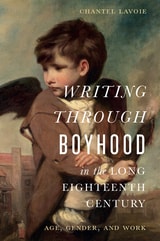
Writing through Boyhood in the Long Eighteenth Century
Age, Gender, and WorkChantel Lavoie
University of Delaware Press, 2024
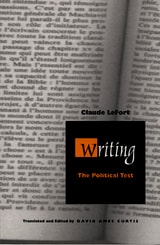
Writing
The Political TestClaude Lefort
Duke University Press, 2000
In Writing: The Political Test, France’s leading political philosopher, Claude Lefort, illuminates the process by which writers negotiate difficult path to free themselves from the ideological and contextual traps that would doom their attempts to articulate a new vision. Lefort examines writers whose works provide special insights into this problem of risk, both literary artists and political philosophers. Among them are Salman Rushdie, Sade, Tocqueville,m Machiavelli, Leo Strauss, Orwell, Kant, Robespierre, Guizot, and Pierre Clastres. In Tocqueville, for example, Lefort finds that the author’s improvisatory and open-ended expression represents the character of the democratic experience. Orwell’s work on totalitarianism shows up the totalitarian subject’s complicity in this political regime. And Rushdie is remarkable for his solid attack on relativism. With the character and fate of the political forms of modernity, democracy, and totalitarianism a central theme, Lefort concludes with some reflections on the collapse of the Soviet Union.
This intriguing and accessible exploration of literature’s political aspects and political philosophy’s literary ones will be welcomed by those who have been stymied by current efforts to bridge these two fields. Taken together, the essays in this volume also stand as an intellectual autobiography of Lefort, making it an excellent introduction to his work for less experience students of political theory or philosophy.
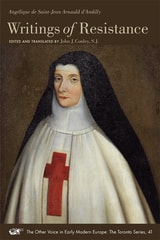
Writings of Resistance
Angélique de Saint-Jean Arnauld d’Andilly
Iter Press, 2015
An erudite abbess of Port-Royal, Angélique de Saint-Jean Arnauld d’Andilly (1624 – 1684) resisted the demands of church and state to condemn the Jansenist theological doctrines which the convent had long upheld. In her autobiographical Report on Captivity, Angélique de Saint-Jean recounts her personal methods of spiritual resistance as she and her fellow nuns underwent waves of persecution resulting in exile, house arrest, interdict, and excommunication. Her voluminous theological writings present the theoretical basis for this resistance, limiting the claims of political and ecclesiastical authorities over the conscience of the individual. In particular, she defends the right of women to refuse to surrender their convictions due to specious appeals to obedience and humility.
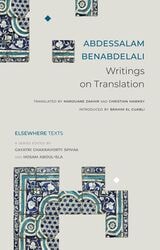
Writings on Translation
Abdessalam Benabdelali
Seagull Books, 2025
Abdessalam Benabdelali is a revered Moroccan philosopher and translator whose work maps an invaluable history of the status of translation in contemporary Arabic thought and language. Bringing together essays from two linked Arabic works by Benabdelali—On Translation and Hosting the Stranger—this volume represents one of the first extended philosophical explorations of translation by a contemporary Arab philosopher. These works reframe Arabic and European cultural histories around translation to counter hegemonic discourses and celebrate translation as a form of philosophical thought and practice, one that both preserves and proliferates difference.
Whether discussing eighteenth-century European perceptions of Arabic culture, classical Arabic literature and its express intent to resist all translation, or contemporary Arabic authors who write in anticipation of translation, Writings on Translation nimbly outlines the key philosophical questions at stake in translation. It concludes with an impassioned argument for translations that “host the stranger” and allow texts to “lift off and migrate.”
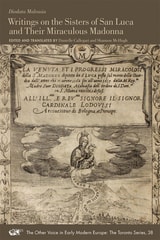
Writings on the Sisters of San Luca and Their Miraculous Madonna
Diodata Malvasia
Iter Press, 2015
The Bolognese nun Diodata Malvasia was presumed to have authored only one work, The Arrival and the Miraculous Workings of the Glorious Image of the Virgin (1617). In her recently discovered second manuscript chronicle, A Brief Discourse on What Occurred to the Most Reverend Sisters of the Joined Convents of San Mattia and San Luca (1575), her writing demonstrates active resistance to Tridentine convent reform. Together, Malvasia’s works read as the bookends to a lifelong crusade on behalf of her convent.
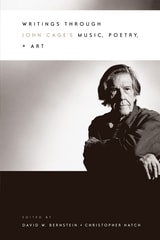
Writings through John Cage's Music, Poetry, and Art
Edited by David W. Bernstein and Christopher Hatch
University of Chicago Press, 2001
The essays in this collection grew out of a pivotal gathering during which a spectrum of participants including composers, music scholars, and visual artists, literary critics, poets, and filmmakers convened to examine Cage's extraordinary artistic legacy. Beginning with David Bernstein's introductory essay on the reception of Cage's music, the volume addresses topics ranging from Cage's reluctance to discuss his homosexuality, to his work as a performer and musician, and his forward-looking, provocative experimentation with electronic and other media. Several of the essays draw upon previously unseen sketches and other source materials. Also included are transcripts of lively panel discussions among some of Cage's former colleagues. Taken together, this collection is a much-needed contribution to the study of one of the most significant American artists of the twentieth century.
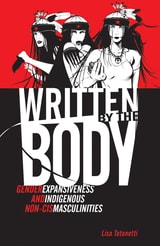
Written by the Body
Gender Expansiveness and Indigenous Non-Cis MasculinitiesLisa Tatonetti
University of Minnesota Press, 2021
Examining the expansive nature of Indigenous gender representations in history, literature, and film
Within Native American and Indigenous studies, the rise of Indigenous masculinities has engendered both productive conversations and critiques. Lisa Tatonetti intervenes in this conversation with Written by the Body by centering how female, queer, and/or Two-Spirit Indigenous people take up or refute masculinity, and, in the process, offer more expansive understandings of gender.
Written by the Body moves from the eighteenth- and nineteenth-century archive to turn-of-the-century and late-twentieth-century fiction to documentaries, HIV/AIDS activism, and, finally, recent experimental film and literature. Across it all, Tatonetti shows how Indigenous gender expansiveness, and particularly queer and non-cis gender articulations, moves between and among Native peoples to forge kinship, offer protection, and make change. She charts how the body functions as a somatic archive of Indigenous knowledge in Native histories, literatures, and activisms—exploring representations of Idle No More in the documentary Trick or Treaty, the all-female wildland firefighting crew depicted in Apache 8, Chief Theresa Spence, activist Carole laFavor, S. Alice Callahan, Thirza Cuthand, Joshua Whitehead, Carrie House, and more.
In response to criticisms of Indigenous masculinity studies, Written by the Body de-sutures masculinity from the cis-gendered body and investigates the ways in which female, trans, and otherwise nonconforming masculinities carry the traces of Two-Spirit histories and exceed the limitations of settler colonial imaginings of gender.
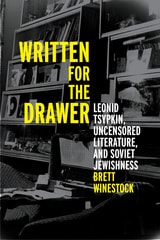
Written for the Drawer
Leonid Tsypkin, Uncensored Literature, and Soviet JewishnessBrett Winestock
University of Wisconsin Press, 2024
Tsypkin’s autobiographical writing explored the impossibility of being both a Russian writer and a Soviet Jew, employing indirection and referentiality. In the first book-length appraisal of Tsypkin and his work, Brett Winestock considers Tsypkin’s fiction as part of a transnational literary response to the horrors of the twentieth century, a reception that helps explain his much-belated international readership. Through close readings of Tsypkin’s work in the context of late-Soviet cultural worlds, Winestock makes an important contribution to studies of Jewish Soviet writing and identity.
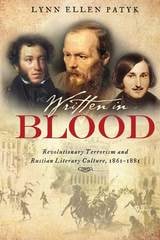
Written in Blood
Revolutionary Terrorism and Russian Literary Culture, 1861–1881Lynn Ellen Patyk
University of Wisconsin Press, 2017
Lynn Ellen Patyk contends that the prototype for the terrorist was the Russian writer, whose seditious word was interpreted as an audacious deed—and a violent assault on autocratic authority. The interplay and interchangeability of word and deed, Patyk argues, laid the semiotic groundwork for the symbolic act of violence at the center of revolutionary terrorism. While demonstrating how literary culture fostered the ethos, pathos, and image of the revolutionary terrorist and terrorism, she spotlights Fyodor Dostoevsky and his "terrorism trilogy"—Crime and Punishment (1866), Demons (1870–73), and The Brothers Karamazov (1878–80)—as novels that uniquely illuminate terrorism's methods and trajectory. Deftly combining riveting historical narrative with penetrating literary analysis of major and minor works, Patyk's groundbreaking book reveals the power of the word to spawn deeds and the power of literature to usher new realities into the world.
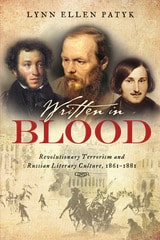
Written in Blood
Revolutionary Terrorism and Russian Literary Culture, 1861–1881Lynn Ellen Patyk
University of Wisconsin Press, 2020
Written in Water, Written in Stone
Twenty Years of Poets on PoetryMartin Lammon, Editor
University of Michigan Press, 1996
Included are selections from, among others, Robert Bly, Hayden Carruth, Amy Clampitt, Robert Creeley, Tess Gallagher, Donald Hall, Robert Hayden, Galway Kinnell, Richard Kostelanetz, Maxine Kumin, Philip Levine, Marge Piercy, Anne Sexton, Charles Simic, Louis Simpson, William Stafford, Diane Wakoski, Charles Wright, and James Wright. This diverse collection of popular contemporary poets is sure to appeal to a wide range of readers.
Martin Lammon teaches creative writing at Fairmont State College. He is a poet and editor of the literary magazine Kestrel.

Wuthering Heights on Film and Television
A Journey Across Time and CulturesValérie V. Hazette
Intellect Books, 2015

Wuthering Heights
A StudyU.C. Knoepflmacher
Ohio University Press, 1994