Results by title
1116 books match the query 'Africa' and 2 start with y
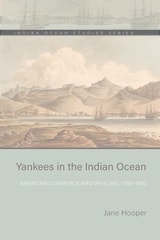
Yankees in the Indian Ocean
American Commerce and Whaling, 1786–1860Jane Hooper
Ohio University Press, 2022
The history of US imperialism remains incomplete without this consideration of long-overlooked nineteenth-century American commercial and whaling ventures in the Indian Ocean.
Yankees in the Indian Ocean shows how nineteenth-century American merchant and whaler activity in the Indian Ocean shaped the imperial future of the United States, influenced the region’s commerce, encouraged illegal slaving, and contributed to environmental degradation. For a brief time, Americans outnumbered other Western visitors to Mauritius, Madagascar, Zanzibar, and the East African littoral. In a relentless search for commodities and provisions, American whaleships landed at islands throughout the ocean and stripped them of resources. Yet Americans failed to develop a permanent foothold in the region and operated instead from a position of weakness relative to other major colonizing powers, thus discouraging the development of American imperial holdings there.
The history of American concerns in the Indian Ocean world remains largely unwritten. Scholars who focus on the region have mostly ignored American involvement, despite arguments for the ocean’s importance in powering global connections during the late eighteenth and early nineteenth centuries. Historians of the United States likewise have failed to examine the western Indian Ocean because of a preoccupation with US interests in Asia and the Pacific. Failing to understand the scale of American trade in the Indian Ocean has led to a fixation on European commercial strength to the exclusion of other maritime networks. Instead, this book reveals how the people of Madagascar and East Africa helped the United States briefly dominate commerce and whaling.
This book investigates how and why Americans were drawn to the western Indian Ocean years before the United States established a formal overseas empire in the late nineteenth century. Ship logs, sailor journals, and travel narratives reveal how American men transformed foreign land- and seascapes into knowable spaces that confirmed American conceptions of people and natural resources; these sources also provide insight into the complex social and ecological worlds of the Indian Ocean during this critical time.
Yaya's Story
The Quest for Well-Being in the WorldPaul Stoller
University of Chicago Press, 2014
Harouna and Stoller would meet in Harlem, at a bustling African market where Harouna built a life as an African art trader and Stoller was conducting research. Moving from Belayara in Niger to Silver Spring, Maryland, and from the Peace Corps to fieldwork to New York, Stoller recounts their separate lives and how the threat posed by cancer brought them a new, profound, and shared sense of meaning. Combining memoir, ethnography, and philosophy through a series of interconnected narratives, he tells a story of remarkable friendship and the quest for well-being. It’s a story of difference and unity, of illness and health, a lyrical reflection on human resiliency and the shoulders we lean on.