Results by title
702 books match the query 'America' and 3 start with y
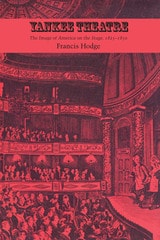
Yankee Theatre
The Image of America on the Stage, 1825–1850By Francis Hodge
University of Texas Press, 1964
The famous "Stage Yankees," with their eccentric New England dialect comedy, entertained audiences from Boston to New Orleans, from New York to London in the years between 1825 and 1850. They provided the creative energy for the development of an American-type character in early plays of native authorship. This book examines the full range of their theatre activity, not only as actors, but also as playmakers, and re-evaluates their contribution to the growth of the American stage.
Yankee theatre was not an oddity, a passing fad, or an accident of entertainment; it was an honest exploitation of the materials of American life for an audience in search of its own identification. The delineation of the American character—a full-length realistic portrait in the context of stage comedy—was its projected goal; and though not the only method for such delineation, the theatre form was the most popular and extensive way of disseminating the American image.
The Yankee actors openly borrowed from what literary sources were available to them, but because of their special position as actors, who were required to give flesh-and-blood imitations of people for the believable acceptance of others viewing the same people about them, they were forced to draw extensively on their actors' imaginations and to present the American as they saw him. If the image was too often an external one, it still revealed the Yankee as a hardy individual whose independence was a primary assumption; as a bargainer, whose techniques were more clever than England's sharpest penny-pincher; as a country person, more intelligent, sharper and keener in dealings than the city-bred type; as an American freewheeler who always landed on top, not out of naive honesty but out of a simple perception of other human beings and their gullibility.
Much new evidence in this study is based on London productions, where the view of English audiences and critics was sharply focused on what Americans thought about themselves and the new culture of democracy emerging around them. The shift from America, the borrower, to America, the original doer, can be clearly seen in this stager activity.
Yankee theatre, then, is an epitome of the emerging American after the Second War for Independence. Emerging nationalism meant emerging national definition. Yankee theatre thus led to the first cohesive body of American plays, the first American actors seen in London, and to a new realistic interpretation of the American in the "character" plays of the 1870s and 1880s.
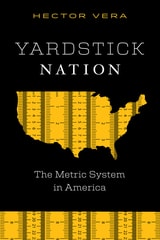
Yardstick Nation
The Metric System in AmericaHector Vera
Vanderbilt University Press, 2025
Honorable Mention, Robert K. Merton Book Award, American Sociological Association’s Science, Knowledge, and Technology (SKAT) Section, 2026
Why is there no metric system in the United States? Why is it that a country known for its openness to the future, its scientific innovations, and its preference for practicality has not adopted the most practical, scientific, and innovative system of measurement? Yardstick Nation answers these questions by analyzing the political, economic, and international factors that determined the trajectory of the United States as a nation self-excluded from one of the most successful global technical languages.
Using a historical-comparative approach and qualitative analysis of archival material, the book examines the trajectories of American scientists, engineers, politicians, and industrialists from 1787 to 1982, to detail what they wanted to attain and to explain what was actually possible to achieve given the political and economic conditions in which they lived. Yardstick Nation argues that in order to understand the unbreached distance between the United States and the metric system, we must consider the interaction between three structural elements: historical timing, state infrastructural power, and international economic integration.
Author Hector Vera’s systematic look at when and why countries have adopted the metric system shows that its introduction is never casual. In the countries that voluntarily embraced the metric system, this was the result of either deep internal political transformations or momentous changes in the international economy. When the adoption of the metric system is politically driven, it comes as the result of a social revolution, independence war, national unification, or the draft of a new constitution. When it is propelled by economic factors, metrication is part of the efforts of economically stagnant countries to integrate into international markets.
Yiddish & English
The Story of Yiddish in AmericaSol Steinmetz
University of Alabama Press, 2001
This is the only book to seriously treat the intriguing linguistic and cultural phenomenon of the intimate contact between Yiddish and English over the past 120 years.
Yiddish arrived in America as the mother tongue of millions of Jewish immigrants from eastern Europe. Not only did this language without a homeland survive in the great American melting pot, it infiltrated the majority language, English, with a wide variety of new words and expressions and helped to establish a new ethnic language called "Jewish English." New Yorkers, in particular, have adopted a long list of Yiddish words, including the well-known "kosher," "chutzpah," "klutz," "yenta," "nosh," "mavin," "schlep," and "shmo."
Yiddish had first developed from language sharing as Jews of northern France and northern Italy migrated into the German-speaking region of the Rhine Valley in the Middle Ages. Sol Steinmetz traces the development of such words as bonhomme from the Old French meaning "good man" to the Yiddish of bonim, or shul for synagogue derived from the German schuol, meaning "school," which had come originally from the Latin schola, for example. With a rich collection of quotations from literature and the press, Steinmetz documents the unusually high lexical, semantic, and intonational exchanges between Yiddish and English in America. He offers more than 1,200 Yiddish words, expressions, idioms, and phrases that have melted into the English vernacular.
Yiddish and English is important for Judaica collections with its two appendixes-one on the romanization of Yiddish and another of Yiddish-origin words, a Jewish-English glossary, a selected bibliography, and an index. But this slim volume is so entertaining and informative for the general reader that it is recommended for anyone who delights in word derivations and language.