Results by title
3576 books match the query 'American' and 19 start with y
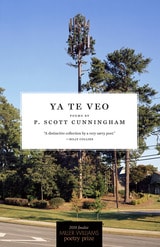
Ya Te Veo
PoemsP. Scott Cunningham
University of Arkansas Press, 2018
Finalist, 2018 Miller Williams Poetry Prize
Ya Te Veo takes as its title the name of a mythical tree that eats people. Like the branches of that tree, the poems in this book seem to capture and nourish themselves on a diverse cast of would-be passers-by, drawing their life-force from the resulting synthesis of characters. Among the seized are poets and painters alongside musicians from Garth Brooks to Wu-Tang Clan to the composer Morton Feldman, whose mysterious personality serves as a backdrop in many poems for meditations on intimacy, ethics, and anxiety.
As the phrase “ya te veo” (“I see you”) implies, this is a book interested in revealing what we think is hidden, in questioning the gap inside all of us, a gap between what we feel and what we say and do, making space for our many contradictions.
Like the works of Feldman, these poems focus and recede, experimenting with form in order to accomplish a state of deep concentration. They impersonate sonnets, ghazals, terza rima, monologues, translations, and freestyles, but inexactly, embracing failed imitation as an opportunity to remix the familiar.
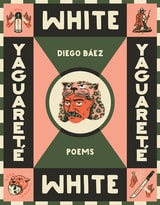
Yaguareté White
PoemsDiego Báez
University of Arizona Press, 2024
The son of a Paraguayan father and a mother from Pennsylvania, Báez grew up in central Illinois as one of the only brown kids on the block—but that didn’t keep him from feeling like a gringo on family visits to Paraguay. Exploring this contradiction as it weaves through experiences of language, self, and place, Báez revels in showing up the absurdities of empire and chafes at the limits of patrimony, but he always reserves his most trenchant irony for the gaze he turns on himself.
Notably, this raucous collection also wrestles with Guaraní, a state-recognized Indigenous language widely spoken in Paraguay. Guaraní both structures and punctures the book, surfacing in a sequence of jokes that double as poems, and introducing but leaving unresolved ambient questions about local histories of militarism, masculine bravado, and the outlook of the campos. Cutting across borders of every kind, Báez’s poems attempt to reconcile the incomplete, contradictory, and inconsistent experiences of a speaking self that resides between languages, nations, and generations.
Yaguareté White is a lyrical exploration of Paraguayan American identity and what it means to see through a colored whiteness in all of its tangled contradictions.
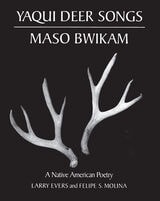
Yaqui Deer Songs/Maso Bwikam
A Native American PoetryLarry Evers and Felipe S. Molina
University of Arizona Press, 1987
Yaqui regard song as a kind of lingua franca of the intelligent universe. It is through song that experience with other living things is made intelligible and accessible to the human community. Deer songs often take the form of dialogues in which the deer and others in the wilderness world speak with one another or with the deer singers themselves. It is in this way, according to one deer singer, that “the wilderness world listens to itself even today.”
In this book authentic ceremonial songs, transcribed in both Yaqui and English, are the center of a fascinating discussion of the Deer Song tradition in Yaqui culture. Yaqui Deer Songs/Maso Bwikam thus enables non-Yaquis to hear these dialogues with the wilderness world for the first time.
Year We Studied Women
Bruce Snider
University of Wisconsin Press, 2003
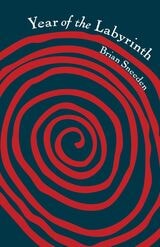
Year of the Labyrinth
Brian Sneeden
Carnegie Mellon University Press, 2026
In this folk-horror pastoral, poet Brian Sneeden threads paths of myth and ritual, fatherhood and climate collapse, ghost stories and grief.
Described by Kiki Petrosino as “a beautiful invasion,” Year of the Labyrinth draws upon Sneeden’s experiences as a translator and multilingual writer working in language preservation to explore boundaries between speech and ritual, myth and ecology. “In these fiercely imagined poems,” Petrosino writes, “our speaker passes between seemingly fixed physical and conceptual worlds—human/animal, past/present, forest/field. This voice finds lyric power in liminal spaces—in ‘the pollen line’ and ‘a change of wind.’ With the speaker, we travel through mirrors to places where you might grasp an animal if only ‘by the curve of its name,’ and where ‘a bird that ha[s]n’t yet been invented’ may sing. This poet’s imagination makes porous the landscapes we thought were familiar.” Kelly Link, in her judge’s citation for the Barthelme Prize, writes: “How wonderful it is, the marriage of economy and the arcane, as if a story could be a kind of lozenge that, slipped under the tongue, estranges us from our idea of how both life and language work. Every sentence has the effect of an acupuncturist’s needle, small pricks that let in strange energy.”
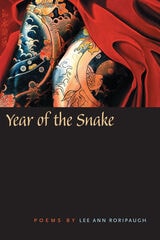
Year of the Snake
Lee Ann Roripaugh
Southern Illinois University Press, 2004
In her second collection of poems, Lee Ann Roripaugh probes themes of mixed-race female identities, evoking the molting processes of snakes and insects who shed their skins and shells as an ongoing metaphor for transformation of self. Intertwining contemporary renditions of traditional Japanese myths and fairy tales with poems that explore the landscape of childhood and early adolescence, she blurs the boundaries between myth and memory, between real and imagined selves. This collection explores cultural, psychological, and physical liminalities and exposes the diasporic arc cast by first-generation Asian American mothers and their second-generation daughters, revealing a desire for metamorphosis of self through time, geography, culture, and myth.
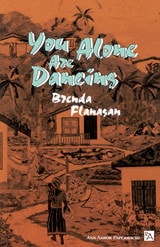
You Alone Are Dancing
Brenda Flanagan
University of Michigan Press, 1996
Rape, the devastation of Hurricane Flora, a child's tragic death, and an indifferent and corrupt government are some of the numerous problems challenging the people of Rosehill. Set on the fictional island of Santabella and spanning three years, You Alone Are Dancing follows the life of young Beatrice Salandy, balancing her ambitions, obligations, and love for Sonny Allen. Determined to create his own opportunities, Sonny leaves Rosehill for the United States in a swirl of promises and expectations. Beatrice remains on Rosehill, sharing her neighbors' struggle, adding their pain to her own, but sharing as well their music and their laughter, their history and their allegiance to it. Like Santabella, set in an indifferent blue sea, Rosehill is part of a larger neglected Caribbean society, and Beatrice must learn to negotiate its tides and ebbs, overcome its storm and ensure its lulls, as she peruses what has to be done. She succeeds--but at a price that changes her life forever, as it does that of Sonny and all of Rosehill. "In Brenda Flanagan's novel, You Alone Are Dancing, there's talk and talk, the life-long dance of talk--it's lyrical, raucous, sorrowful, vibrant, inventive. And there you are, on the island, in the midst and mix of it all. What the best musicians do with wood and brass and air, Brenda Flanagan does with words--she gives them voice and life." --Janet Kauffman, author of Places in the World a Woman Could Walk.
You Are Here
Paul Breslin
Northwestern University Press, 2000
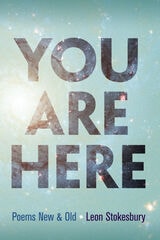
You Are Here
Poems New & OldLeon Stokesbury
University of Arkansas Press, 2016
Winnowed from a distinguished career, then distilled, then polished and winnowed again, the poems in You Are Here are Leon Stokesbury’s best from fifty years of published work.
The selections from his earlier volumes are as fully realized as one would expect from the winner of the AWP Poetry Competition and the Poets’ Prize. But it is in Stokesbury’s new work, collected under the heading “These Days,” that he reveals something completely different. From a carnival sideshow to Hitchcock’s Mount Rushmore, from John Keats’s backyard to the miseries of a failed crematorium operator, every turned page divulges a particular we didn’t see coming. You Are Here is like a sideshow of this modern world, even when we discover, amazed, our selves looking back at us.
“Why do we still only stand here?” Stokesbury asks in one of his earliest salvos. The poems in this collection give such varied answers that readers will have no idea what the next page holds, only that they will find themselves somewhere new.
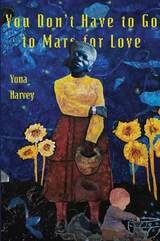
You Don’t Have to Go to Mars for Love
Yona Harvey
Four Way Books, 2020
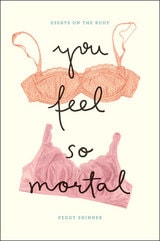
You Feel So Mortal
Essays on the BodyPeggy Shinner
University of Chicago Press, 2014
Over the course of twelve essays, Shinner holds a mirror up to the complex desires, fears, confusions, and mysteries that shape our bodily perceptions. Driven by the collision between herself and the larger world, she examines her feet through the often-skewed lens of history to understand what makes them, in the eyes of some, decidedly Jewish; considers bras, breasts, and the storied skills of the bra fitter; asks, from the perspective of a confused and grieving daughter, what it means to cut the body open; and takes a reeling time-trip through myth, culture, and history to look at women’s hair in ancient Rome, Laos, France, Syria, Cuba, India, and her own past. Some pieces investigate the body under emotional or physical duress, while others use the body to consider personal heritage and legacy. Throughout, Shinner writes with elegance and assurance, weaving her wide-ranging thoughts into a firm and fascinating fabric.
Turning the category of body books on, well, its ear, You Feel So Mortal offers a probing view of our preoccupation with the body that is both idiosyncratic and universal, leaving us with the deep satisfaction of our shared humanity.
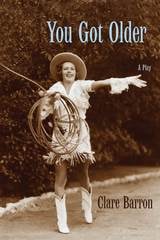
You Got Older
A PlayClare Barron
Northwestern University Press, 2017
Winner of a 2015 Obie Award for Playwriting
Mae has returned home to help her father while he undergoes treatment for cancer. But she needs a little help herself. She’s just lost her boyfriend and her job. (It turns out there are consequences to dating your boss . . .) And she’s desperately craving intimacy of any sort. Mae escapes into the the arms of a chain-smoking, imaginary Cowboy who turns her on and ties her up. And she escapes into chatter with her siblings as they attempt to distract and entertain themselves in a hospital waiting room. But ultimately, it’s her deep love for her father that teaches Mae to remain optimistic and ambitious in the face of suffering and that gets her back on track.
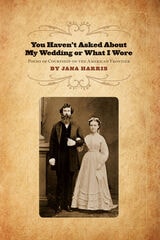
You Haven't Asked About My Wedding or What I Wore
Poems of Courtship on the American FrontierJana Harris
University of Alaska Press, 2014
For thirty years poet Jana Harris researched the diaries and letters of North American pioneer women. While the names and experiences of the authors varied, Harris found one story often connected them: their most powerful memories were of courtships and weddings. They dreamed of having a fine wedding while they spent their lives hauling water, scrubbing floors, and hoping for admirers. Many married men they hardly knew.
Based on primary research of nineteenth-century frontier women, Harris uses her compelling poetry to resurrect a forgotten history. She captures the hope, anxiety, anger, and despair of these women through a variety of characters and poetic strategies, while archival photographs give faces to the names and details to the settings. Harris’s meticulous research and stirring words give these pioneer women a renewed voice that proves the timelessness of the hopes and fears of love and marriage.
You Must Revise Your Life
William Stafford
University of Michigan Press, 1987
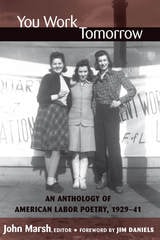
You Work Tomorrow
An Anthology of American Labor Poetry, 1929-41John Marsh, Editor
University of Michigan Press, 2007
---Nicholas Coles, University of Pittsburgh
---Alan Wald, University of Michigan

You're Only Young Twice
Children's Literature and FilmTim Morris
University of Illinois Press, 2000
Moving from classic texts (The Secret Garden, Goodnight Moon) to ephemera (the Hardy Boys, Goosebumps, and Harry Potter series), from the printed page to the silver screen (Willie Wonka, Jumanji, 101 Dalmatians, Beethoven), Tim Morris employs his experience as a parent and teacher to interrogate children's culture and reveal its conflicting messages.
Books and films for children--favorites accepted as wholesome fare for impressionable young minds --do not always teach straightforward lessons. Instead, they reflect the anxieties of the times and the desires of adults. At the heart of many a children's classic lies power, often expressed through racism, sexism, or violence. Under Morris's gaze, revered animal stories like Black Beauty turn into litanies of abuse; fantasies of childhood like Big are revealed as patriarchal struggles.
You're Only Young Twice redirects the focus on children's literature, asking not "What messages should children receive?" but "What messages do adults actually send?" For example, Morris recounts his own childhood confusion upon viewing Peter Pan, with its queenish, inept pirate and a grown woman (Mary Martin) in tights who pretends to be a crowing boy.
Morris shatters our long-held assumptions and challenges our best intentions, demonstrating how children's literature and films lay bare a troubled and troubling worldview.
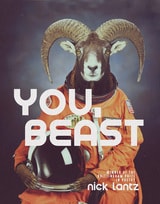
You, Beast
PoemsNick Lantz
University of Wisconsin Press, 2017
Young Lions
How Jewish Authors Reinvented the American War NovelLeah Garrett
Northwestern University Press, 2015
Finalist, 2015 National Jewish Book Awards in the American Jewish Studies category
Winner, 2017 AJS Jordan Schnitzer Book Award in the category of Modern Jewish History and Culture: Africa, Americas, Asia, and Oceania
Young Lions: How Jewish Authors Reinvented the American War Novel shows how Jews, traditionally castigated as weak and cowardly, for the first time became the popular literary representatives of what it meant to be a soldier and what it meant to be an American. Revisiting best-selling works ranging from Norman Mailer’s The Naked and the Dead to Joseph Heller’s Catch-22, and uncovering a range of unknown archival material, Leah Garrett shows how Jewish writers used the theme of World War II to reshape the American public’s ideas about war, the Holocaust, and the role of Jews in postwar life. In contrast to most previous war fiction these new “Jewish” war novels were often ironic, funny, and irreverent and sought to teach the reading public broader lessons about liberalism, masculinity, and pluralism.
Yours
The Civil War, a Love Triangle, and the Steamboat SultanaLila Jeanne Elliott Sybesma
Indiana Historical Society Press, 2019