Results by title
365 books match the query 'Correspondence' and 2 start with y
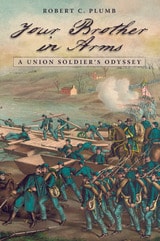
Your Brother in Arms
A Union Soldier's OdysseyRobert C. Plumb
University of Missouri Press, 2011
George P. McClelland, a member of the 155th Pennsylvania Infantry in the Civil War, witnessed some of the war’s most pivotal battles during his two and a half years of Union service. Death and destruction surrounded this young soldier, who endured the challenges of front line combat in the conflict Lincoln called “the fiery trial through which we pass.” Throughout his time at war, McClelland wrote to his family, keeping them abreast of his whereabouts and aware of the harrowing experiences he endured in battle. Never before published, McClelland’s letters offer fresh insights into camp life, battlefield conditions, perceptions of key leaders, and the mindset of a young man who faced the prospect of death nearly every day of his service. Through this book, the detailed experiences of one soldier—examined amidst the larger account of the war in the eastern theater—offer a fresh, personal perspective on one of our nation’s most brutal conflicts.
Your Brother in Arms follows McClelland through his Civil War odyssey, from his enlistment in Pittsburgh in the summer of 1862 and his journey to Washington and march to Antietam, followed by his encounters in a succession of critical battles: Fredericksburg, Chancellorsville, Gettysburg, Spotsylvania Court House, the North Anna River, Petersburg, and Five Forks, Virginia, where he was gravely injured. McClelland’s words, written from the battlefield and the infirmary, convey his connection to his siblings and his longing for home. But even more so, they reflect the social, cultural, and political currents of the war he was fighting. With extensive detail, Robert C. Plumb expounds on McClelland’s words by placing the events described in context and illuminating the collective forces at play in each account, adding a historical outlook to the raw voice of a young soldier.
Beating the odds of Civil War treatment, McClelland recovered from his injury at Five Forks and was discharged as a brevet-major in 1865—a rank bestowed on leaders who show bravery in the face of enemy fire. He was a common soldier who performed uncommon service, and the forty-two documents he and his family left behind now give readers the opportunity to know the war from his perspective.
More than a book of battlefield reports, Your Brother in Arms: A Union Soldier’s Odyssey is a volume that explores the wartime experience through a soldier’s eyes, making it an engaging and valuable read for those interested in American history, the Civil War, and military history.
[more]

Yrs. Ever Affly
The Correspondence of Edith Wharton and Louis BromfieldDaniel Bratton
Michigan State University Press, 2000
The close friendship between Edith Wharton (Ethan Frome, The Age of Innocence, and The Buccaneers) and Louis Bromfield (Early Autumn, The Farm, and The Rains Came) evolved toward the end of Wharton's long and distinguished life and during the height of Bromfield's career. Despite the disparity in their ages and backgrounds-he was thirty-four years her junior and a Jeffersonian democrat from the Midwest, she an aristocratic Old New Yorker with a penchant for Hamiltonian economics-the bond between them, described by Bromfield was "a close bond, as close in many senses as I have ever known."
During the period of their correspondence (1931-1937), Wharton divided her time between the Pavillon Colombe, an eighteenth-century house north of Paris, and Sainte Claire du Vieux Château, near Hyères in the south of France. Bromfield lived not far from the Pavillon Colombe, in Senlis, at the Presbytère de St. Étienne. The gardens of these estates and the fervor they inspired in these two Pulitzer Prize-winning authors began a relationship that would endure until Wharton's death in 1937.
At the heart of these letters is Wharton and Bromfield's devotion to the earth and to horticultural pursuits, a devotion immediately recognizable to all who share the passion of gardening. But these letters speak of so much more. The two friends wrote of the social-political milieu of America and France during the 1930s, gossiped about the literary worlds in which they lived, discussed the publishing climate of the Depression era, and shared their kindred love of travel and literature. Consisting of thirty-two letters, one postcard, and a note from Wharton's secretary to Bromfield's wife, their correspondence is presented here with meticulous annotation by Daniel Bratton to give an insight into the private worlds of these two literary magnates.
[more]