Results by title
2728 books match the query 'Education' and 13 start with y
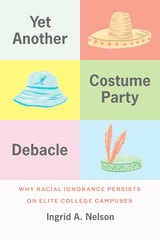
Yet Another Costume Party Debacle
Why Racial Ignorance Persists on Elite College CampusesIngrid A. Nelson
University of Chicago Press, 2024
On a cold February evening, a group of students at Bowdoin College, an elite and historically white liberal arts college in Maine, gathered to drink tequila at a party referred to as “not not a fiesta.” By noon the next day, Instagram videos of students sporting miniature sombreros had spread like wildfire through campus. Over the next few weeks, national media outlets would broadcast the embarrassing fallout. But the frequency with which similar parties recur on campuses across the United States begs the question: what, if anything, do undergraduates learn about race and racism from these encounters?
Drawing on interviews and archival research, Yet Another Costume Party Debacle shows us how colleges both contest and reproduce racialized systems of power. Sociologist Ingrid A. Nelson juxtaposes how students and administrators discuss race with how they behave in the aftermath of racially charged campus controversies. Nelson spoke in-depth with students and other key players in several controversial parties—“Cracksgiving,” a “gangster party,” and the “not not a fiesta” tequila party—at Bowdoin. The college’s administrative response failed to encourage productive dialogue or address larger questions about race on campus. Nelson shows how the underlying campus structures at elite liberal arts colleges foster an environment that is ripe for racially charged incidents; we shouldn’t be surprised when we read about yet another costume party debacle. Nelson advises how we can take charge of diversity on our campuses by changing the systems that bring students together and drive them apart.
Yet Another Costume Party Debacle
Why Racial Ignorance Persists on Elite College CampusesIngrid A. Nelson
University of Chicago Press, 2024
How the policies of elite colleges allow racially themed parties to continue by perpetuating the status quo.
On a cold February evening, a group of students at Bowdoin College, an elite and historically white liberal arts college in Maine, gathered to drink tequila at a party referred to as “not not a fiesta.” By noon the next day, Instagram videos of students sporting miniature sombreros had spread like wildfire through campus. Over the next few weeks, national media outlets would broadcast the embarrassing fallout. But the frequency with which similar parties recur on campuses across the United States begs the question: what, if anything, do undergraduates learn about race and racism from these encounters?
Drawing on interviews and archival research, Yet Another Costume Party Debacle shows us how colleges both contest and reproduce racialized systems of power. Sociologist Ingrid A. Nelson juxtaposes how students and administrators discuss race with how they behave in the aftermath of racially charged campus controversies. Nelson spoke in-depth with students and other key players in several controversial parties—“Cracksgiving,” a “gangster party,” and the “not not a fiesta” tequila party—at Bowdoin. The college’s administrative response failed to encourage productive dialogue or address larger questions about race on campus. Nelson shows how the underlying campus structures at elite liberal arts colleges foster an environment that is ripe for racially charged incidents; we shouldn’t be surprised when we read about yet another costume party debacle. Nelson advises how we can take charge of diversity on our campuses by changing the systems that bring students together and drive them apart.

Yo Soy
From a Migrant Field Worker to a University ProfessorRoberto E. Villarreal
University of North Texas Press, 2025
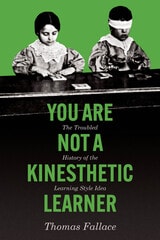
You Are Not a Kinesthetic Learner
The Troubled History of the Learning Style IdeaThomas Fallace
University of Chicago Press, 2025
The widely embraced notion that we all process information in one of three distinct modes—visual, auditory, or kinesthetic—has informed educational practices for decades. In recent years, however, numerous studies have questioned the effectiveness of aligning instruction with the alleged learning styles of individual students. So, why is it still commonplace in the literature on beneficial teaching at all levels of education?
In You Are Not a Kinesthetic Learner: The Troubled History of a Dangerous Idea, historian Thomas Fallace traces the origins, evolution, and history of the learning style idea, demonstrating its relationship to a legacy of unequal education for children of color. Fallace argues that the research supporting the learning style idea was problematic from its inception in the 1910s and that it was used to label and justify a diminished curriculum for many Black and Latine students, whose cultural differences were perceived as weaknesses. In recent years, numerous empirical studies have not found the approach to be effective. This fascinating history clearly shows the danger of sorting and labeling students with permanent style identities and makes a strong case for removing learning styles as the basis for any educators’ instructional toolkit.
The first book-length history of learning styles, You Are Not a Kinesthetic Learner encourages us all to consider the research, be open to future developments and updates, and question even our most intuitive assumptions.
You Are Not a Kinesthetic Learner
The Troubled History of the Learning Style IdeaThomas Fallace
University of Chicago Press, 2025
A compelling history of the learning style concept and how it was shaped by shifting ideas in psychology, anthropology, and education.
The widely embraced notion that we all process information in one of three distinct modes—visual, auditory, or kinesthetic—has informed educational practices for decades. In recent years, however, numerous studies have questioned the effectiveness of aligning instruction with the alleged learning styles of individual students. So, why is it still commonplace in the literature on beneficial teaching at all levels of education?
In You Are Not a Kinesthetic Learner: The Troubled History of a Dangerous Idea, historian Thomas Fallace traces the origins, evolution, and history of the learning style idea, demonstrating its relationship to a legacy of unequal education for children of color. Fallace argues that the research supporting the learning style idea was problematic from its inception in the 1910s and that it was used to label and justify a diminished curriculum for many Black and Latine students, whose cultural differences were perceived as weaknesses. In recent years, numerous empirical studies have not found the approach to be effective. This fascinating history clearly shows the danger of sorting and labeling students with permanent style identities and makes a strong case for removing learning styles as the basis for any educators’ instructional toolkit.
The first book-length history of learning styles, You Are Not a Kinesthetic Learner encourages us all to consider the research, be open to future developments and updates, and question even our most intuitive assumptions.
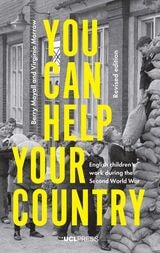
You Can Help Your Country
English Children's Work During the Second World WarBerry Mayall and Virginia Morrow
University College London, 2020
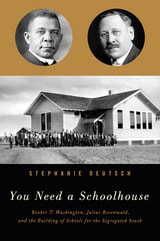
You Need a Schoolhouse
Booker T. Washington, Julius Rosenwald, and the Building of Schools for the Segregated SouthStephanie Deutsch
Northwestern University Press, 2011
Washington, though widely admired, had weathered severe crises both public and private in his fifty-six years. He had dined with President Theodore Roosevelt and drunk tea with Queen Victoria, but he had also been assaulted on a street in New York City. He had suffered personal heartbreak, years of overwork, and the discouraging knowledge that, despite his optimism and considerable success, conditions for African Americans were not improving as he had assumed they would. From within his own community, Washington faced the bitter charge of accommodationism that haunts his legacy to this day. Despite their differences, the two men would work together well and their collaboration would lead to the building of five thousand schoolhouses. By the time segregation ended, the “Rosenwald Schools” that sprang from this unlikely partnership were educating one third of the South’s African American children. These schoolhouses represent a significant step in the ongoing endeavor to bring high quality education to every child in the United States—an ideal that remains to be realized even today.
Youth Media Matters
Participatory Cultures and Literacies in EducationKorina M. Jocson
University of Minnesota Press, 2018
In an information age of youth social movements, Youth Media Matters examines how young people are using new media technologies to tell stories about themselves and their social worlds. They do so through joint efforts in a range of educational settings and media environments, including high school classrooms, youth media organizations, and social media sites. Korina M. Jocson draws on various theories to show how educators can harness the power of youth media to provide new opportunities for meaningful learning and “do-it-together production.” Describing the impact that youth media can have on the broader culture, Jocson demonstrates how it supports expansive literacy practices and promotes civic engagement, particularly among historically marginalized youth.
In Youth Media Matters, Jocson offers a connective analysis of content area classrooms, career and technical education, literary and media arts organizations, community television stations, and colleges and universities. She provides examples of youth media work—including videos, television broadcasts, websites, and blogs—produced in the San Francisco Bay Area, Los Angeles, New York, and St. Louis. At a time when educators are increasingly attentive to participatory cultures yet constrained by top-down pedagogical requirements, Jocson highlights the knowledge production and transformative potential of youth media with import both in and out of the classroom.
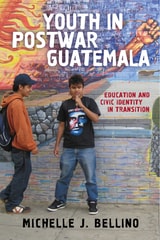
Youth in Postwar Guatemala
Education and Civic Identity in TransitionMichelle J. Bellino
Rutgers University Press, 2017
In the aftermath of armed conflict, how do new generations of young people learn about peace, justice, and democracy? Michelle J. Bellino describes how, following Guatemala’s civil war, adolescents at four schools in urban and rural communities learn about their country’s history of authoritarianism and develop civic identities within a fragile postwar democracy.
Through rich ethnographic accounts, Youth in Postwar Guatemala, traces youth experiences in schools, homes, and communities, to examine how knowledge and attitudes toward historical injustice traverse public and private spaces, as well as generations. Bellino documents the ways that young people critically examine injustice while shaping an evolving sense of themselves as civic actors. In a country still marked by the legacies of war and division, young people navigate between the perilous work of critiquing the flawed democracy they inherited, and safely waiting for the one they were promised...
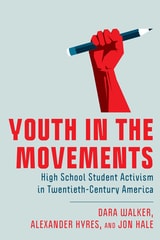
Youth in the Movements
High School Student Activism in Twentieth-Century AmericaDara Walker
Rutgers University Press, 2027
Youth in the Movements documents the history of the rise of American high school and youth activism in the United States since the Second World War. Spaces within high schools and the adults at them provided support or inspiration – both negative and positive – for youth engaged in protest, organizing, and activism. Through rich research of archival sources and oral histories, contributors reveal new perspectives on American high school and youth activism. Viewed through the eyes of high school-aged youth around the United States – in familiar locations such as Boston, New York City, and Detroit, as well as less familiar locales in the historiography, such as Salt Lake City and the Navajo Reservation – we extend our understanding of high school and how it has been experienced by youth activists in the post-World War II period.

Youth, Power, Performance
Applied Theatre with Systemically Marginalized YouthDiane Conrad
Intellect Books, 2026
Drawing on over twenty years of scholarship from Diane Conrad's academic career in applied theater research with systemically marginalized youth, this book examines applied theater research conducted with youth in three specific contexts: alternative high schools, a youth jail, and street-involved youth.
By highlighting youths’ voices and youths’ creations, this book offers an introduction to the theoretical considerations for the research, suggests practical strategies for engaging with marginalized youth, and describes how the applied theater process developed. It also addresses specific considerations for working with incarcerated and Indigenous youth and explores the ethical considerations in conducting such work and the role of applied theater in social change. The book will be of interest to applied theater researchers, instructors, practitioners, students, drama teachers, and youth workers.

Youthful Offenders at Highfields
An Evaluation of the Effects of the Short-Term Treatment of Delinquent BoysH. Ashley Weeks
University of Michigan Press, 1958
Youthful Offenders at Highfields
An Evaluation of the Effects of the Short-Term Treatment of Delinquent BoysH. Ashley Weeks
University of Michigan Press, 1958