Results by title
944 books match the query 'Indians of North America' and 4 start with y
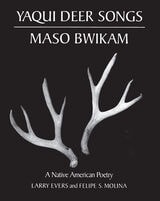
Yaqui Deer Songs/Maso Bwikam
A Native American PoetryLarry Evers and Felipe S. Molina
University of Arizona Press, 1987
Yaqui regard song as a kind of lingua franca of the intelligent universe. It is through song that experience with other living things is made intelligible and accessible to the human community. Deer songs often take the form of dialogues in which the deer and others in the wilderness world speak with one another or with the deer singers themselves. It is in this way, according to one deer singer, that “the wilderness world listens to itself even today.”
In this book authentic ceremonial songs, transcribed in both Yaqui and English, are the center of a fascinating discussion of the Deer Song tradition in Yaqui culture. Yaqui Deer Songs/Maso Bwikam thus enables non-Yaquis to hear these dialogues with the wilderness world for the first time.
Year of the Hangman
George Washington's Campaign Against the IroquoisGlenn F. Williams
Westholme Publishing, 2007
Winner of the 2005 Thomas Fleming Award for the Best Book in American Revolutionary War History
Finalist for the Army Historical Foundation Distinguished Writing Award
After two years of fighting, Great Britain felt confident that the American rebellion would be crushed in 1777, the "Year of the Hangman." Britain devised a bold new strategy. Turning its attention to the colonial frontiers, especially those of western New York, Pennsylvania, and Virginia, Britain enlisted its provincial rangers, Tories, and allied warriors, principally from the Iroquois Confederacy, to wage a brutal backwoods war in support of General John Burgoyne's offensive as it swept southward from Canada in an attempt to cut the colonies in half, divert the Continental Army, and weaken its presence around British-occupied New York City and Philadelphia.
Burgoyne's defeat at Saratoga sent shock waves through the British command. But the efforts along the frontier under the direction of Sir John Johnson, Colonel John Butler, and the charismatic Mohawk leader, Joseph Brant, appeared to be impairing the American ability to conduct the war. Destroying Patriot settlements and farms across hundreds of miles of frontier, the British and Indian forces threatened to reduce Continental army enlistment, and more importantly, precious food supplies. Following the massacres at the well-established colonial settlements of Wyoming, Pennsylvania, and Cherry Valley, New York, the Continental Congress persuaded General George Washington to conduct a decisive offensive to end the threat once and for all. Brewing for years, the conflict between the Iroquois and colonists would now reach its deadly climax.
Charging his troops "to not merely overrun, but destroy," Washington devised a two-prong attack to exact American revenge. The largest coordinated American military action against American Indians in the war, the campaign shifted the power in the east, ending the political and military influence of the Iroquois, forcing large numbers of loyalist to flee to Canada, and sealing Britain's fateful decision to seek victory in the south. In Year of the Hangman: George Washington's Campaign Against the Iroquois, historian Glenn F. Williams recreates the riveting events surrounding the action, including the checkered story of European and Indian alliances, the bitter frontier wars, and the bloody battles of Oriskany and Newtown.
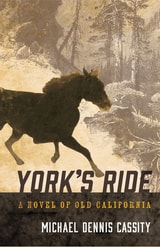
York's Ride
A Novel of Old CaliforniaMichael Dennis Cassity
University of Nevada Press, 2025
Jim, an orphan, has moved to the West to live on his Uncle Martin and Aunt Hanna’s ranch in the small, post-Gold Rush town of Taylorsville where the Sierra Nevada meets the Cascades. Mostly, Jim doesn’t miss his family farm in Missouri, and when he’s not doing ranch chores, he spends his time fly-fishing on nearby Indian Creek. This is where he first encounters York, a local boy from the Maidu tribe, and the two become fast friends. Jim and York soon meet up with Blind Charlie, a famous Maidu elder storyteller, who fills their heads with ancestral myths and legends.
After the untimely death of York, Meshuga’s caretaker, Jim is suddenly moved to take responsibility for the great black mustang and become part of Blind Charlie’s prophecies. With York gone, Jim must fulfill what his friend knew all along—that he and Meshuga would learn to conquer the challenge of the race of the century. A romantic novel of the Old West imbued with rich historical details, York’s Ride is a complex and beautiful tale about family relationships and coming-of-age in early twentieth-century California.
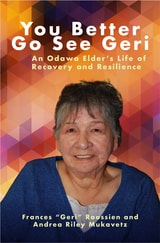
You Better Go See Geri
An Odawa Elder’s Life of Recovery and ResilienceFrances “Geri” Roossien
Oregon State University Press, 2021
While a graduate student, Andrea Riley Mukavetz was invited into Geri’s home to listen to her stories and assist in compiling and publishing a memoir. Geri wanted her stories to serve as a resource, form of support, and affirmation that Indigenous people can be proud of who they are and overcome trauma. Geri hoped to be a model to current and future generations, and she believed strongly that more Indigenous people should become substance abuse counselors and work with their communities in tribally specific ways.
Geri died in 2019, but Riley Mukavetz carried on the work. This book presents Geri’s stories, lightly edited and organized for clarity, with an introduction by Riley Mukavetz that centers Geri’s life and the process of oral history in historical and theoretical context.