Results by title
4030 books match the query 'Language Arts & Disciplines' and 17 start with y
Yale Papyri in the Beinecke Rare Book and Manuscript Library IV
Hélène Cuvigny, Ruth Duttenhöfer, Ann Ellis Hanson, editors
University of Michigan Press, 2021
Yiddish & English
The Story of Yiddish in AmericaSol Steinmetz
University of Alabama Press, 2001
This is the only book to seriously treat the intriguing linguistic and cultural phenomenon of the intimate contact between Yiddish and English over the past 120 years.
Yiddish arrived in America as the mother tongue of millions of Jewish immigrants from eastern Europe. Not only did this language without a homeland survive in the great American melting pot, it infiltrated the majority language, English, with a wide variety of new words and expressions and helped to establish a new ethnic language called "Jewish English." New Yorkers, in particular, have adopted a long list of Yiddish words, including the well-known "kosher," "chutzpah," "klutz," "yenta," "nosh," "mavin," "schlep," and "shmo."
Yiddish had first developed from language sharing as Jews of northern France and northern Italy migrated into the German-speaking region of the Rhine Valley in the Middle Ages. Sol Steinmetz traces the development of such words as bonhomme from the Old French meaning "good man" to the Yiddish of bonim, or shul for synagogue derived from the German schuol, meaning "school," which had come originally from the Latin schola, for example. With a rich collection of quotations from literature and the press, Steinmetz documents the unusually high lexical, semantic, and intonational exchanges between Yiddish and English in America. He offers more than 1,200 Yiddish words, expressions, idioms, and phrases that have melted into the English vernacular.
Yiddish and English is important for Judaica collections with its two appendixes-one on the romanization of Yiddish and another of Yiddish-origin words, a Jewish-English glossary, a selected bibliography, and an index. But this slim volume is so entertaining and informative for the general reader that it is recommended for anyone who delights in word derivations and language.
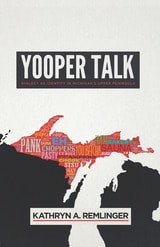
Yooper Talk
Dialect as Identity in Michigan's Upper PeninsulaKathryn A. Remlinger
University of Wisconsin Press, 2019
Drawing on sixteen years of fieldwork, including interviews with seventy-five lifelong residents of the UP, Kathryn Remlinger examines how the idea of a unique Yooper dialect emerged. Considering UP English in relation to other regional dialects and their speakers, she looks at local identity, literacy practices, media representations, language attitudes, notions of authenticity, economic factors, tourism, and contact with immigrant and Native American languages. The book also explores how a dialect becomes a recognizable and valuable commodity: Yooper talk (or "Yoopanese") is emblazoned on t-shirts, flags, postcards, coffee mugs, and bumper stickers.
Yooper Talk explains linguistic concepts with entertaining examples for general readers and also contributes to interdisciplinary discussions of dialect and identity in sociolinguistics, anthropology, dialectology, and folklore.
Yosano Akiko and The Tale of Genji
G. G. Rowley
University of Michigan Press, 2000
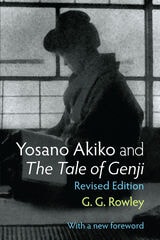
Yosano Akiko and The Tale of Genji
G. G. Rowley
University of Michigan Press, 2000
The Tale of Genji provided Akiko with her conception of herself as a writer and inspired many of her most significant literary projects. She, in turn, refurbished the tale as a modern novel, pioneered some of the most promising avenues of modern academic research on Genji, and, to a great extent, gave the text the prominence it now enjoys as a translated classic. Through Akiko’s work Genji became, in fact as well as in name, an exemplum of that most modern of literary genres, the novel. In delineating this important aspect of Akiko’s life and her bibliography, this study aims to show that facile descriptions of Akiko as a “poetess of passion” or “new woman” will no longer suffice.
You Must Revise Your Life
William Stafford
University of Michigan Press, 1987
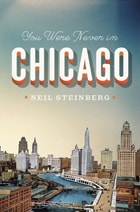
You Were Never in Chicago
Neil Steinberg
University of Chicago Press, 2012
In 1952 the New Yorker published a three-part essay by A. J. Liebling in which he dubbed Chicago the "Second City." From garbage collection to the skyline, nothing escaped Liebling's withering gaze. Among the outraged responses from Chicago residents was one that Liebling described as the apotheosis of such criticism: a postcard that read, simply, "You were never in Chicago."
Neil Steinberg has lived in and around Chicago for more than three decades—ever since he left his hometown of Berea, Ohio, to attend Northwestern—yet he remains fascinated by the dynamics captured in Liebling's anecdote. In You Were Never in Chicago Steinberg weaves the story of his own coming-of-age as a young outsider who made his way into the inner circles and upper levels of Chicago journalism with a nuanced portrait of the city that would surprise even lifelong residents.
Steinberg takes readers through Chicago's vanishing industrial past and explores the city from the quaint skybridge between the towers of the Wrigley Building, to the depths of the vast Deep Tunnel system below the streets. He deftly explains the city's complex web of political favoritism and carefully profiles the characters he meets along the way, from greats of jazz and journalism to small-business owners just getting by. Throughout, Steinberg never loses the curiosity and close observation of an outsider, while thoughtfully considering how this perspective has shaped the city, and what it really means to belong. Intimate and layered, You Were Never in Chicago will be a welcome addition to the bookshelves of all Chicagoans, be they born in the city or forever transplanted.
You're On!
101 Tips to improve your public speaking skillsRuth Stotter
Parkhurst Brothers, Inc., 2016
You've Got to Be Carefully Taught
Learning and Relearning LiteratureJerome Klinkowitz. Foreword by Kurt Vonnegut
Southern Illinois University Press, 2001
Drawing on his own experience in the profession, veteran English professor and internationally renowned scholar Jerome Klinkowitz sorts out the wrong ways of teaching literature before devising a new, successful method. Specifically, he concludes that a historically based “story of English” is precisely the wrong narrative approach to making sense of what literature does. Instead, Klinkowitz proposes a new method focused not on the product of literary writing but on the process of writing. Long involved with the making of contemporary literature, Klinkowitz shows how his classroom approach draws on the same strengths and inspirations writers use in the creation of literature. He involves students in the literary work as production.
Despite almost universal agreement that literary studies fail both writers and students, solutions have been limited to suggestions by superstar theorists teaching cream-of-the-crop students at elite universities. Klinkowitz aims not at the elite but at the ordinary student in an introduction to literature class. His goal is to introduce teachers to a new philosophy of teaching literature and to further deepen students’ natural love for the subject. He also seeks to revive the love of fine writing in those whose joy in the subject fell victim to obtuse teaching methods. Uniquely, his is not an esoteric theory developed by the best academics for elite students but a commonsense approach that works well in the kind of schools most students attend.

Young Activists and the Public Library
Facilitating DemocracyVirginia A. Walter
American Library Association, 2020
Young Adult Literature, Fourth Edition
From Romance to RealismMichael Cart
American Library Association, 2022
Editorial Advisory Board: Sarah Park Dahlen, Associate Professor, School of Information Sciences, University of Illinois Urbana-Champaign; Marianne Martens, Associate Professor, School of Information, Kent State University; Amy Pattee, Associate Professor and Co-coordinator of Dual-Degree MS LIS/MA Children’s Literature, School of Library and Information Science, Children’s Literature, Simmons University
“Comprehensive and substantial … a highly recommended resource," raved VOYA about the third edition. Now, to keep pace with changes in the field of publishing and realign itself to the newest generation of young adults, Cart returns with a sweeping update of his classic text. Relied upon by educators, LIS instructors and students, and practitioners for its insight and thoroughness, his book
- surveys the landscape of YA lit both past and present, sketching out its origins and showing how it has evolved to deal with subjects every bit as complex as its audience;
- closely examines teen demographics, literacy, audiobooks, the future of print, the role of literary criticism, and other key topics;
- provides updated coverage of perennially popular genre fiction, including horror, sci fi, and dystopian fiction;
- delves deeply into multicultural and LGBTQIA+ literature, substantially updated in this edition;
- features expansive interviews with best-selling authors like Eric Shanower, Jackie Woodson, and Bill Konigsberg as well as several publishers and leaders in the field;
- discusses the impact of the Printz Award, ALAN’s Walden Award, the National Book Award, The Los Angeles Times Book Award, and other honors; and
- features abundant bibliographic material to aid in readers' advisory and collection development.
Young Adult Literature
From Romance to RealismMichael Cart
American Library Association, 2016
Young Adult Literature
From Romance to RealismMichael Cart
American Library Association, 2010
Young Adults Deserve the Best
YALSA's Competencies in ActionSarah Flowers
American Library Association, 2010
Your Craft as a Teaching Librarian
Using Acting Skills to Create a Dynamic PresenceJeff Sundquist
American Library Association, 2022
Your Craft as a Teaching Librarian: Using Acting Skills to Create a Dynamic Presence —a revised and expanded edition of The Craft of Librarian Instruction—captures how acting techniques can sharpen your instructional skills and establish your teaching identity, enliven your performance, and create an invigorating learning experience for your students. It’s divided into three entertaining sections:
- Prepare and Rehearse: Centering yourself, physical and vocal preparation, mindfulness, and avoiding stage fright
- Perform and Connect: Role playing, identity, action/reaction, and information literacy
- Reflect and Sharpen: Assessment and adaptation
Your Technology Outreach Adventure
Tools for Human-Centered Problem SolvingErin Jones
American Library Association, 2019
Yuarn Music Dramas
Studies in Prosody and Structure and a Complete Catalogue of Northern Arias in the Dramatic StyleDale R. Johnson
University of Michigan Press, 1981