Results by title
1917 books match the query 'Law' and 4 start with y
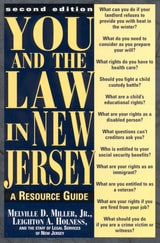
You and the Law in New Jersey
A Resource GuideLeighton A. Holness
Rutgers University Press, 1998
What are your rights if you are fired from your job? What should you do if you are a crime victim or witness? How can you fight a child custody battle? What can you do if your landlord refuses to provide you with heat in the winter?
You and the Law in New Jersey, newly updated, is the ideal guidebook to assist readers in understanding the law, their rights, and how to get legal help. In clear, straightforward language, the book describes how law is made, how to do legal research, how the state and federal court systems work, how to get help if you can't afford a lawyer, how to hire a lawyer, and what to do if you are sued. The second edition contains much new information, including a chapter on credit, debt, and banking, and others on the rights of senior citizens, veterans, and people with disabilities. The authors have also expanded their information on the rights of renters, homeowners, and consumers of public utilities, as well as their treatment of employment law. They have rewritten chapters on health and public benefits to address the recent sweeping reforms of federal and state law. Other topics include family matters such as marriage, divorce, adoption, and domestic violence; the landlord-tenant relationship and buying a home; consumer rights; the criminal justice system; and citizen involvement in environmental law.
Your Time Will Come
The Law of Age Discrimination and RetirementLawrence M. Friedman
Russell Sage Foundation, 1984
Youth Violence
Sex and Race Differences in Offending, Victimization, and Gang MembershipFinn-Aage Esbensen, Dana Peterson, Terrance J. Taylor and Adrienne Freng
Temple University Press, 2010
Violence by and against youth continues to be one of the most challenging subjects facing criminologists. In this comprehensive and integrated analysis of the interrelationships of youth violence, violent victimization, and gang membership, Finn-Aage Esbensen, Dana Peterson, Terrance J. Taylor and Adrienne Freng seek to understand what causes youth violence and what can be done about it. Using the results from an inclusive study they conducted of eighth-graders in eleven American cities, the authors examine how the nature, etiology, and intersections of youth violence are structured by both sex and race/ethnicity.
Youth Violence is pertinent to juvenile justice policy considerations. The authors frame their discussion within the public health perspective, focusing on risk factors associated with violent behavior. Thefindings address prevalence and incidence, as well as the demographic correlates and cumulative effects of the risk factors associated with engagement in violence. Ultimately, the theories and research methodologies here are essential for understanding the dynamics of youth violence.
Youth on Trial
A Developmental Perspective on Juvenile JusticeEdited by Thomas Grisso and Robert G. Schwartz
University of Chicago Press, 2003